

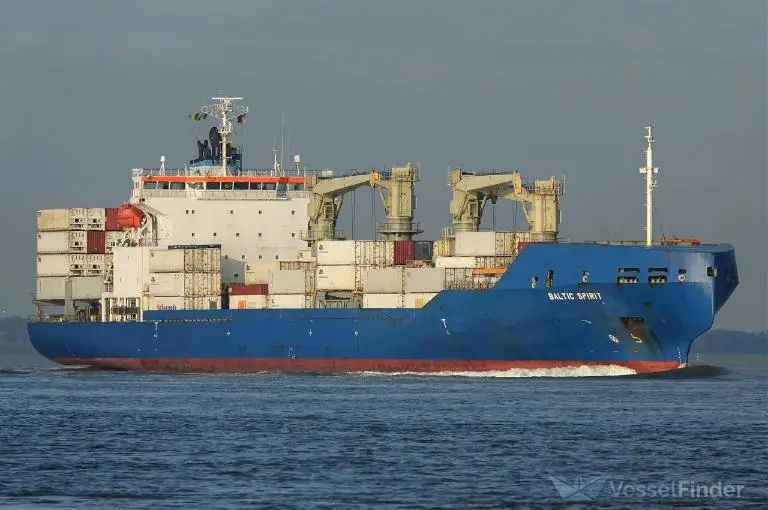
Photo by Vesselfinder
The case of the Baltic Spirit is a classic “maritime whodunnit” where the lack of a smoking gun—or in this case, 2.5 tons of white powder—leaves plenty of room for interpretation.
While the dramatics of a K-Commando helicopter boarding certainly look like a “publicity stunt” to the owner, the reality of modern maritime security is far more nuanced. Here is an expert breakdown of the situation for maritime-hub.com.
The Baltic Spirit Incident: Tactical Necessity or Political Theatre?
The detention of the Baltic Spirit (16,580 dwt) in the Gulf of Finland highlights the increasingly friction-filled relationship between and national security agencies. On February 3, 2026, Estonian elite forces treated the reefer like a high-stakes target, only to release it 36 hours later with a “sorry for the inconvenience.”
The “Red Flags” That Triggered the Raid
From a law enforcement perspective, the Baltic Spirit checked every box on the “High Risk” checklist:
-
The Route: Puerto Bolivar, Ecuador to Saint Petersburg, Russia. Ecuador remains a primary departure point for narcotics reaching European markets.
-
The Cargo: Refrigerated containers (reefers) are the preferred vehicle for contraband because the complex machinery and insulation provide excellent “deep concealment” opportunities.
-
Intelligence: The Estonian Tax and Customs Board confirmed the raid was based on “international partner” data—likely a tip from Europol or the DEA.
Why the “Political” Label Sticks
CoolCarriers’ frustration is understandable. To a commercial operator, a full-scale tactical boarding during bunkering is an expensive nightmare. The “politically motivated” claim likely stems from three factors:
-
The Russian Connection: While the ship is Bahamas-flagged, the 23-man crew are Russian nationals, and the destination is St. Petersburg. In the current geopolitical climate, any ship heading to Russia is viewed through a magnifying glass by Baltic states.
-
The “Waterbed Effect”: As major hubs like Rotterdam and Antwerp tighten security, traffickers are moving to smaller “Tier 2” ports. Estonia seeks to demonstrate that it is not a “soft” alternative.
-
The 2022 Precedent: Estonia’s largest-ever bust also involved an Ecuadorian ship. Authorities were clearly hoping for a repeat performance to justify their recent and security investments.
Technical Data: Baltic Spirit Profile
| Feature | Specification |
| Vessel Name | Baltic Spirit |
| Deadweight (DWT) | 16,580 |
| Capacity | 5,700 Pallets / 268 REEFER Units |
| Flag State | Bahamas |
| Classification Society | |
| Last Port of Call | Puerto Bolivar, Ecuador |
The Verdict: A Necessary Evil?
Is it a “publicity stunt”? Probably not entirely. Law enforcement’s “actionable intelligence” is notoriously hit-or-miss. In the maritime world, if you wait for 100% certainty, the ship has already crossed the 12-mile limit.
However, the use of K-Commando forces to secure a cooperating vessel suggests that Estonia sought to send a clear message to both the “international partners” (to demonstrate its reliability as an ally) and the smuggling cartels. For and owners, this is a stark reminder that in 2026, your route is your reputation.
Sources: Estonian Tax and Customs Board (MTA) Official Statement, Feb 2026.
-
ERR News: “No drugs found on Baltic Spirit.”
-
Lloyd’s List: “Estonia detains reefer boxship on route to Russia.”
