
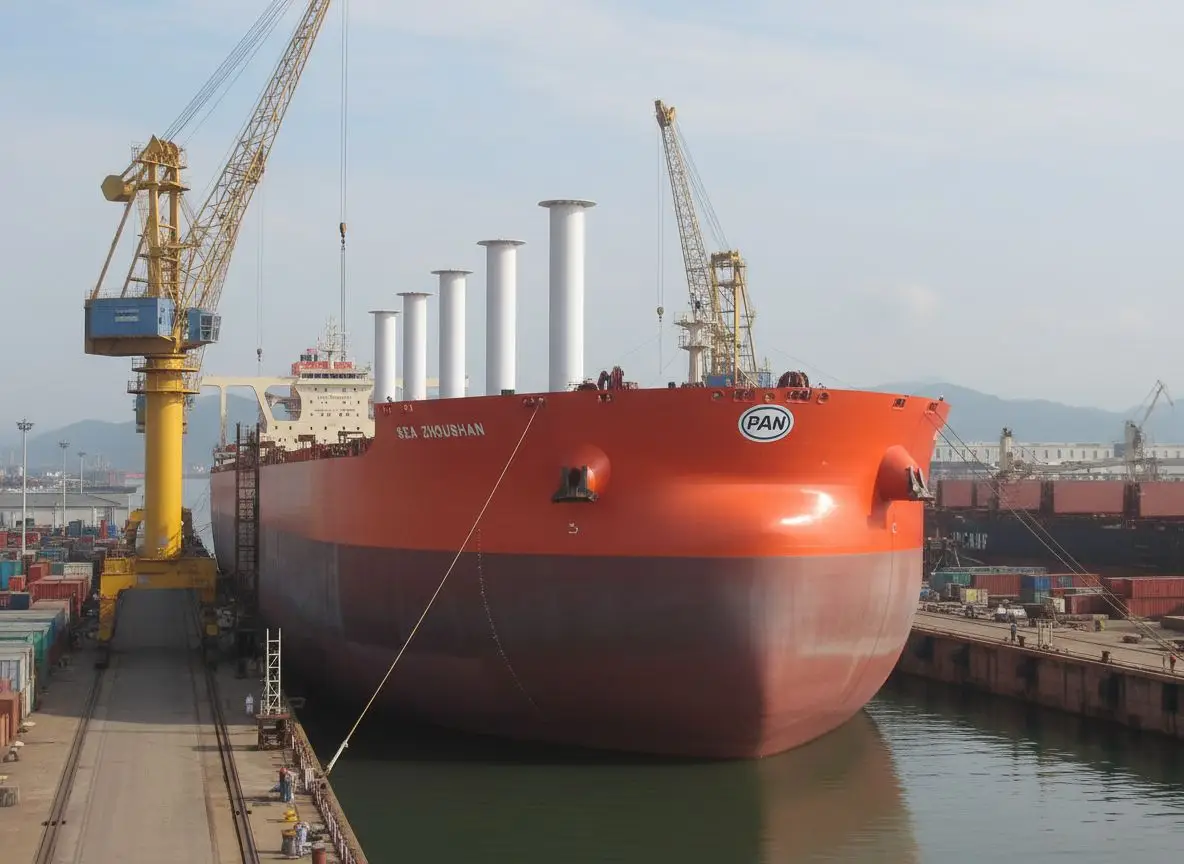
The world’s leading iron ore producer, Vale, is once again rewriting the playbook for maritime logistics. In a massive move to secure its supply chain and meet aggressive decarbonization targets, reports from early 2026 indicate the Brazilian mining giant is seeking to commission 30 newbuilding ore carriers in a deal valued at approximately $3 billion.
This fleet expansion is not just about capacity; it represents a technological leap toward “triple-fuel” capabilities and wind-assisted propulsion, reinforcing the industry’s shift toward sustainable practices.
Vale Sohar Max
Technical Specifications: The New “Guaibamax” and “Newcastlemax”
The proposed order is expected to be split between two strategic vessel sizes, designed to optimise the trade route between Brazil’s deep-water ports and Asian steel mills.
Fleet Breakdown and Dimensions
| Vessel Type | Quantity | Capacity (DWT) | Primary Features |
| Guaibamax | 10 | ~325,000 | Rotor sails, high-efficiency engines, 340m length |
| Newcastlemax | 20 | ~210,000 | Triple-fuel ready, optimized for diverse port access |
These ships are built to surpass the efficiency of the original “Valemax” series. The new generation of shipping companies partnering with Vale—including Shandong Shipping and HMM—are focusing on high-tech retrofits such as shaft generators, variable-frequency inverters, and advanced silicone paints to reduce drag.
Guaibamax vessels
Innovation in Propulsion: Beyond Traditional Fuel
The headline feature of this 30-ship initiative is the integration of triple-fuel technology. These vessels are designed to run on:
-
LNG (Liquefied Natural Gas)
-
Methanol or Ammonia (as future-ready options)
-
Wind Power (via Rotor Sails)
“Wind energy will play a central role in the decarbonization of maritime transport of iron ore,” noted Vale’s shipping director.
By installing up to five rotor sails per vessel (standing 35 meters high), Vale expects to cut carbon emissions by up to 3,000 tonnes per ship annually, providing a 6% boost in fuel efficiency.This aligns with the company’s goal to reduce its Scope 3 emissions by 15% by 2035.
Strategic Impact on Chinese Shipyards
Much like the 2016 “Valemax” second-generation order, this new wave is expected to heavily involve major Chinese Shipyards. The collaboration between Vale and Chinese entities, such as the Ningbo Zhoushan Port Company, ensures that the infrastructure—including new loading berths and stockyards—is ready to handle these behemoths.
For Classification Societies, these “triple-fuel” designs present a new frontier in safety and certification, as they must manage the complexities of multiple fuel storage and handling systems simultaneously.
Comparative Analysis: Vale’s Strategic Fleet Classes
To understand the scale of Vale’s latest 30-ship commitment, it is essential to compare the new generation with its legendary predecessors. While the Valemax remains the titan of the seas in terms of pure volume, the Guaibamax and Newcastlemax represent a shift toward port flexibility and multi-fuel innovation.
Technical Specification Comparison
| Feature | Valemax (Chinamax) | Guaibamax (New Gen) | Newcastlemax |
| Deadweight Tonnage (DWT) | 400,000 t | 325,000 t | 210,000 t |
| Length Overall (LOA) | 362 m | 340 m | ~300 m |
| Beam (Width) | 65 m | 62 m | 50 m |
| Max Draft | 23 m | 21.4 m | 18.5 m |
| Key Innovation | Scale efficiency | Triple-fuel & Rotor sails | High port accessibility |
| Emission Reduction | Up to 41% vs Capesize | Target 14% improvement | Dual-fuel ready |
VALE: Global Leader in Mining and Logistics: An Overview of Vale
Founded in 1942 as Companhia Vale do Rio Doce (CVRD), Vale S.A. has evolved from a Brazilian state entity into the world’s largest producer of iron ore and nickel. Headquartered in Rio de Janeiro, the company operates an unrivalled integrated logistics network, including its own railroads and ports, and a massive fleet of Very Large Ore Carriers (VLOCs) that connect its high-grade mines in the Carajás region to global markets. With a 2026 iron ore production target of 335-345 million metric tons, Vale is a critical pillar for global steel manufacturing and the burgeoning electric vehicle sector, where it serves as a key supplier of low-carbon nickel. Today, the company is pivoting toward a future of sustainable practices for green shipping and mining, committing to a 33% reduction in Scope 1 and 2 emissions by 2030 and investing heavily in “Mega Hubs” and wind-assisted propulsion to decarbonise the maritime supply chain.
Sources
-
Seatrade Maritime: 360-metre ore carrier becomes largest wind-assisted vessel.
-
Vale Official Release: Long-term agreements for the new generation of Guaibamax vessels.
-
TradeWinds/InforMARE: Vale seeks 30 triple-fuel ore carrier newbuildings.
