
Introduction
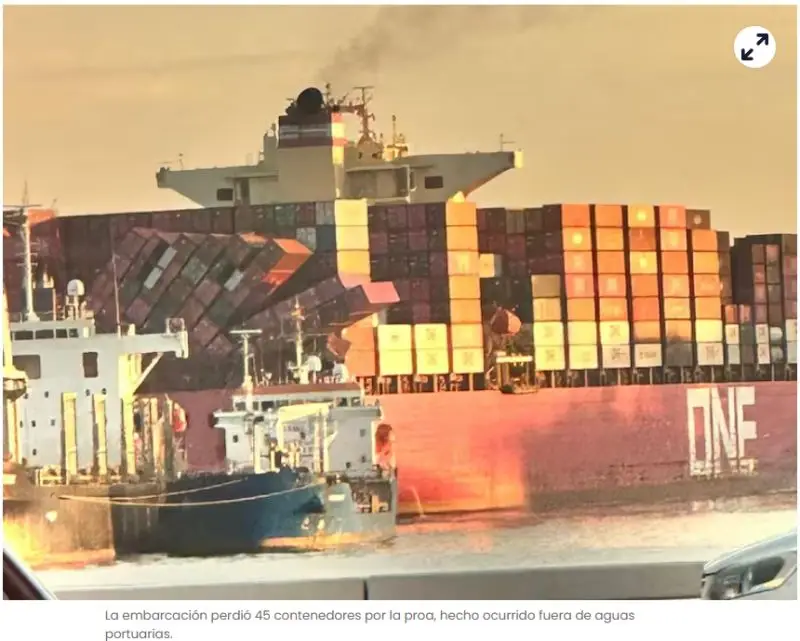
In December 2025, the container ship ONE Continuity suffered a significant cargo loss south of the Canary Islands. This incident, involving the loss of approximately 45 containers and the destabilisation of many more, has prompted renewed scrutiny of container stowage practices, vessel stability, and the technical challenges of operating large containerships in severe weather.
Vessel and Voyage Technical Specifications
- Vessel Name: ONE Continuity
- IMO Number: 9388352
- Flag: Singapore
- Type: Fully Cellular Containership
- Year Built: 2008
- Length: 320 metres
- Beam: 46 metres
- Gross Tonnage: 88,089
- Capacity: 9,362 TEU
- Owner: Seaspan S-2262 Private Limited
- Manager: Onesea Solutions Private Limited.
The vessel was en route from Le Havre, France, to Singapore, carrying over 16,000 empty containers when it encountered severe weather conditions in the Atlantic, south of the Canary Islands.
Incident Overview: What Happened?
On 6 December 2025, ONE Continuity encountered powerful waves, resulting in the collapse of ten rows of containers at the stern. Approximately 45 containers were lost overboard, while a further 100 were left unstable. The captain observed multiple stacks leaning dangerously to starboard and declared an emergency, diverting the vessel to Las Palmas Port, Spain, for inspection and recovery.

Technical Factors in the Collapse
1. Stacking and Lashing Forces
- Container stacks are subject to significant racking (sideways) and compressive (vertical) forces, especially in rough seas.
- The maximum permissible racking force for a standard ISO container is about 15 metric tons, while compressive forces should not exceed 85 metric tons.
- Lashing gear, such as twistlocks and rods, typically have a safe working load of 25 metric tons.
- In this incident, the collapse was likely triggered by a combination of excessive rolling and wave impact, exceeding the design limits of the containers and lashing systems.
2. Stowage Plan and Stability (GM)
- The vessel’s stowage plan determines the vertical and horizontal distribution of container weights. Heavy containers should be placed in lower tiers to avoid overloading upper stacks.
- The metacentric height (GM) is a key measure of a ship’s initial static stability. A higher GM can result in larger rolling angles and shorter roll periods, increasing forces on cargo and lashings.
- Carrying a large number of empty containers, as in this case, can raise the vessel’s centre of gravity and alter stability characteristics, making stacks more vulnerable to collapse in heavy seas.
3. Weather and Rolling Phenomena
- Parametric rolling and synchronous rolling are resonance phenomena that can cause rapid, large-amplitude rolling motions, subjecting container stacks to extreme accelerations.
- Severe weather, especially in the Bay of Biscay and Atlantic approaches, is a known risk factor for such incidents.
4. Securing Equipment and Procedures
- The effectiveness of securing equipment (twistlocks, lashing rods, lashing bridges) is critical. Any failure, improper application, or incompatibility (e.g., rogue twistlocks) can compromise stack integrity.
- The Cargo Securing Manual (CSM) and dedicated loading software are used to calculate and monitor permissible forces, but limitations in planning or execution can leave vulnerabilities.
Emergency Response and Recovery
- Upon arrival at Las Palmas, authorities used aerial drones to assess the damage.
- A team of eight specialists was deployed to stabilise and safely unload the affected containers.
- The vessel’s mooring equipment, partly damaged during the incident, was scheduled for repairs.
Industry Implications and Lessons Learned
1. Cargo Delays and General Average
- Cargo deliveries are expected to be delayed, and a General Average may be declared, requiring cargo interests to provide security before cargo is released.
2. Stowage and Stability Best Practices
- The incident underscores the importance of robust stowage planning, accurate stability calculations, and the use of advanced loading software to prevent stack collapse.
- Regular inspection and maintenance of securing equipment are essential.
3. Weather Routing and Monitoring
- Enhanced weather forecasting and route planning can help avoid the worst conditions, reducing the risk of cargo loss.
4. Regulatory and Reporting Developments
- The IMO is introducing stricter reporting requirements for container losses at sea, aiming to improve accountability and environmental protection.
Conclusion
The ONE Continuity cargo loss incident near the Canary Islands is a stark reminder of the technical and operational challenges facing modern containerships. By applying lessons learned in stowage planning, stability management, and securing practices, the industry can reduce the risk of similar incidents in the future.
References and Further Reading
- New Casualty – ONE CONTINUITY – Loss of Stowed Containers – W.E. Cox Claims Group
- Why do containership stacks collapse, and who is liable when they do? – Professional Mariner
- Containership operation: Common reasons for stow collapse
