

by Sanvee Goupta
Introduction
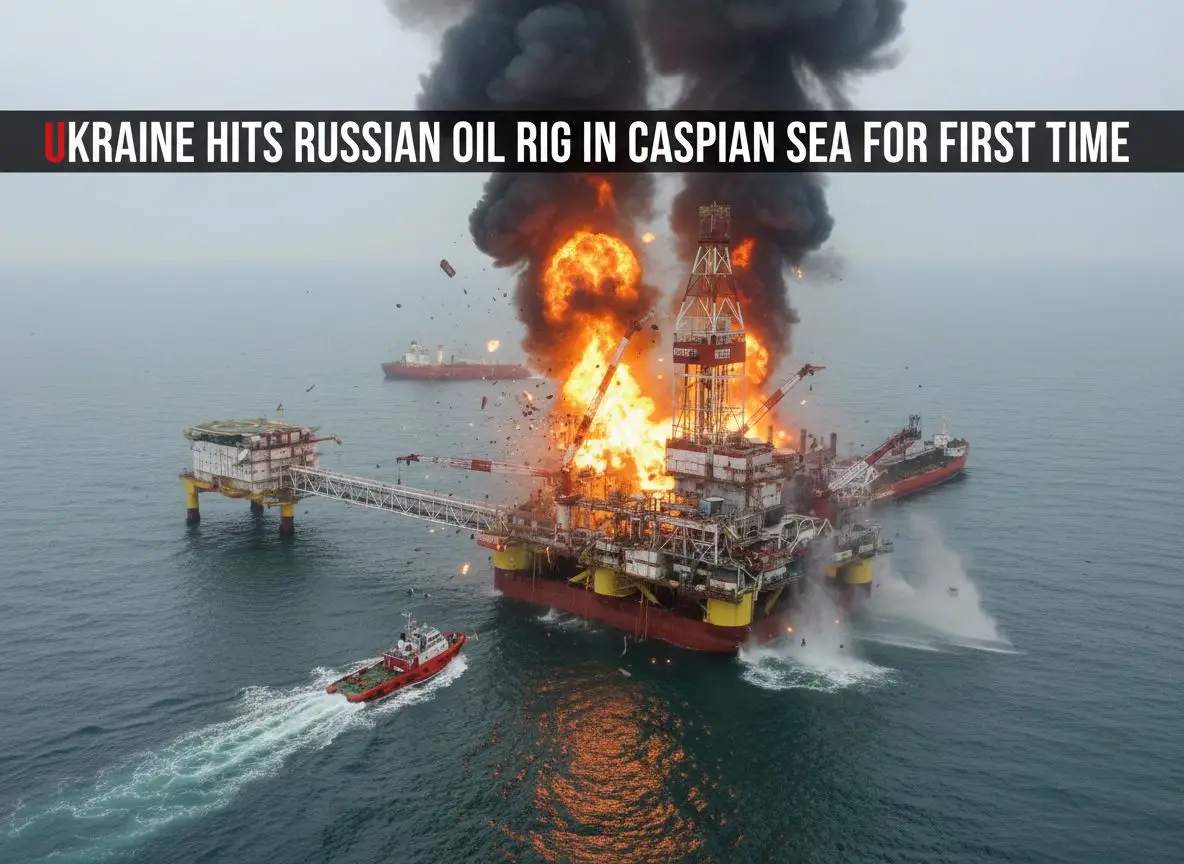
In a dramatic escalation of the ongoing conflict, Ukraine has struck a Russian oil rig in the Caspian Sea for the first time, halting production at one of Russia’s most significant energy assets. This unprecedented attack signals a new phase in Ukraine’s campaign to disrupt Russian oil and gas output, with far-reaching implications for global energy markets and the war’s trajectory.
Key Details of the Strike
On 11 December 2025, Ukrainian long-range drones targeted the Vladimir Filanovsky oil platform, owned by Russian oil giant Lukoil, in the northern Caspian Sea. According to sources in Ukraine’s Security Service (SBU), at least four drones hit the platform, forcing the suspension of oil and gas production from more than 20 wells. The Filanovsky field, discovered in 2005 and operational since 2016, is Russia’s largest offshore oil field, producing approximately 120,000 barrels per day.
Strategic Significance
This operation marks the first confirmed Ukrainian strike on hydrocarbon extraction infrastructure in the Caspian region. The Caspian Sea is over 700 km from Ukraine’s nearest border, demonstrating the reach of Ukraine’s domestically produced long-range drones. The attack was conducted by the SBU’s “Alpha” special operations unit, highlighting Ukraine’s growing capability to hit critical Russian infrastructure far from the frontlines.

Impact on Russian Energy and Global Markets
The Filanovsky field’s reserves are estimated at 129 million tonnes of oil and 30 billion cubic metres of natural gas, exported via the Caspian Pipeline Consortium (CPC)—a key route for Russian and Central Asian energy exports. The disruption of production at this site could have ripple effects on global energy supplies, especially as Ukraine intensifies its campaign against Russian energy facilities.
Broader Campaign and Geopolitical Implications
Ukraine has ramped up strikes on Russian oil infrastructure throughout 2025, aiming to undermine Moscow’s ability to finance its war effort. Previous attacks have focused on refineries and fuel storage sites deep inside Russian territory, as well as tankers transporting Russian oil through the Black Sea and Mediterranean. Russia has accused Ukraine of piracy and threatened to restrict Ukraine’s maritime access in response to these attacks.
Official Responses
- Ukraine: Officials from the Security Service of Ukraine confirmed the operation, describing it as a legitimate targeting of enterprises supporting Russia’s war effort.
- Russia: The Russian Ministry of Defence has not commented on the specific incident at the Filanovsky field, but has reported downing hundreds of Ukrainian drones in recent days.
Conclusion
The Ukrainian strike on the Russian oil rig in the Caspian Sea marks a significant escalation in the conflict, expanding the geography of the war and targeting assets previously considered beyond reach. As Ukraine continues its campaign against Russian energy infrastructure, the global energy market and the dynamics of the war are likely to be affected in unpredictable ways.
References
- Ukraine hits Russian oil rig in Caspian Sea for first time, official says | The Straits Times
- Russian oil rig in Caspian Sea halts production after Ukrainian drone strike | Kyiv Independent
- Lukoil Rig Halts Oil Production After Ukrainian Drone Attack | The Moscow Times
