

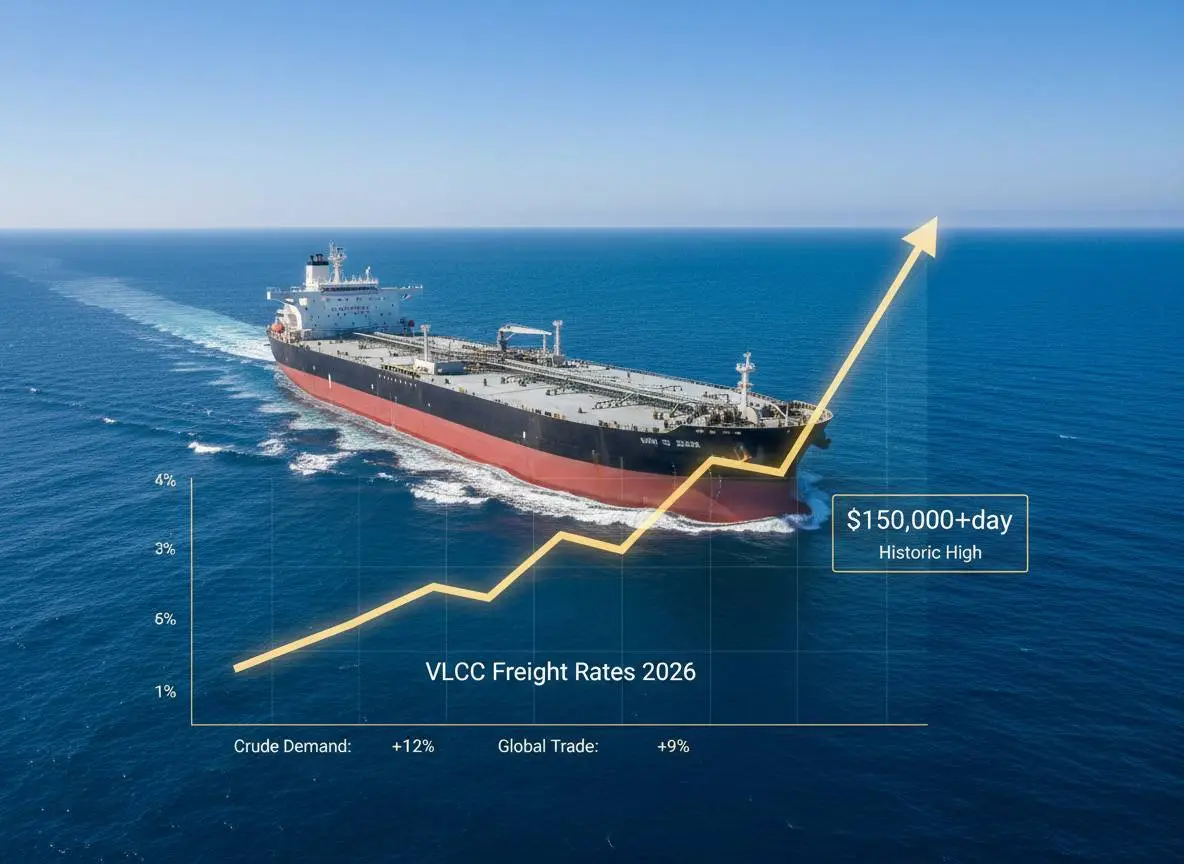
Singapore – February 26, 2026 – The Very Large Crude Carrier (VLCC) market is booming, with freight rates reaching historically high levels. Currently, there is an unprecedented surge, with daily spot freight rates for key routes exceeding $150,000. This dramatic increase is driven by heightened geopolitical tensions in the Middle East and a dwindling supply of available vessels, creating a highly competitive environment for oil tanker owners.
Unpacking the Market Explosion: Rates Not Seen in Years
For the first time since the 2020 oil price war, VLCC spot earnings are consistently breaching six-figure levels. The benchmark Middle East Gulf (MEG) to China (TD3C) route is now commanding rates around Worldscale (WS) 163.28, translating to daily Time Charter Equivalent (TCE) earnings exceeding $151,000. Other vital routes, such as West Africa to China (TD15), are following suit, with TCE earnings topping $130,000 per day. Even the longer-haul US Gulf to China (TD22) route is seeing rates approaching $100,000 per day, despite the extended voyage time.
The time charter sector is also reflecting this newfound strength, with one-year time charter rates for VLCCs now hovering between $93,000 and $105,000 per day. This represents the highest level in decades, with a recent fixture by DHT Holdings for their DHT Redwood (a 2011-built vessel) securing a remarkable $105,000 per day for a year-long contract. Such figures underscore charterers’ long-term confidence in sustained high demand and tight supply.
The “Perfect Storm”: Geopolitics, Sanctions, and Fleet Dynamics
Industry analysts point to a confluence of factors creating this “perfect storm” in the VLCC market:
- Escalating Geopolitical Risks: Renewed tensions and military posturing in the Middle East, particularly involving the U.S. and Iran, are driving a frantic pace of chartering activity. Oil traders are rushing to secure tonnage and move crude out of the region, fearing potential supply disruptions or shipping impediments. This pre-emptive “panic fixing” is layering significant risk premiums onto freight costs.
- The Shrinking Mainstream Fleet: The supply side of the equation is equally critical. The global VLCC fleet is bifurcated. A significant portion of tonnage—estimated at over 15%—has migrated into the so-called “shadow fleet” to service sanctioned trades. These vessels are effectively removed from the mainstream compliant market used by major international oil companies, drastically reducing the pool of available ships.
- Strategic Consolidation and Leverage: The remaining compliant fleet is more tightly controlled than ever. Aggressive acquisition campaigns by major players like Sinokor have consolidated ownership, giving these large entities significant leverage in negotiations. With fewer ships available and fewer owners to talk to, the power balance has shifted decisively in favour of shipowners.
Long-Term Confidence: The Time Charter Signal
Perhaps the strongest indicator of the market’s underlying strength is the time charter sector. Unlike the volatile spot market, time charters reflect long-term sentiment.
Charterers are rushing to lock in tonnage for longer periods to hedge against future volatility, driving one-year time charter rates to record highs of $95,000 to $105,000 per day. Deals like DHT Holdings fixing a 15-year-old vessel at over $100,000 per day signal a profound belief that this high-rate environment is not a fleeting event but a new reality for the medium term.
Outlook
As we move towards the second quarter of 2026, the VLCC market shows few signs of cooling. With a historically low orderbook for new vessels guaranteeing limited supply growth over the next few years, and geopolitical fires continuing to burn, the fundamentals remain overwhelmingly bullish. For now, the supertanker market remains one of the most volatile and lucrative corners of the global economy.