

By A. Dimitriou
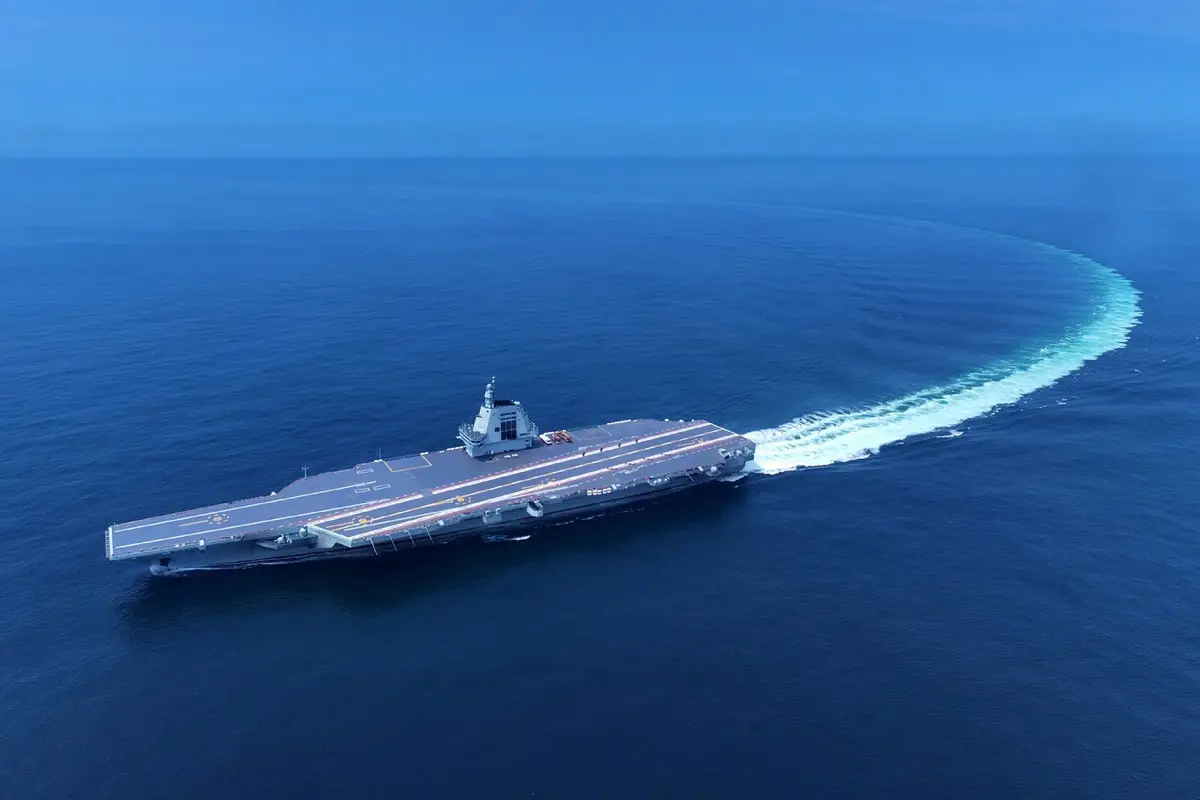
PHOTO / XINHUA (CNS Fujian during Sea Trials)
China’s aircraft carriers represent a significant shift in global naval power dynamics, as the nation pursues an ambitious expansion program that could fundamentally alter maritime security in the Indo-Pacific. According to recent Pentagon assessments, China plans to operate nine aircraft carriers by 2035, marking one of the most aggressive naval modernization efforts in modern history.
The People’s Liberation Army Navy (PLAN) currently operates three carriers, but this expansion would nearly triple its fleet size within the next decade. This development has captured international attention as military analysts assess the strategic implications of such rapid naval growth.
Recent news on China’s aircraft carriers indicates that Beijing is not merely expanding its fleet but also advancing its technological capabilities. The newest carrier, CNS Fujian, features electromagnetic catapults similar to those found on the most advanced U.S. Navy vessels, demonstrating China’s commitment to matching Western naval technology.
Chinese Aircraft Carriers: Current Fleet Status and Capabilities
The development of Chinese aircraft carriers has accelerated dramatically over the past decade, with three operational vessels now in service with the PLAN. Each carrier represents a significant technological leap from its predecessor, showcasing China’s evolving naval engineering capabilities.
How many aircraft carriers does China have? Currently, the People’s Liberation Army Navy operates three carriers with plans for six more. The existing fleet consists of CNS Liaoning, a refurbished Soviet-era hull that entered service in 2012, CNS Shandong, China’s first domestically built carrier commissioned in 2019, and CNS Fujian, the most technologically advanced vessel featuring electromagnetic catapults.
CNS Liaoning primarily serves as a training platform, enabling Chinese naval personnel to develop expertise in carrier operations. The vessel, originally the Soviet Varyag, underwent extensive modifications in Chinese shipyards before entering service. Despite its age, Liaoning has proven instrumental in establishing China’s carrier aviation program.
CNS Shandong represents China’s first independently designed and constructed aircraft carrier. Built at Dalian Shipyard, this Type 002 carrier incorporates lessons learned from Liaoning operations while featuring improved aircraft handling systems and enhanced defensive capabilities. The vessel can accommodate approximately 36 aircraft, including J-15 Flying Shark fighters and various support aircraft.
The crown jewel of China’s current fleet, CNS Fujian, showcases the nation’s technological advancement in naval engineering. This Type 003 carrier features three electromagnetic catapults, making it the first non-U.S. carrier equipped with this advanced launch system. The electromagnetic catapults enable more efficient aircraft launches with heavier payloads, significantly enhancing operational capabilities.
Fujian’s advanced systems allow operation of various aircraft types, including the new J-35 stealth fighter currently under development. This capability positions China alongside the United States as one of the few nations operating carriers with electromagnetic launch systems, representing a major technological achievement.
China Aircraft Carrier Fleet Expansion Timeline Through 2035
The China aircraft carrier fleet expansion represents the most ambitious naval modernization program outside the United States. Pentagon reports indicate that China aims to construct six additional carriers over the next decade, bringing the total fleet to nine operational vessels by 2035.
Central to this expansion is the Type 004 program, which will produce China’s first nuclear-powered aircraft carrier. China’s development of nuclear-powered aircraft carriers would place the nation in an exclusive club alongside the United States and France. Nuclear propulsion offers unlimited range and endurance, enabling sustained operations far from Chinese shores.
The Type 004 carrier is currently under construction at Jiangnan Shipyard, with satellite imagery suggesting significant progress on the vessel’s hull. Intelligence assessments indicate the carrier will feature advanced systems, including electromagnetic catapults and enhanced aircraft capacity, compared to existing Chinese carriers.
Beyond the Type 004, China plans to construct additional carriers incorporating lessons learned from each previous design. These future vessels are expected to feature incremental improvements in aircraft capacity, defensive systems, and operational capabilities. The construction timeline suggests China could launch one new carrier approximately every two years through 2035.
The rapid expansion timeline reflects China’s strategic priority on naval modernization under President Xi Jinping’s military reform initiative. This pace of construction requires substantial industrial capacity and technological expertise, both of which China has been developing through its domestic shipbuilding industry.
China Naval Power Projection: Strategic Implications for the Indo-Pacific
China naval power projection capabilities will be substantially enhanced through the planned carrier fleet expansion. The strategic implications extend far beyond simple numerical increases, fundamentally altering regional power dynamics and international maritime security calculations.
China’s deployment of aircraft carriers in the Pacific will significantly alter the regional power balance over the coming decade. Unlike land-based aircraft, carriers provide mobile airfields that can operate beyond the range of shore-based defences. This capability enables China to project power throughout the South China Sea, East China Sea, and potentially into the broader Pacific Ocean.
The geographic advantages China enjoys in regional operations cannot be understated. Chinese carriers operating in the Western Pacific benefit from shorter supply lines and more efficient logistics compared to U.S. forces operating from distant bases. This proximity advantage could enable China to deploy more carriers in regional conflicts than the U.S. Navy could sustain over extended periods.
Strategic analysts note that China’s carrier expansion aligns with broader military modernization goals focused on regional dominance and global power projection. The shift from a coastal defence navy to a blue-water force capable of global operations represents a fundamental change in Chinese military doctrine.
The expansion also supports China’s territorial claims in disputed maritime regions. Carrier-based aircraft can provide air cover for Chinese operations in the South China Sea while demonstrating Beijing’s commitment to defending claimed territories. This capability enhances China’s position in ongoing territorial disputes with neighbouring nations.
International responses to China’s carrier expansion have varied: some nations are increasing their naval capabilities, while others are seeking diplomatic solutions to rising tensions. The United States has maintained its commitment to freedom of navigation operations, while regional allies have strengthened defence cooperation agreements.
Technical Challenges and Development Obstacles
Despite ambitious timelines, China faces significant technical challenges in achieving its nine-carrier goal. Complex systems integration, advanced technology requirements, and the development of operational expertise present substantial obstacles to the expansion program.
A comparison of China’s aircraft carriers with U.S. naval capabilities reveals both technological gaps and strategic advantages. While Chinese carriers incorporate advanced systems such as electromagnetic catapults, they still lag U.S. vessels in areas including nuclear propulsion, advanced radar systems, and combat management capabilities.
The development of nuclear propulsion for the Type 004 represents perhaps the most significant technical challenge. Nuclear-powered carriers require sophisticated reactor technology, specialized maintenance capabilities, and extensive safety protocols. China’s naval nuclear program, while advancing rapidly, lacks the decades of operational experience that characterize U.S. and French programs.
Pilot training and crew development present additional challenges for rapid fleet expansion. Operating aircraft carriers requires specialized skills that take years to develop. China must simultaneously train pilots for carrier operations while building the institutional knowledge necessary for effective carrier group operations.
The China aircraft carrier fleet expansion timeline targets nine operational carriers by 2035, according to Pentagon assessments, but achieving this goal will require overcoming substantial logistical and technical hurdles. Shipyard capacity, specialized component manufacturing, and quality control systems must all scale dramatically to support accelerated construction schedules.
Integration of advanced aircraft systems poses another significant challenge. The J-35 stealth fighter, intended for carrier operations, remains under development with uncertain delivery timelines. Coordinating aircraft development with carrier construction requires precise planning and execution across multiple defence contractors and military organisations.
Future Implications and Strategic Outlook
The successful implementation of China’s nine-carrier plan would fundamentally reshape the global distribution of naval power. By 2035, China could operate a carrier fleet second only to the United States in terms of numbers, though likely still trailing in overall technological sophistication and operational experience.
Regional security implications extend throughout the Indo-Pacific, where increased Chinese naval presence could alter existing security arrangements and alliance structures. Nations throughout the region are already adjusting their defence planning to account for enhanced Chinese naval capabilities.
The economic implications of such massive naval expansion are equally significant. China’s defence spending priorities reflect the strategic importance placed on naval modernisation, with carrier construction representing billions of dollars in annual investment. This spending supports domestic shipbuilding industries while advancing technological capabilities across multiple sectors.
International maritime law and freedom-of-navigation principles may face challenges as China’s carrier capabilities expand. Enhanced power projection capabilities could enable more assertive enforcement of territorial claims, potentially heightening tensions with nations that support international maritime law.
The success of China’s carrier program will ultimately depend on the nation’s ability to overcome technical challenges while managing international reactions and regional tensions. The development of nuclear-powered carriers and advanced launch systems will serve as crucial indicators of China’s progress toward its naval modernization goals.
As China continues to build aircraft carriers at an unprecedented pace, the international community closely watches for signs of how this enhanced naval capability will be employed. The next decade will be critical to determining whether China’s carrier expansion contributes to regional stability or increases the risk of maritime conflicts in the world’s most economically important waterways.