

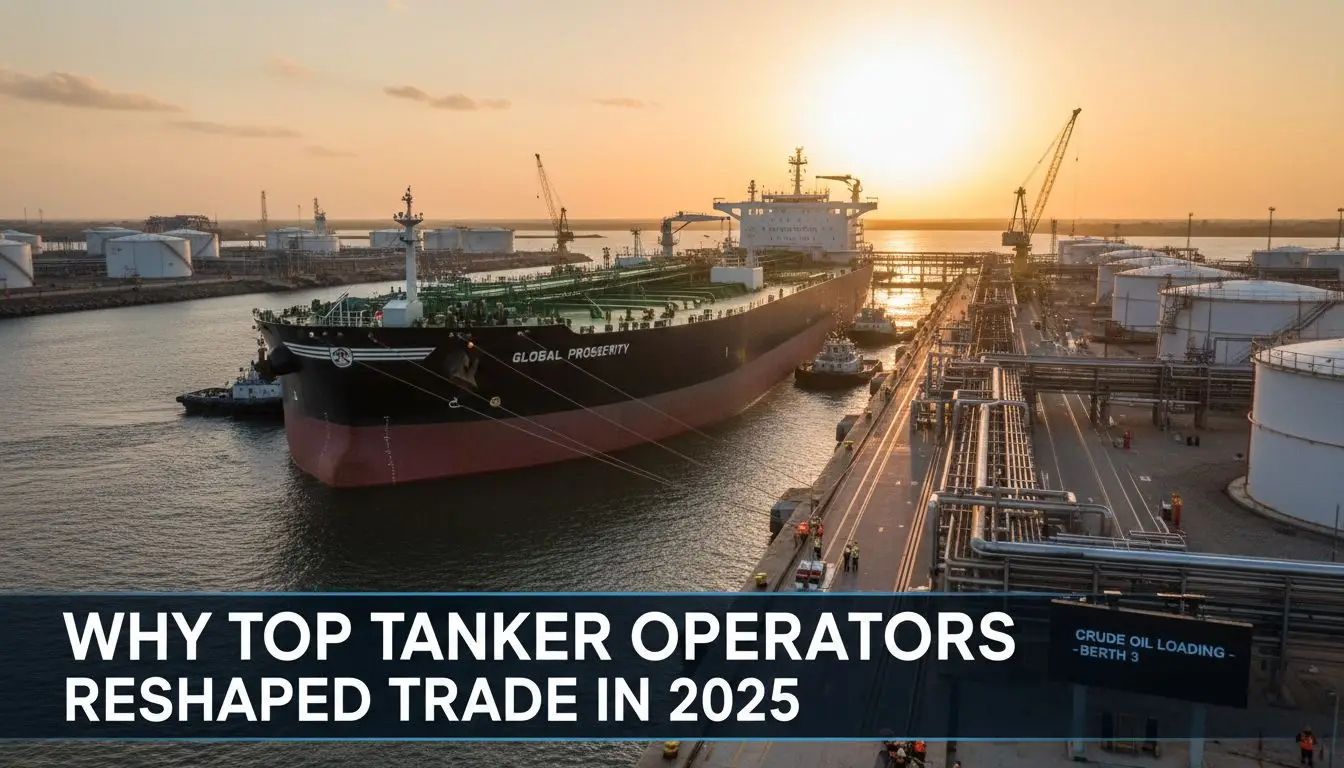
Global tanker freight rates are strengthening in 2025 as US sanctions and geopolitical disruptions fundamentally alter shipping patterns. Market rates continue to surge across key regions despite 200 tankers scheduled for delivery this year—double the number from 2024.
The tanker shipping market is projected to grow from USD 209.4 billion in 2024 to USD 345.2 billion by 2035, at a CAGR of 4.65%. This expansion occurs amid significant operational challenges. Almost 10% of global VLCCs and Suezmax fleet and 18% of Aframaxes are currently on sanctioned lists, creating market opportunities for compliant operators.
Aframax freight from Russia’s Kozmino port to North China has increased almost fourfold to over $6 million since the latest sanctions were announced. The Aframax/LR segment stands out with expected growth rates of 9.4% in 2025 and 11.3% in 2026. Many operators are repositioning their fleets to capitalize on these disrupted trade lanes.
Maritime trade volume is expected to expand by only 0.5% in 2025, with containerized trade increasing by 1.4%. Additionally, 23% of tankers in the largest segments are considered tied to illicit activities.
Leading operators are implementing strategies to reshape maritime trade patterns through 2025 and beyond.
Sanctions and Trade Rerouting: A New Normal
Sanctions against Russia and other oil-producing nations have altered global shipping routes, creating both challenges and opportunities for operators. Western nations introduced sweeping restrictions that continue to ripple through maritime trade, pushing vessels into unfamiliar patterns.
Impact of US and EU sanctions on tanker routes
The US sanctions on Rosneft and Lukoil—Russia’s two largest oil producers, responsible for half of its crude exports—mark the most significant intervention since January 2025. The EU ratified its 19th sanctions package targeting 117 additional vessels. These measures follow earlier restrictions that blacklisted over 100 tankers, reduced the crude price cap, and imposed stricter documentation standards for ship-to-ship transfers.
Charterers must now conduct extensive due diligence to ensure vessels are “clean, covered, and clause-compliant. This verification process creates operational delays and increases risk exposure, particularly for those using outdated contract templates.
Russian oil has been redirected away from Europe toward Asian markets. This redirection increases transportation costs as vessels travel longer distances. The crude sanctions preserve an unprecedented spread between market prices and what Russia receives for its exports.
Rise in Aframax and Suezmax demand
Limited vessel availability coupled with high crude volumes has elevated VLCC rates to a 31-month high. Stricter sanctions on Russia, Iran, and Venezuela have restricted dark fleet capacity—a development benefiting mainstream tanker utilization.
Crude inflows to the Atlantic Basin increased by 8% year-on-year in Q3, strengthening demand for these vessel types. Suezmax tankers have become increasingly regional in their operations. Routes within the Atlantic Basin—particularly from South America to Europe and the US—now dominate.
Aframaxes are experiencing increased transatlantic demand. Voyages from the Gulf of Mexico to Northwest Europe and the Mediterranean have supplanted shorter trips from Mexico’s east coast to the US Gulf, which have reached nine-year lows.
How sanctions are reshaping ton-mile demand
Platts’ Global VLCC Index nearly doubled from mid-October to November 17, reaching $119,807 per day after the Rosneft and Lukoil sanctions announcement. The Global Suezmax Index strengthened to $63,136.65 per day on November 17, up from $36,620.14 on October 3.
The amount of oil in transit globally is approaching 2 billion barrels—the highest level in at least eight years. “There’s no better time to be in the shipping industry. If there’s more sanctions, freight rates will go up,” says Janet Kong, CEO of Hengli Petrochemical International.
Voyage distances have lengthened substantially. The EU ban on Russian oil imports and Suez Canal diversions extend journey lengths and tighten vessel supply. European importers have shifted from short-haul Russian supplies to longer-distance sources in the Middle East, US, and Latin America.
EU restrictions on petroleum products made from Russian crude in third countries, effective January 2026, add further complexity. This measure could divert Indian oil shipments to Europe toward Latin America or Asia instead, potentially increasing product tanker ton-miles.
Fleet Expansion and Newbuild Impact
The tanker industry faces historic vessel delivery schedules that will reshape supply dynamics throughout 2025. Operators are positioning their fleets for this supply-side transformation.
Record deliveries across vessel segments
A wave of 200 tanker deliveries is scheduled for 2025, representing double the number from 2024. This surge includes more than 100 new Medium Range (MR) tankers, representing the largest fleet expansion since 2009.
Growth varies significantly across vessel segments. VLCC capacity will increase modestly by just 0.4% in 2025, while Suezmax growth is projected at 4%. The Aframax/LR segment faces expansion rates of 9.4% in 2025 and 11.3% in 2026.
This uneven growth reflects changing trade patterns. Operators are investing heavily in newbuilds to capitalize on favorable market conditions, particularly for larger crude carriers serving expanded US-to-Asia routes.
East Asian dominance in shipbuilding
China, South Korea, and Japan collectively command 96% of total orders by deadweight tonnage. China’s prominence has grown substantially, now accounting for 75% of 2025 newbuild orders, up from 32.4% of the tanker orderbook in 2022 to 71.2% in 2024.
South Korea holds 19% of 2025 orders but focuses on high-value, technologically advanced vessels. Korean shipbuilders are developing innovations such as LNG carriers with reduced tank numbers to improve fuel efficiency. Japan maintains strength in bulk carriers with 737 vessels totaling 40.7 million dwt in its orderbook.
Market balance amid oversupply concerns
The rapid delivery schedule presents risks to market earnings. However, operators are counting on several factors to balance potential oversupply. The aging global fleet shows between 19% and 41% of existing tankers are already 20 years or older, with LR1/Panamaxes and Handies showing the oldest age profiles.
Numerous tanker operators are delaying vessel launch dates in response to projected record-high deliveries in 2026. Although scrapping activity remains insufficient to offset growth, the anticipated decline in sub-20-year vessel numbers (except during 2026) may help maintain market equilibrium.
The Aframax/LR segment faces particular vulnerability to oversupply risks. Its widespread use in regional and medium-haul trades offers fewer opportunities for ton-mile growth compared to VLCCs or Suezmaxes. Many operators are carefully timing their orders and exploring alternative deployment strategies to mitigate these risks.
Fleet Capacity Drives Market Transformation
The tanker industry faces historic vessel delivery schedules, with 200 tankers entering service in 2025. This represents double the number from 2024 and marks the most substantial fleet expansion since 2009 .
Delivery surge across segments
More than 100 new Medium Range (MR) tankers will enter service this year . Growth varies markedly across vessel segments. VLCC capacity will increase modestly by just 0.4% in 2025 , while Suezmax growth is projected at 4% . The Aframax/LR segment faces expansion rates of 9.4% in 2025 and 11.3% in 2026 .
Operators are adjusting their fleets to match evolving cargo demands. Many are investing in newbuilds to capitalize on favorable market conditions, particularly for larger crude carriers serving US-to-Asia routes.
East Asian yards dominate construction
China, South Korea, and Japan collectively command 96% of total orders by deadweight tonnage . China’s prominence has grown substantially, now accounting for 75% of 2025 newbuild orders , up from 32.4% of the tanker orderbook in 2022 to 71.2% in 2024 .
South Korea holds 19% of 2025 orders but focuses on high-value, technologically advanced vessels. Korean shipbuilders are developing innovations such as LNG carriers with reduced tank numbers to improve fuel efficiency. Japan maintains strength in bulk carriers with 737 vessels totaling 40.7 million dwt in its orderbook .
Oversupply concerns and market balance
The rapid delivery schedule presents risks to market earnings . Operators are counting on several factors to balance potential oversupply. The aging global fleet shows between 19% and 41% of existing tankers are already 20 years or older , with LR1/Panamaxes and Handies showing the oldest age profiles .
Numerous operators are delaying vessel launch dates in response to projected record-high deliveries in 2026 . Although scrapping activity remains insufficient to offset growth , the anticipated decline in sub-20-year vessel numbers may help maintain market equilibrium.
The Aframax/LR segment faces particular vulnerability to oversupply risks as its widespread use in regional and medium-haul trades offers fewer opportunities for ton-mile growth compared to VLCCs or Suezmaxes.
Cargo Flexibility Becomes Operational Priority
Tanker flexibility has emerged as a competitive advantage as market volatility reshapes maritime trade. Operators are adapting vessels to switch between clean petroleum products and crude oil cargoes.
LR2 tankers gain market preference
LR2-type tankers, with their coated tanks, represent a growing preference among operators seeking to maximize trading opportunities. These vessels can carry both crude oil and clean petroleum products interchangeably. This versatility allows operators to capitalize on market fluctuations, as demonstrated when Red Sea disruptions affected both clean and dirty trades.
The economic incentives are substantial. When properly positioned, flexible vessels can participate in both market segments, capturing premium rates regardless of which sector performs better. Currently, earnings for clean LR2 tankers remain at approximately $40,000/day, while their dirty counterparts (Aframaxes) fetch around $30,000/day with lower fleet employment rates.
Complex operational procedures required
Switching between cargo types involves extensive operational procedures. Cargo owners typically require tankers to carry intermediate cargo, like diesel oil, for three voyages after transporting crude oil before they can carry clean products such as gasoline. Alternatively, vessels can undergo thorough cleaning during ballast voyages to remove all traces of previous cargo.
DNV GL has developed the ITC (Interchangeable Tank Cargo) class notation to help operators demonstrate their vessels’ cleaning capabilities. This notation specifies three mandatory qualifiers:
- Tank-washing machine coverage must reach at least 80% of tank surfaces
- Stripping efficiency limiting cargo residue to a maximum of 3,000 liters
- Measurement of horizontal surface area where sludge might accumulate
Vessels must have fully coated tanks compatible with all intended cargoes, plus either coated or stainless-steel cargo tank piping. These requirements present substantial technical hurdles.
Direct impact on freight rates
The practice of switching tankers between clean and dirty trades directly impacts freight rates. Large-scale switching of dirty tankers to clean products trading occurred in July 2024 as operators sought to capitalize on robust LR2 earnings. This shift caused pressure on clean tanker freight rates, with the LR2 Persian Gulf-Japan route declining 37% in about a month.
By July 2024, 18 VLCCs, 48 Suezmaxes, and 85 Aframaxes had switched from dirty to clean products trading, compared to just 7 VLCCs, 22 Suezmaxes, and 58 Aframaxes at the end of 2023. This flexibility creates notable cost differentials—moving clean petroleum products on LR2s from the Persian Gulf to UK Continent cost $74.89/mt in early July 2024. In contrast, VLCCs and Suezmaxes could move the same products for just $10.72/mt and $23.14/mt respectively.
The ability to switch between cargo types has become a strategic tool, though one that comes with significant operational complexity.
Shadow Fleet Operations Challenge Market Transparency
The maritime industry confronts a parallel shipping ecosystem as shadow fleets—vessels engaged in sanctioned trades or operating under opaque ownership—expand beyond traditional oversight.The maritime industry faces a parallel shipping ecosystem as shadow fleets—vessels engaged in sanctioned trades or operating under opaque ownership—grow beyond traditional oversight.
Dark fleet expansion following the Ukraine conflict
The shadow fleet has grown substantially since Russia invaded Ukraine. Originally comprising a few dozen vessels serving primarily Iran and Venezuela, it now includes approximately 900-1,200 vessels worldwide. Currently, 23% of tankers in the largest segments (VLCC, Suezmax, and Aframax/LR2) operate within these illicit activities.
S&P Global estimates indicate a 45% increase in the shadow fleet during the year ending May 2024. This parallel maritime ecosystem now represents between 10-20% of the global tanker fleet, altering market dynamics for legitimate operators.
Vessel evasion methods
Shadow vessels employ sophisticated tactics that undermine market transparency. AIS manipulation and outright disabling occurred in 274 instances between 2021 and mid-2025. Ship-to-ship (STS) transfers, often conducted under cover of darkness, create operational inefficiencies yet support higher freight rates by reducing available supply.
Flag-hopping has reached unprecedented levels in 2025, with vessels frequently changing registrations to evade scrutiny. 40% of Iranian-linked tankers are using entirely false flags. These vessels typically operate through shell companies in jurisdictions like Dubai, where rapid buying and selling by anonymous firms makes tracing ownership nearly impossible.
Operator compliance responses
Legitimate tanker operators face mounting compliance costs. Many now employ specialized teams to monitor vessel movements and ownership structures. This includes extensive verification processes before engaging in charters or STS operations.
Several major tanker companies have implemented enhanced due diligence procedures, including satellite tracking beyond AIS data. Others have withdrawn completely from certain high-risk regions—as demonstrated by Turkish firm Besiktas Shipping Group’s recent cessation of all operations involving Russian interests.
Transparent operators stand to benefit from premium rates for verified clean vessels, though they must navigate increasingly complex regulatory waters.
Environmental Pressures and Aging Fleets
Environmental regulations present unprecedented challenges for tanker operators. Compliance costs and competitive advantages are reshaping fleet management decisions across the industry.
IMO emissions targets and EU ETS impact
The International Maritime Organization (IMO) has approved regulations for net-zero emissions by 2050. Beginning in 2027, ships must reduce their greenhouse gas fuel intensity while those exceeding thresholds will acquire remedial units.
The EU Emissions Trading System now covers maritime transport, requiring allowances for emissions. Shipping companies need only surrender allowances for 40% of emissions in 2025, increasing to 100% by 2027.
Scrapping trends and fleet age profile
The global tanker fleet has reached an unprecedented age, climbing from 10 years in 2018 to above 14 years by mid-2025. Ship recycling has collapsed from 160 demolitions in 2021 to merely 10 in 2024.
Vessels over 21 years old have more than tripled since 2018. Sanctions created alternative markets for aged vessels that would normally face scrapping.
Investment in dual-fuel and LNG tankers
Alternative fuel represents 50% of all tonnage ordered in 2024. LNG dual-fuel technology dominates with 70% of alternative-fueled tonnage ordered.
Fleet capacity using alternative fuels is forecast to exceed 20% by 2030, up from just 8% in 2024.
Market Transformation Ahead
The tanker shipping market stands at a critical inflection point in 2025. Major geopolitical shifts, particularly sanctions against Russia and other oil-producing nations, have fundamentally altered global shipping routes. Freight rates have surged despite scheduled delivery of 200 new tankers this year.
These disruptions create both challenges and opportunities for compliant operators. They must now operate in an increasingly complex maritime landscape.
Vessel flexibility has emerged as a crucial competitive advantage. Tankers equipped to switch between clean and dirty cargoes can capitalize on market volatility, though this versatility comes with significant operational hurdles. The shadow fleet continues its expansion, now representing between 10-20% of the global tanker fleet and undermining market transparency.
Environmental pressures add another layer of complexity. The aging global fleet, combined with IMO emissions targets and the EU Emissions Trading System, forces operators to make difficult decisions about fleet management and future investments. This reality explains the growing interest in alternative fuels, with 50% of all tonnage ordered in 2024 designed for non-traditional propulsion.
Operators who successfully adapt to these challenges will reshape maritime trade throughout 2025 and beyond. Those with strong compliance programs, strategic fleet deployment, and forward-thinking environmental policies will likely capture market share as sanctions, supply changes, and sustainability requirements continue to transform the industry.
The maritime landscape may appear turbulent, yet these market disruptions present opportunities for agile, well-positioned tanker companies.
