

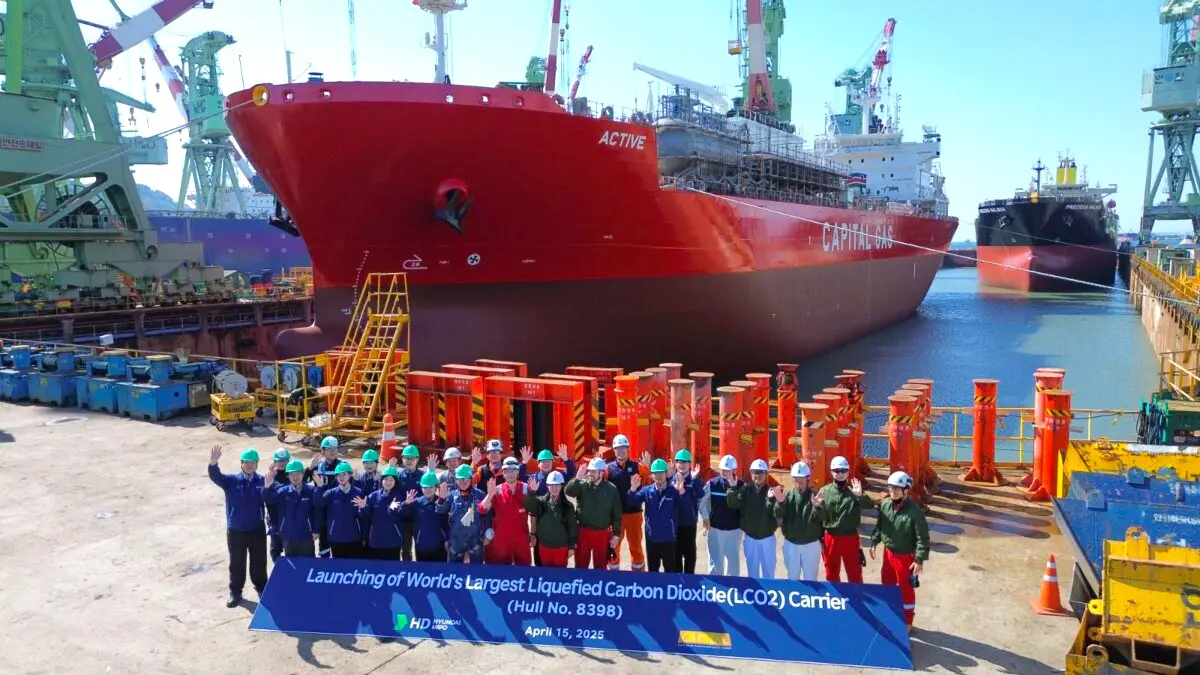
The maritime industry has reached a major milestone in the energy‑transition era with the delivery of the world’s first large LCO₂ / multi‑gas carrier to Capital, marking a decisive step toward the commercialisation of carbon capture, utilisation and storage (CCUS) at sea.
The newly delivered vessel represents the first large‑scale, purpose‑built liquid carbon dioxide (LCO₂) carrier designed to transport CO₂ and multiple liquefied gases safely and efficiently, positioning shipping as a central enabler in global decarbonisation strategies.
A Landmark Delivery for Carbon Shipping
The delivery of this vessel underscores growing confidence in CO₂ shipping as a viable transport solution, particularly for regions where pipeline infrastructure is impractical or uneconomical. As CCUS projects expand across Europe, Asia and the Middle East, maritime transport is expected to play a critical role in moving captured CO₂ from industrial hubs to permanent offshore or onshore storage sites.
Capital’s entry into this emerging segment signals a strategic commitment to next‑generation gas shipping, aligning with broader industry efforts to diversify fleets toward low‑carbon and transitional energy payloads.
This latest delivery follows increasing industry focus on alternative gas carriers, alongside LNG, ethane and ammonia vessels, covered extensively in the Sustainable Shipping and Shipyards sections of https://maritime-hub.com/sustainable-shipping/.
General Particulars of the LCO₂ / Multi‑Gas Carrier
While full class documentation has yet to be publicly released, the vessel’s principal particulars have been disclosed or widely reported within industry circles.
Key General Characteristics:
- Vessel Type: Liquid CO₂ / Multi‑Gas Carrier
- Owner / Operator: Capital
- Cargo Capability: LCO₂, LPG‑related gases, and compatible liquefied products
- Cargo Capacity: Approx. 22,000–30,000 cubic metres
- Length Overall (LOA): Approx. 160–180 metres
- Beam: Approx. 27–30 metres
- Deadweight: In the range of 30,000–40,000 dwt
- Cargo Containment: IMO Type C pressure tanks
- Design Pressure: Up to 18 bar (depending on cargo)
- Cargo Temperature: Down to approximately –50°C
- Classification Society: IACS member class
- Flag: To be confirmed on entry into service
The vessel has been engineered with high flexibility, allowing owners to switch between different liquefied gases depending on market demand—an important risk‑mitigation feature in a young sector.
For more on advanced gas‑carrier technology, see Marine Engines and Shipbuilding coverage on https://maritime-hub.com/shipyards/.
What Is an LCO₂ Carrier?
An LCO₂ carrier is a specialised ship designed to transport liquid carbon dioxide in bulk form by sea. CO₂ is typically captured from industrial sources such as cement plants, steel mills, refineries and power stations, then liquefied under controlled temperature and pressure conditions.
Physical Characteristics of CO₂
Transporting CO₂ presents unique technical challenges:
- CO₂ becomes liquid at relatively high pressures compared with LNG
- It requires moderate refrigeration
- It has a distinct phase‑change behaviour that demands precise cargo control
Because of these characteristics, most LCO₂ carriers use pressure vessels rather than membrane tanks, differentiating them from LNG carriers.
Multi‑Gas Capability: A Strategic Advantage
What sets Capital’s new vessel apart is its multi‑gas design, which allows it to carry:
- Liquid CO₂
- Certain LPG‑type gases
- Other compatible liquefied industrial gases
This flexibility offers several advantages:
- Commercial adaptability – The vessel is not reliant solely on CO₂ projects during early market development
- Higher utilisation rates – Operators can ballast fewer days between charters
- Lower investment risk – Owners can pivot as CCUS demand matures
This design philosophy mirrors trends already seen in ethane‑ready and ammonia‑ready vessels, a topic frequently discussed in https://maritime-hub.com/sustainable-shipping/.
Role of CO₂ Shipping in CCUS Supply Chains
CO₂ shipping is now viewed as a critical link between capture sites and permanent storage locations.
In many regions:
- CO₂ capture sites are inland or coastal
- Storage reservoirs are offshore or in remote areas
- Dedicated pipelines are often cost‑prohibitive
Shipping enables cross‑border CO₂ transport, allowing countries without suitable geology to export captured carbon for sequestration elsewhere.
Large‑scale vessels, such as Capital’s new carrier, are expected to support:
- North Sea storage hubs
- Mediterranean industrial corridors
- Emerging Asian CCUS clusters
More on maritime’s role in carbon regulation and compliance can be found in the Classification Societies section of
The maritime industry has reached a major milestone in the energy‑transition era with the delivery of the world’s first large LCO₂ / multi‑gas carrier to Capital, marking a decisive step toward the commercialisation of carbon capture, utilisation and storage (CCUS) at sea.
The newly delivered vessel represents the first large‑scale, purpose‑built liquid carbon dioxide (LCO₂) carrier designed to transport CO₂ and multiple liquefied gases safely and efficiently, positioning shipping as a central enabler in global decarbonisation strategies.
A Landmark Delivery for Carbon Shipping
The delivery of this vessel underscores growing confidence in CO₂ shipping as a viable transport solution, particularly for regions where pipeline infrastructure is impractical or uneconomical. As CCUS projects expand across Europe, Asia and the Middle East, maritime transport is expected to play a critical role in moving captured CO₂ from industrial hubs to permanent offshore or onshore storage sites.
Capital’s entry into this emerging segment signals a strategic commitment to next‑generation gas shipping, aligning with broader industry efforts to diversify fleets toward low‑carbon and transitional energy payloads.
This latest delivery follows the growing industry focus on alternative gas carriers, alongside LNG, ethane, and ammonia vessels, which are covered extensively in the Sustainable Shipping and Shipyards sections of https://maritime-hub.com/sustainable-shipping/.
General Particulars of the LCO₂ / Multi‑Gas Carrier
While full class documentation has not yet been publicly released, the vessel’s principal particulars have been disclosed or widely reported in industry circles.
Key General Characteristics:
- Vessel Type: Liquid CO₂ / Multi‑Gas Carrier
- Owner / Operator: Capital
- Cargo Capability: LCO₂, LPG‑related gases, and compatible liquefied products
- Cargo Capacity: Approx. 22,000–30,000 cubic metres
- Length Overall (LOA): Approx. 160–180 metres
- Beam: Approx. 27–30 metres
- Deadweight: In the range of 30,000–40,000 dwt
- Cargo Containment: IMO Type C pressure tanks
- Design Pressure: Up to 18 bar (depending on cargo)
- Cargo Temperature: Down to approximately –50°C
- Classification Society: IACS member class
- Flag: To be confirmed on entry into service
The vessel has been engineered for high flexibility, allowing owners to switch between different liquefied gases as market demand changes—an important risk‑mitigation feature in a young sector.
For more on advanced gas‑carrier technology, see Marine Engines and Shipbuilding coverage on https://maritime-hub.com/shipyards/.
What Is an LCO₂ Carrier?
An LCO₂ carrier is a specialised ship designed to transport liquid carbon dioxide in bulk form by sea. CO₂ is typically captured from industrial sources such as cement plants, steel mills, refineries and power stations, then liquefied under controlled temperature and pressure conditions.
Physical Characteristics of CO₂
Transporting CO₂ presents unique technical challenges:
- CO₂ becomes liquid at relatively high pressures compared with LNG
- It requires moderate refrigeration
- It has distinct phase‑change behaviour that demands precise cargo control
Because of these characteristics, most LCO₂ carriers use pressure vessels rather than membrane tanks, differentiating them from LNG carriers.
Multi‑Gas Capability: A Strategic Advantage
What sets Capital’s new vessel apart is its multi‑gas design, which allows it to carry:
- Liquid CO₂
- Certain LPG‑type gases
- Other compatible liquefied industrial gases
This flexibility offers several advantages:
- Commercial adaptability – The vessel is not reliant solely on CO₂ projects during early market development
- Higher utilisation rates – Operators can ballast fewer days between charters
- Lower investment risk – Owners can pivot as CCUS demand matures
This design philosophy mirrors trends already seen in ethane‑ready and ammonia‑ready vessels, a topic frequently discussed in https://maritime-hub.com/sustainable-shipping/.
Role of CO₂ Shipping in CCUS Supply Chains
CO₂ shipping is now viewed as a critical link between capture sites and permanent storage locations.
In many regions:
- CO₂ capture sites are inland or coastal
- Storage reservoirs are offshore or in remote areas
- Dedicated pipelines are often cost‑prohibitive
Shipping enables cross‑border CO₂ transport, allowing countries without suitable geology to export captured carbon for sequestration elsewhere.
Large‑scale vessels, such as Capital’s new carrier, are expected to support:
- North Sea storage hubs
- Mediterranean industrial corridors
- Emerging Asian CCUS clusters
More on maritime’s role in carbon regulation and compliance can be found in the Classification Societies section.
Safety and Regulatory Framework
LCO₂ carriers fall under existing IMO gas carrier regulations, with classification societies developing additional guidance to address the scale‑up of CO₂ transport.
Key regulatory considerations include:
- Pressure‑tank integrity
- Emergency release systems
- Cargo monitoring and control
- Crew training for CO₂‑specific hazards
The delivery of this vessel reflects growing regulatory confidence that bulk CO₂ shipping can be conducted safely under established maritime rules.
Why This Delivery Matters for the Shipping Industry
The delivery of the world’s first large LCO₂/multi-gas carrier is more than a technological milestone—it is a commercial signal.
It suggests:
- CCUS is moving beyond pilot projects
- Shipowners see long‑term CO₂ transport demand
- Capital is positioning early in a potentially high‑growth segment
As with LNG in the early 2000s, first movers in CO₂ shipping may benefit from design leadership, operational experience and early charter relationships.
Looking Ahead
As governments tighten carbon policies and industries seek cost‑effective decarbonisation routes, LCO₂ carriers are expected to move rapidly from niche to necessity.
Capital’s new vessel sets a benchmark for:
- Size
- Flexibility
- Commercial readiness
Future designs are likely to increase capacity, integrate digital monitoring, and further align with low‑emission propulsion systems.
For ongoing coverage of gas carriers, energy transition and alternative shipping technologies, visit https://maritime-hub.com/.
.
Safety and Regulatory Framework
LCO₂ carriers fall under existing IMO gas carrier regulations, with additional guidance being developed by classification societies to address the scale‑up of CO₂ transport.
Key regulatory considerations include:
- Pressure‑tank integrity
- Emergency release systems
- Cargo monitoring and control
- Crew training for CO₂‑specific hazards
The delivery of this vessel reflects growing regulatory confidence that bulk CO₂ shipping can be conducted safely under established maritime rules.
Why This Delivery Matters for the Shipping Industry
The delivery of the world’s first large LCO₂ / multi‑gas carrier is more than a technological milestone—it is a commercial signal.
It suggests:
- CCUS is moving beyond pilot projects
- Shipowners see long‑term CO₂ transport demand
- Capital is positioning early in a potentially high‑growth segment
As with LNG in the early 2000s, first movers in CO₂ shipping may benefit from design leadership, operational experience and early charter relationships.
Looking Ahead
As governments tighten carbon policies and industries seek cost‑effective decarbonisation routes, LCO₂ carriers are expected to move rapidly from niche to necessity.
Capital’s new vessel sets a benchmark for:
- Size
- Flexibility
- Commercial readiness
Future designs are likely to grow in capacity, integrate digital monitoring, and align further with low‑emission propulsion systems.
For ongoing coverage of gas carriers, energy transition and alternative shipping technologies, visit https://maritime-hub.com/.
