

Keyword focus: Largest Car Carrier
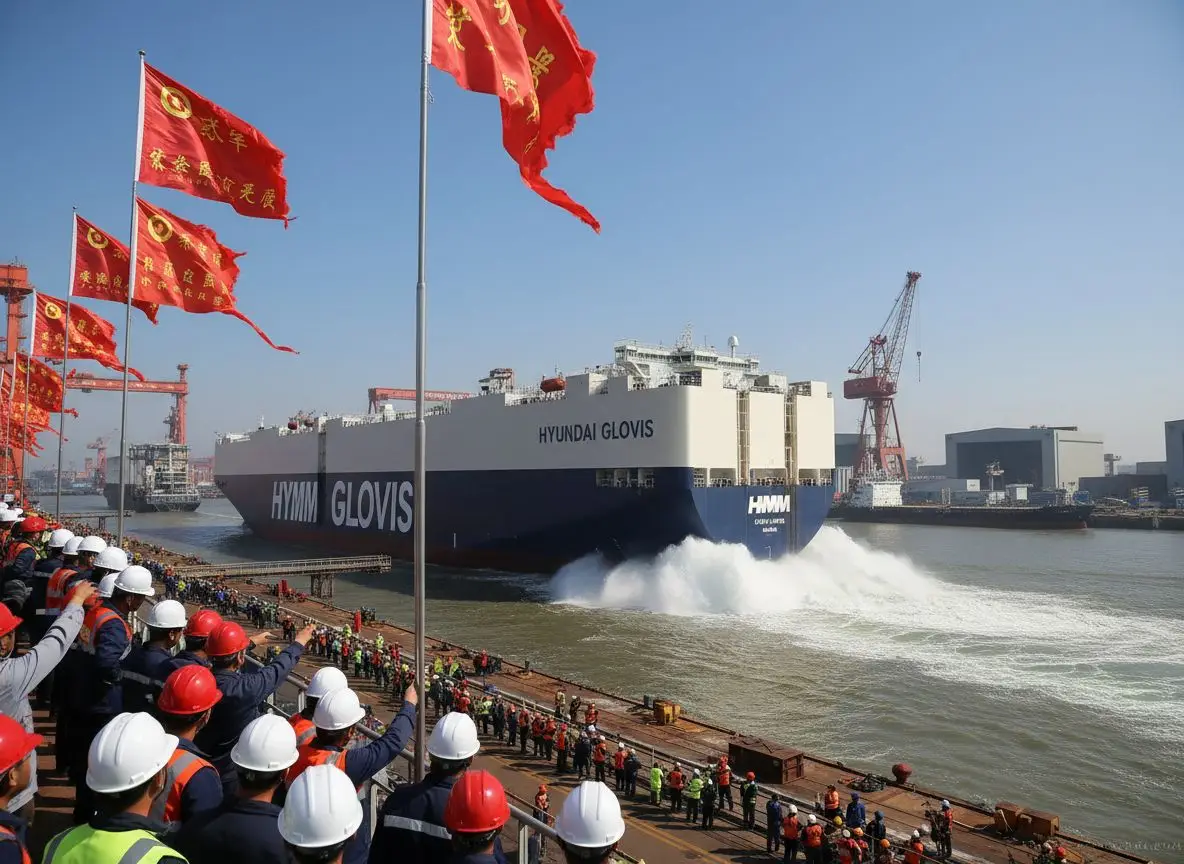
China has officially launched what is currently recognised as the largest car carrier ever built, marking a major milestone for both the Chinese shipbuilding sector and the strategic partnership between South Korea’s HMM and Hyundai Glovis. The vessel, which floated out at Guangzhou Shipyard International (GSI) on January 21, 2026, represents a new generation of ultra‑large, environmentally advanced vehicle carriers designed to meet surging global demand for automotive transport.

A New Global Record in Car Carrier Capacity
The newly launched vessel surpasses the 10,000‑unit threshold, offering a massive 10,500 CEU (car equivalent units) capacity. This achievement makes it the largest car carrier ever constructed in China and one of the largest in the world. The launch follows GSI’s earlier production of 9,500‑unit carriers in 2025, reflecting the shipyard’s rapid expansion in the high‑capacity PCTC (Pure Car and Truck Carrier) market.
While this vessel currently holds the title, the global race for capacity continues. Wallenius Wilhelmsen has announced plans for even larger ships—up to 11,700 CEU—expected to enter service in 2027. Still, for now, the HMM–Hyundai Glovis partnership stands at the forefront of operational capacity.
Built for HMM as Part of a Strategic Expansion
This vessel is the first car carrier ever built for HMM, South Korea’s major shipping company, as part of its diversification strategy. HMM has entered long‑term agreements with Hyundai Glovis, which will operate the new fleet of high‑capacity carriers. The partnership aims to strengthen South Korea’s position in the global automotive logistics chain, particularly as exports of electric vehicles and high‑value cars continue to rise.
Technical Specifications and Design Features
The new largest car carrier measures 230 meters in length and features a 14‑deck configuration, allowing it to transport a wide range of vehicles—from conventional passenger cars to electric vehicles, hydrogen‑powered cars, heavy trucks, and oversized machinery.
Key design highlights include:
- LNG dual‑fuel propulsion, reducing emissions and supporting global decarbonization goals
- Optimized hull design for improved fuel efficiency
- Flexible deck arrangements to accommodate diverse cargo types
- Advanced fire‑safety systems are essential for transporting EVs and alternative‑fuel vehicles
These features position the vessel as a next‑generation solution for sustainable automotive logistics.
A Milestone for China’s Shipbuilding Industry
Guangzhou Shipyard International, a subsidiary of China State Shipbuilding Corporation (CSSC), has rapidly become a global leader in constructing high‑capacity car carriers. The launch of this vessel underscores China’s growing dominance in the PCTC market and its ability to deliver technologically advanced, environmentally compliant ships at scale.
The shipyard’s recent achievements include:
- Delivering multiple 9,500‑unit carriers in 2025
- Developing LNG dual‑fuel propulsion systems
- Expanding production capacity to meet global demand
This latest launch further solidifies China’s position as a top builder of large‑capacity vehicle carriers.
Meeting Global Demand for Automotive Transport
The global automotive shipping market is experiencing unprecedented growth, driven by:
- Rising exports of electric vehicles
- Increased global car production
- Expansion of automotive supply chains
- Demand for greener, more efficient transport solutions
The largest car carrier launched for the HMM–Hyundai Glovis partnership is designed to meet these evolving needs, offering both scale and sustainability.
Looking Ahead
The vessel launched on January 21 is the first in a series of next‑generation carriers planned for the HMM–Hyundai Glovis partnership. As more ships join the fleet, the companies aim to strengthen their competitive edge in global automotive logistics while supporting greener maritime operations.
With its massive capacity, advanced propulsion, and flexible cargo design, this new vessel represents a significant leap forward for both Asian maritime cooperation and the global car‑carrier industry.
