

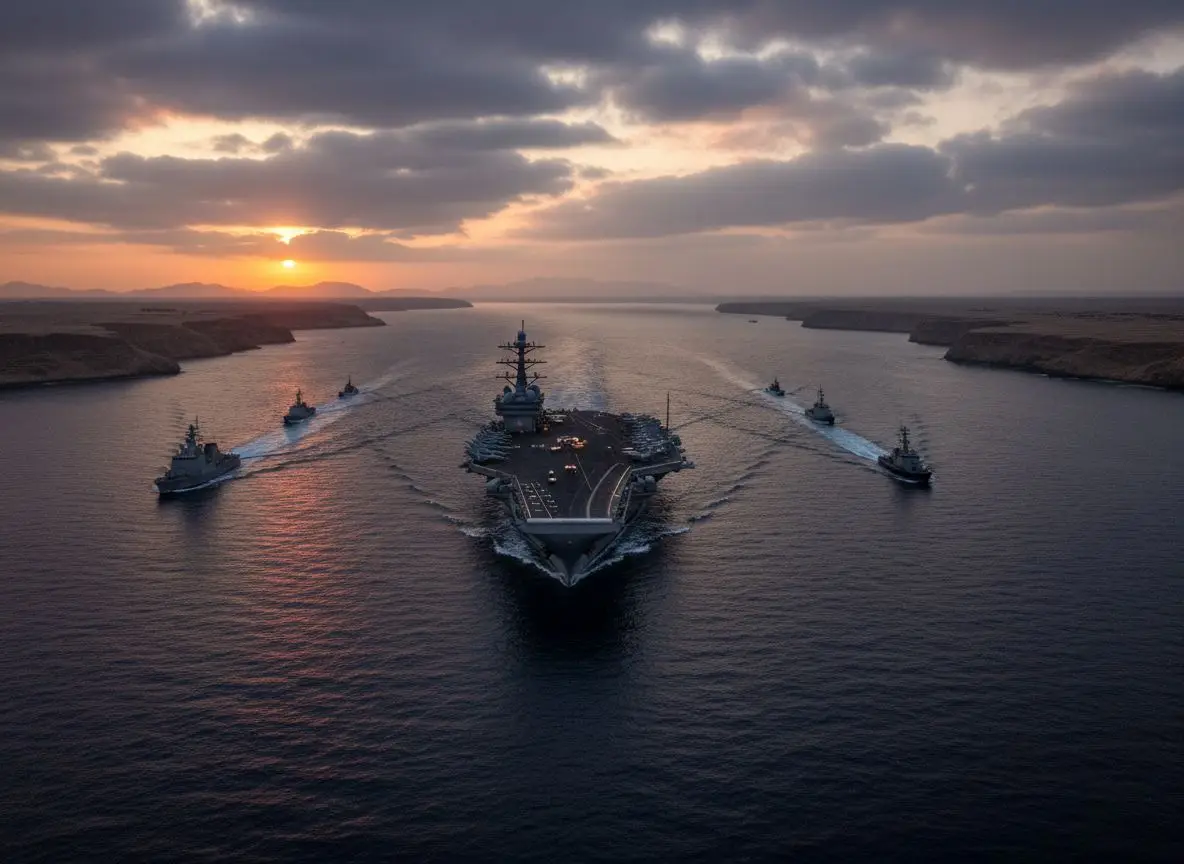
Tensions in the Middle East have escalated sharply following new warnings from Iranian officials about exerting “control over” maritime traffic in the Strait of Hormuz, coinciding with United States President Donald Trump’s announcement that a “massive armada” of U.S. naval forces is heading toward the region. The developments have fueled global concerns about the possibility of confrontation and the broader implications for energy markets, regional security, and the risk of US strikes on Iran.
Rising Tensions in the Strait of Hormuz
The Strait of Hormuz remains one of the world’s most critical maritime chokepoints, with roughly one‑fifth of global oil supply passing through its narrow waters. Iran has repeatedly used the Strait as leverage during periods of heightened geopolitical tension. According to recent reporting, Iranian officials have warned that they could impose “control” over vessel movements if the United States escalates its military posture or intervenes further in regional conflicts.
This rhetoric follows earlier threats from Tehran that it could shut the strait entirely if the U.S. “officially and operationally” enters the conflict in support of Israel. Such a move would have immediate and severe consequences for global energy markets, potentially driving oil prices up by $10–$20 per barrel, according to industry analysts.
Trump Sends “Massive Armada” Toward the Gulf
On January 23, 2026, President Trump confirmed that a large U.S. naval force—including an aircraft carrier strike group—is heading toward the Gulf region. Speaking aboard Air Force One, he stated that the U.S. is “watching Iran” closely and that the deployment is intended as a deterrent amid rising tensions. He emphasised that he would “rather not see anything happen,” but described the fleet as a “big force going towards Iran.”
Additional reporting indicates that the USS Abraham Lincoln carrier group and its escort ships were already positioned in the Indian Ocean and moving toward the Middle East “just in case.” Trump noted that the armada is meant to ensure readiness should Iran escalate or threaten regional stability.
Strategic Importance of the Strait of Hormuz
The Strait of Hormuz has long been a flashpoint in U.S.–Iran relations. At its narrowest point, the strait is only 21 miles wide, making it highly vulnerable to disruption. Iran has previously threatened to block the passage in response to sanctions, military pressure, or perceived threats to its sovereignty.

For countries such as India, Japan, South Korea, and European importers, the strait is essential to energy security. More than 40% of India’s crude oil imports transit through Hormuz, underscoring the global stakes of any disruption.
Risk of Escalation and Potential for US Strikes on Iran
The combination of Iranian threats and the U.S. naval buildup has raised fears of miscalculation. Analysts warn that even a minor incident—such as a vessel boarding, drone encounter, or misinterpreted radar lock—could trigger a chain reaction leading to US strikes on Iran.
While experts currently assess the likelihood of a full closure of the strait as low, they caution that Iran may attempt limited harassment or symbolic actions to demonstrate its capability without provoking full‑scale retaliation. The U.S. presence, meanwhile, is intended to deter such moves but also increases the density of military assets in a confined space, heightening the risk of unintended escalation.
Global Market and Diplomatic Reactions
Oil markets have already shown volatility as traders price in the possibility of supply disruptions. Diplomatic channels are active, with European and Asian governments urging restraint and calling for de‑escalation. The United Nations has expressed concern about the potential humanitarian and economic consequences of a conflict in such a strategically vital region.
Conclusion
The latest exchange of threats—an Iranian warning of “control over” Hormuz traffic and President Trump’s deployment of a “massive armada”—marks one of the most dangerous flashpoints in recent U.S.–Iran relations. With the world watching closely, the risk of confrontation remains real. Any misstep could lead to US strikes on Iran, a closure of the Strait of Hormuz, and a global economic shock.
