

196
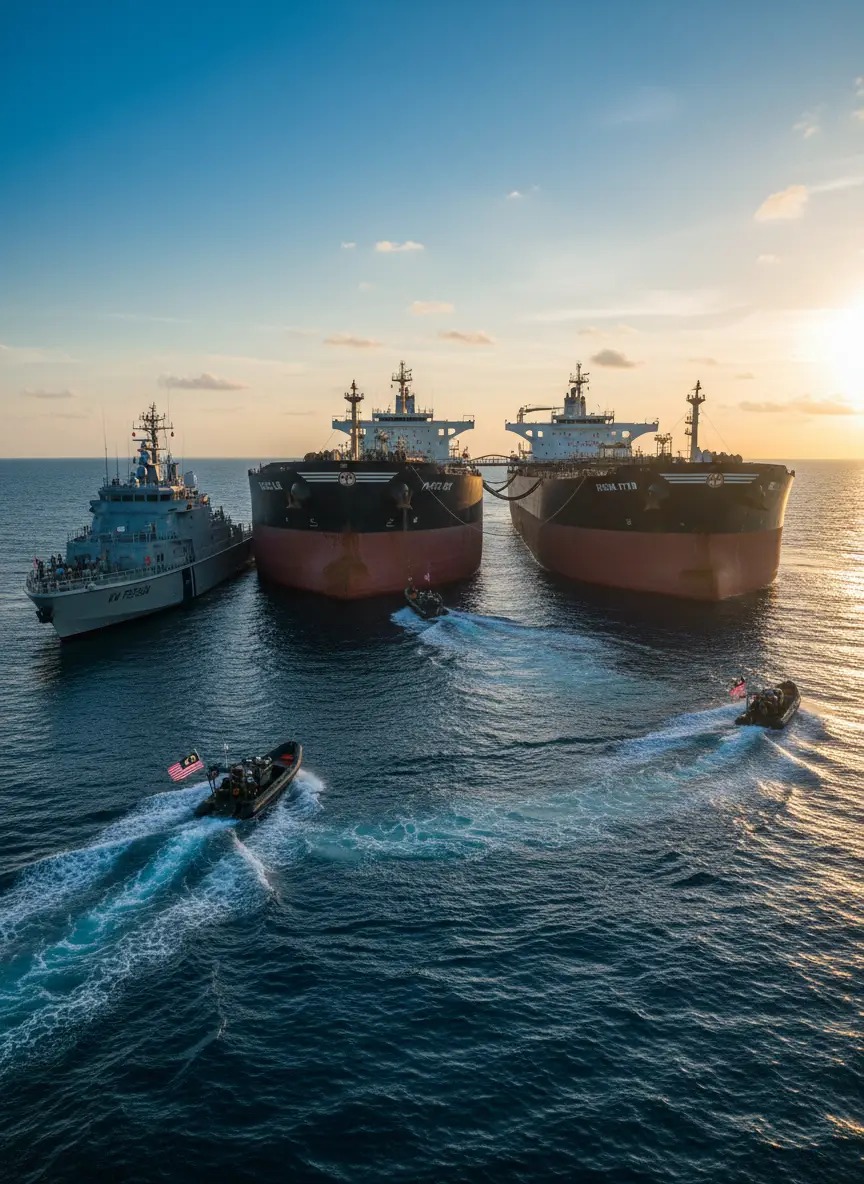
In a major maritime enforcement operation, the Malaysian Maritime Enforcement Agency (MMEA) recently intercepted and detained two tankers engaged in a massive illegal STS transfer of crude oil valued at an estimated $130 million (RM512 million). This high-stakes seizure off the coast of Penang highlights the growing challenges of policing the “shadow fleet” and the sophisticated methods used to evade global sanctions and maritime regulations.
The Penang Seizure: A $130 Million Blow to Shadow Shipping
The operation unfolded in the early hours of Thursday, January 29, 2026, when MMEA patrol units responded to a tip-off about suspicious vessel behaviour approximately 24 nautical miles west of Muka Head, Penang. Authorities discovered two large tankers—identified by independent tracking services as the Nora (flying the Guyana flag) and the Rcelebra (Cameroon-flagged)—moored side-by-side in a “coupled” position typical of ship-to-ship transfers.
Key Details of the Seizure:
- Total Cargo Value: Over RM512 million (approx. $129.9 million).
- Vessel Value: The combined worth of the two tankers is estimated at RM718 million ($182 million).
- Crew Demographics: 53 crew members were detained, representing a diverse international group from China, Myanmar, Iran, Pakistan, and India.
- Legal Violations: The vessels are under investigation for unauthorized anchorage and conducting ship-to-ship transfers without the necessary Malaysian permits.
While the MMEA did not officially disclose the origin of the oil, international observers like United Against Nuclear Iran (UANI) and TankerTrackers.com suggest the cargo is linked to sanctioned Iranian and Russian crude.
What is an Illegal STS Transfer?
A ship-to-ship (STS) transfer is the transfer of cargo—typically oil or gas—between vessels at sea. While a standard industry practice when done with proper permits and safety protocols, it becomes an illegal STS transfer when conducted without government authorization.
This practice is the primary tool for the “shadow fleet”—a network of aging tankers with opaque ownership and minimal insurance. These operators use illegal transfers to:
- Conceal Origin: Blending sanctioned oil with “clean” crude to obscure its true source.
- Evade Sanctions: Bypassing Western price caps or trade bans on Russian, Iranian, or Venezuelan petroleum.
- Avoid Taxes and Fees: Skipping port dues and regulatory oversight.
Why Malaysia is a Hotspot for Illicit Transfers
Malaysian waters, particularly the Strait of Malacca and the areas off Johor and Penang, have become global hubs for these operations. The strategic location near major shipping lanes and the proximity to China—the primary destination for much of this “Malaysian-labeled” oil—makes it an ideal transit zone.
Data indicates that the volume of such transfers off the Malaysian coast has more than doubled in recent years. In 2025 alone, Chinese refiners reportedly received over 1.3 million barrels per day of “Malaysian crude,” a figure that significantly exceeds Malaysia’s actual production capacity of roughly 660,000 bpd.
The Risks of the “Shadow Fleet”
The rise of the illegal STS transfer poses severe risks beyond financial and political sanctions:
- Environmental Catastrophes: Many shadow tankers operate without standard P&I insurance, meaning a spill during an unsupervised transfer could leave coastal nations like Malaysia with billions in cleanup costs.
- Safety Hazards: These transfers often occur with disabled AIS (Automatic Identification System) transponders—so-called “dark” operations—increasing the risk of maritime collisions.
- Legal Abandonment: Shell companies behind these vessels often abandon the tankers and their crews once legal proceedings begin to avoid further liability.
Malaysia’s Intensified Crackdown
The Penang seizure is part of a broader pledge by the Malaysian government to step up enforcement against unregulated maritime activities. In July 2025, authorities announced tighter scrutiny of STS operations, leading to more frequent patrols and intelligence-led raids.
However, the battle is far from over. Shortly after the initial detention, reports surfaced that the Nora and Rcelebra were released on bond pending trial—a move criticized by international watchdog groups as a “slap on the wrist” that may not deter well-funded shadow fleet operators.
As global energy markets remain volatile and sanctions tighten, the fight against the illegal STS transfer remains a critical front in maintaining maritime security and environmental safety in Southeast Asia.
