
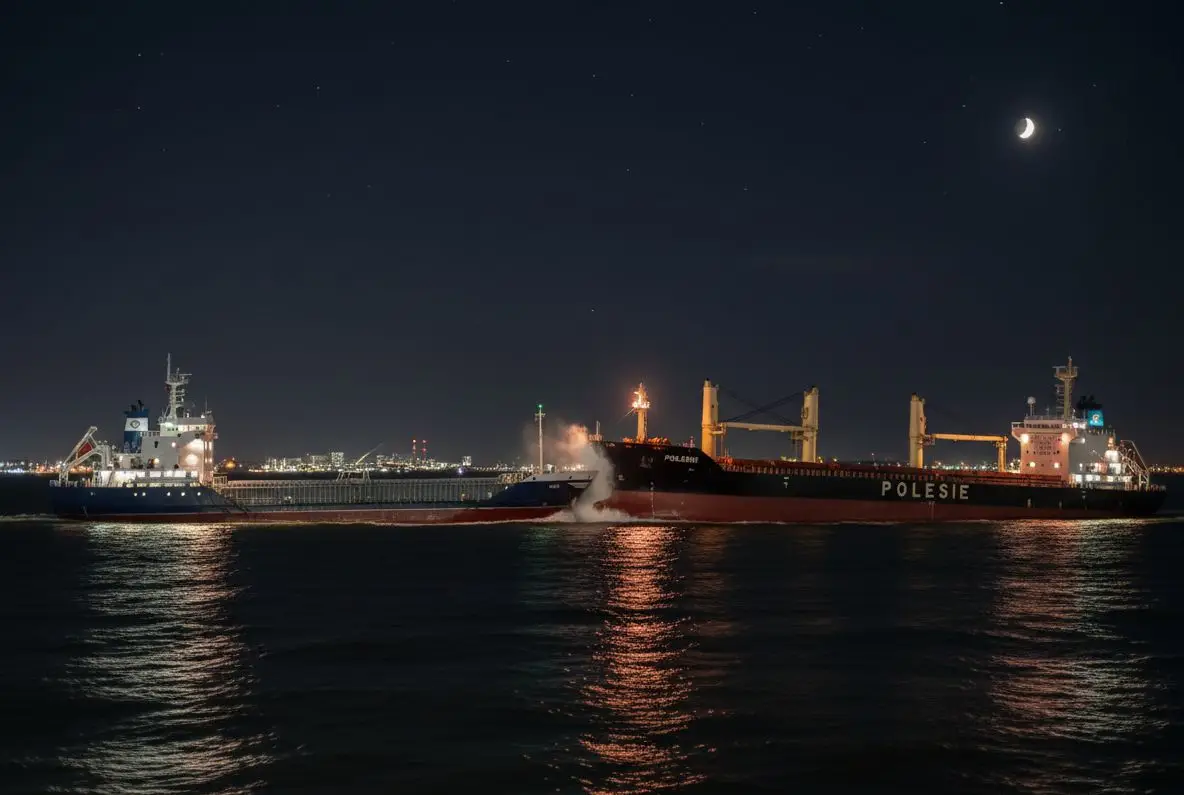
“The maritime community has finally received the final findings on one of the most devastating collisions in recent North Sea history. On 24 October 2023, the bulk carrier POLESIE and the general cargo ship VERITY collided in the German Bight, resulting in the rapid sinking of VERITY and the loss of five of its seven crew.”
Learn more about maritime incidents at maritime-hub.com/accidents page.
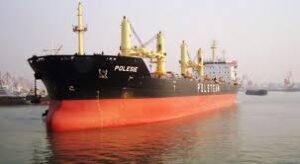
After more than two years of analysis, the UK Marine Accident Investigation Branch (MAIB) released its final set of reports in February 2026, offering a stark and unequivocal conclusion: the tragedy was entirely preventable.
This article explores the investigation’s findings, the factors that led to the disaster, the systemic failures identified, and the lessons the industry must urgently adopt to prevent similar incidents.
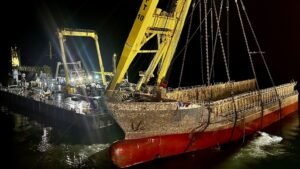
Salvage operations
A Preventable Tragedy
In its final report, the MAIB did not mince words. The fatal collision, which occurred in darkness during routine transits through the German Bight Traffic Separation Scheme, was described as “wholly avoidable”. Investigators determined that neither vessel exercised the caution, communication, or adherence to navigational rules that would have prevented the crash.
Chief Inspector of Marine Accidents, Andrew Moll OBE, said:
The tragic loss of Verity and five crew was wholly avoidable. Neither vessel applied the regulations for preventing collisions diligently, and they accepted passing close to each other when there was no need to do so. Give-way vessels must take early, substantial action that is clearly visible to others and results in passing at a safe distance.
Vessel traffic services provide vital safety information to ships using traffic separation schemes, but operators must consider whether their interventions are timely and appropriate, particularly when the outcome might be uncertain.
Finally, very high frequency radio can help clarify intentions and resolve developing situations, but only if used correctly and with caution.
Five seafarers paid the ultimate price for what the MAIB has characterised as a sequence of human failures—not mechanical breakdowns, weather events, or technological faults. This underscores a critical truth for the industry: even in an era of advanced maritime technology, fundamental human‑element errors remain one of shipping’s greatest vulnerabilities.
Unsafe Watchkeeping: The First and Most Critical Failure
The investigation’s most troubling finding was the watchkeeping behaviour on both vessels. The bridge teams failed to maintain proper situational awareness and failed to take several opportunities to prevent danger.
According to the MAIB:
- Both vessels accepted dangerously close passing distances, well below widely accepted safe parameters.
- Neither vessel initiated early or decisive collision‑avoidance manoeuvres, even as their CPA (Closest Point of Approach) continued to shrink.
- CPA alarms were not set, or if they were, they were not acted upon.
- Radar and AIS data indicating the risk were not properly used to inform action.
These behaviours constituted a systemic disregard of basic bridge resource management and watchstanding principles.
With both the give‑way and stand‑on vessels failing to meet their responsibilities under internationally recognised rules, the developing risk was allowed to escalate unchecked.
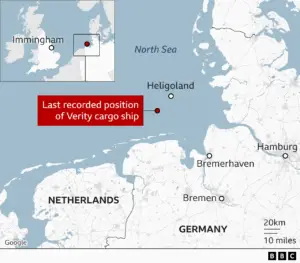
Curtesy BBC
VTS Intervention: Too Little, Too Late
The German Bight Vessel Traffic Services (VTS) attempted to intervene mere minutes before the collision. But MAIB found that the intervention came too late to meaningfully alter the vessels’ trajectories. Equally problematic, the VTS guidance did not lead to any effective avoidance action. This late-stage communication contributed to a confused response on the bridges of both ships.
VTS organizations typically play a critical safety role in congested or complex waterways. Yet the report highlights an essential boundary: VTS cannot replace proper watchkeeping or navigational decision‑making on board. Instead, it functions as a supplementary layer of safety—one that must be timely and appropriate to be effective.
Communication Breakdown: The VHF Failure
Perhaps the most frustrating element of the investigation is the finding that simple VHF communication between the vessels could have prevented the collision. The MAIB emphasised that clear radio exchanges can resolve uncertainty, verify intentions, and coordinate manoeuvres as risk increases. But in this case:
- Neither vessel used VHF early enough, despite mounting evidence of a developing close-quarters situation.
- Opportunities to clarify intentions were missed, leading to parallel misjudgments on both bridges.
This breakdown in communication—one of the most fundamental elements of collision prevention—was a key contributing factor.
COLREGS Violations: A Shared Responsibility
The International Regulations for Preventing Collisions at Sea (COLREGS) exist to ensure predictability, clarity, and mutual responsibility among vessels operating globally. Yet both POLESIE and VERITY failed to apply them appropriately.
The MAIB highlighted two critical breakdowns:
- Give‑way vessel failure: The vessel required to take early and bold action under COLREGS did not do so.
- Stand‑on vessel failure: Even the stand‑on vessel, which normally maintains course and speed, did not preserve a safe passing distance or take precautionary action when the situation deteriorated.
These failures created a situation in which both vessels were operating without reference to established, internationally recognised rules—an alarming breakdown in maritime discipline.
The Human Cost: Rapid Sinking and Structural Devastation
Investigators found that VERITY sank within just five minutes of the collision. This rapid flooding gave the crew no meaningful time to don life jackets, reach muster stations, or deploy survival craft.
The salvaged hull sections revealed:
- A large breach caused by the impact
- Severe structural damage across the starboard side
- Cargo (steel coils) that had broken through internal bulkheads and hull sections
The nature of the damage left no realistic opportunity for the crew to survive without immediate abandonment capabilities, which the speed of sinking made impossible.
Industry-Wide Recommendations: A Call for Systemic Change
The MAIB issued a series of recommendations following the final report, targeting the shipping companies involved, regulatory bodies, and maritime authorities.
1. For Shipping Companies
- Improve adherence to COLREGS across fleets
- Strengthen watchkeeping standards
- Reinforce bridge resource management training
- Ensure CPA alarms and navigational tools are properly used
2. For German Waterways Authorities
- Review VHF radio channel usage
- Update VTS communication protocols
- Ensure VTS actions are timely, coordinated, and effective
3. For the Isle of Man Ship Registry
- Propose expanded Voyage Data Recorder (VDR) requirements at the IMO, improving transparency and safety insights for future investigations
These recommendations reflect an urgent need for the maritime sector to address human‑element failures with the same rigour applied to technical safety.
Lessons for the Maritime Community
The MAIB’s final report reinforces an uncomfortable reality: human factors remain the most persistent and dangerous source of risk at sea. Despite sophisticated navigation systems, automated alarms, and robust international rules, tragedies can still unfold when situational awareness and communication break down.
This case is a reminder that:
- The COLREGS are foundational—not optional
- Effective VHF communication can save lives
- VTS support is not a replacement for active bridge management
- Continuous training and oversight are essential
- Safety culture is built through discipline, not technology alone
Conclusion: An Avoidable Chain of Errors
The collision between POLESIE and VERITY was not an act of fate. It was a chain of preventable failures—human judgment errors, communication lapses, and missed opportunities to break the sequence of events before it reached catastrophe.
As MAIB pointed out, better decision‑making, consistent communication, and adherence to COLREGS would almost certainly have prevented the loss of life. The maritime industry must now absorb these lessons and ensure they translate into action on every bridge, in every traffic separation scheme, and across every fleet.
This report is more than an account of what happened. It is a call to elevate vigilance, professionalism, and accountability at sea—so that tragedies like the POLESIE–VERITY collision never occur again.