

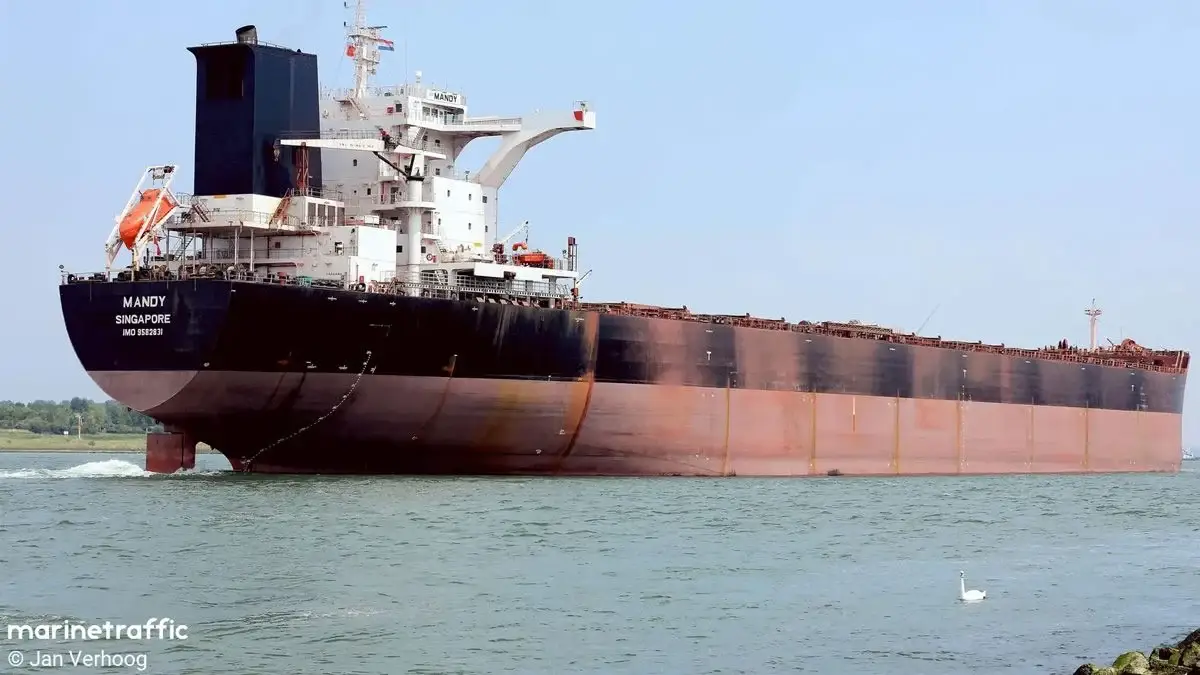
Photo: MarineTraffic
Another accident (engine room fire) on a vessel with a serious PSC history and deficiencies highlights that high charter rates should not compromise crew safety. All ships need to have periods of downtime for maintenance and repairs.
A tragic accident aboard the Singapore‑flagged bulk carrier MANDY has claimed the lives of two seafarers and left another injured after a sudden engine room fire broke out off the coast of China on 17 February 2026. According to multiple maritime authorities and news outlets, the fire commenced at approximately 7:35 p.m. Singapore time, while the vessel was sailing toward Yantai Port in China.
The Maritime and Port Authority of Singapore (MPA) confirmed that 25 Myanmar nationals were on board at the time of the incident and that no Singaporean personnel were present. The fire was eventually extinguished by the crew, but not before it resulted in the deaths of two crew members and injuries to a third, who was medically evacuated to a shore‑based hospital for treatment.
The Incident: A Deadly Engine Room Fire
Initial reports indicate that the blaze originated within the vessel’s engine room—a location that maritime safety experts frequently describe as among the most dangerous spaces onboard due to the presence of flammable fluids, high‑temperature machinery, and limited escape routes. According to MPA statements, the fire was brought under control through onboard firefighting measures and later fully extinguished.
The MANDY, a 2010‑built bulk carrier operated by Pacific Rim International Shipping, was en route from Singapore to Yantai when the fire broke out. The ship was nearing the end of its voyage, and arrangements were immediately made to tow the vessel to Yantai Port following the incident.
Authorities reported no pollution in the surrounding waters, an important consideration given that engine room fires can sometimes trigger secondary fuel leaks or other hazardous releases.
Casualties and Medical Evacuation
Tragically, two Myanmar crew members were discovered in the engine room without signs of life. Both were later pronounced dead. A third injured crewmember required emergency evacuation to a medical facility ashore in China. As of the latest updates, no additional details on the injured sailor’s condition have been released.
The MPA has expressed condolences to the families of the deceased and confirmed it is working with the vessel’s operator and Chinese authorities to coordinate further assistance.
A Vessel With a Recent Safety History
An important contextual detail highlighted in Seatrade Maritime’s reporting is MANDY’s safety record. During a June 2025 port state control inspection in Rotterdam, the vessel was detained for 15 days after inspectors identified 25 deficiencies, including nine grounds for detention. Of particular concern were seven deficiencies in the fire safety category, ranging from inoperative firefighting equipment to issues with machinery space fire‑control systems.
Deficiencies included failures in:
- Ready availability of firefighting equipment
- Fire pump and fire damper functionality
- Crew performance in fire safety drills
These findings raise questions about whether previous issues may have contributed to the severity of the 2026 incident and whether corrective actions were adequately implemented.
International Response and Ongoing Investigation
Following the fire, Chinese authorities reportedly dispatched professional rescue vessels, a helicopter, and merchant ships in the area to assist the crew. Chinese responders retrieved the injured and assisted with initial containment efforts.
The MPA has launched an investigation to determine the root cause, examining:
- Technical failures within machinery spaces
- Crew training and emergency response actions
- Maintenance records
- Possible human factor contributions
Engine room fires are notoriously difficult to diagnose because they can stem from numerous sources—fuel leaks, electrical faults, lubrication system failures, exhaust manifold issues, or even human error.
Other Recent Maritime Fires Highlight Systemic Risk
The accident aboard the MANDY occurred amid a string of engine room fires reported globally in early 2026. The Week noted that just days earlier, the Dutch‑flagged Diezeborg experienced an engine room fire that incapacitated the vessel, requiring intervention from the Swedish Coast Guard to prevent grounding.
Although the Diezeborg incident caused no fatalities, the proximity of the two events underscores how vulnerable modern ships remain to machinery space fires—even as safety technologies advance.
Possible Causes: Understanding Engine Room Fire Triggers
While the investigation is ongoing, maritime safety patterns lend insight into what commonly causes such fires. According to industry analyses and prior incident reports:
1. Fuel & Lubrication Leaks
Pressurized fuel systems or hydraulic lines can leak onto hot surfaces, causing immediate ignition.
2. Electrical Faults
Overloaded circuits or short‑circuits in confined machinery spaces can trigger rapid fires.
3. Human Factors
Improper maintenance, fatigue, or bypassed safety protocols remain major contributors.
4. Poorly Maintained Fire Systems
Given the MANDY’s previously documented deficiencies, it remains a critical area of investigation.
Because the MANDY had several fire‑related deficiencies in 2025, investigators will likely scrutinize whether all repairs were verified and whether firefighting readiness met international standards.
Repatriation and Support for Crew Families
With the deceased crew members being Myanmar nationals, coordination now involves:
- The ship operator
- Singapore’s MPA
- Myanmar’s consular representatives
- Local authorities in Yantai
Such multinational coordination is typical in the maritime sector, where crew often come from multiple countries and accidents occur in international waters or foreign jurisdictions.
MPA stated it is “in contact with the company and relevant Chinese authorities” to ensure that all necessary assistance is provided.
Toward Yantai Port: Assessing Damage
The vessel, reported stable after the fire, is being transported to Yantai Port, where technical teams will:
- Inspect structural and mechanical damage
- Verify cargo status
- Monitor pollution risk
- Determine if the ship can be repaired or requires dry‑dock intervention
Initial reports indicate no hull damage and no cargo involvement, according to preliminary technical statements.
Conclusion: A Stark Reminder of Maritime Realities
The loss of life aboard the Singapore‑flagged MANDY highlights once again the inherent risks that merchant seafarers face daily. Despite advances in automation, safety technology, and regulatory oversight, the maritime industry continues to battle engine room fires—one of the most catastrophic onboard emergencies.
As investigations progress, the incident will likely contribute to broader industry discussions about:
- Fire safety compliance
- Crew training standards
- Machinery space design
- Enforcement of port state control findings
For now, the global maritime community mourns the loss of two crewmembers whose lives were cut short while maintaining the flow of international trade—an essential but often dangerous responsibility carried out far from public view.