

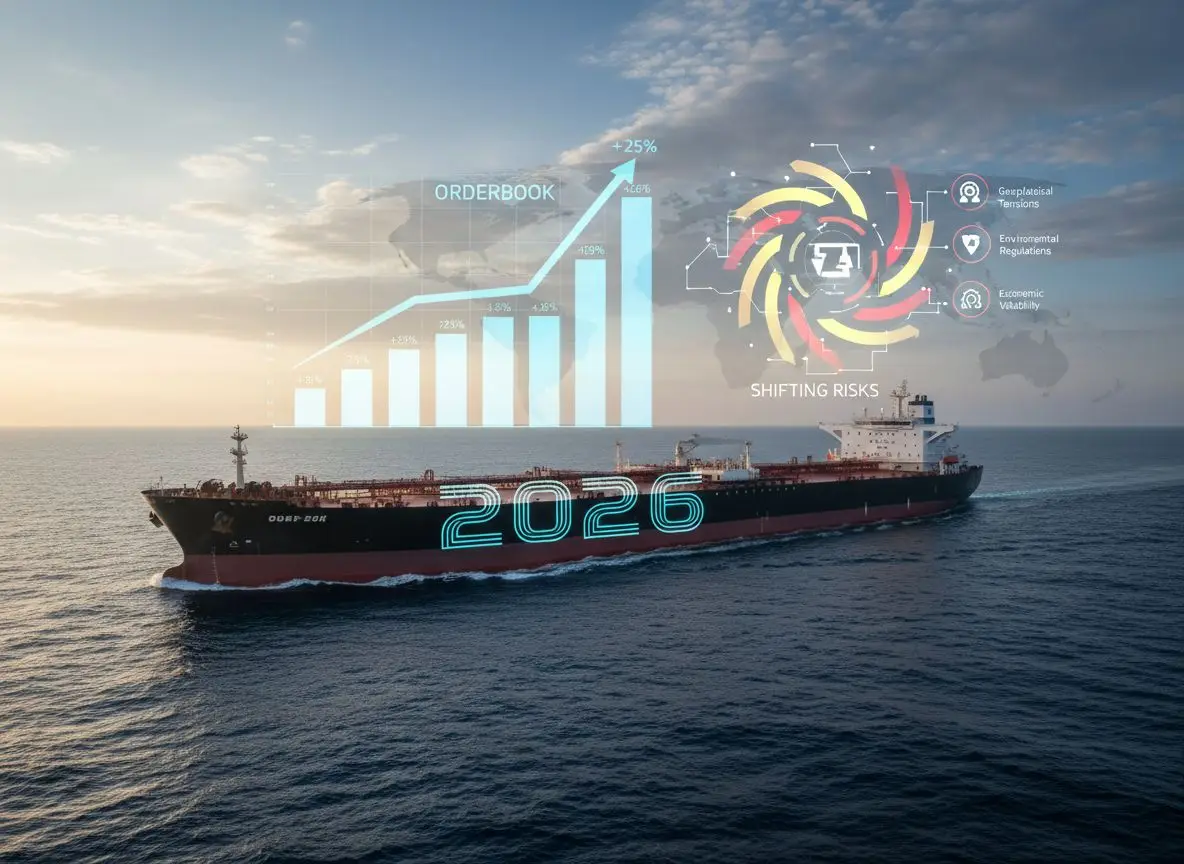
The global tanker market has sailed into 2026 on a remarkably strong footing, yet the horizon is becoming increasingly crowded. According to recent analysis from DNV, the sector is currently navigating a “bullish but complex” environment. While freight rates for Very Large Crude Carriers (VLCCs) soared past $100,000 per day in late 2025, a surge in newbuild orders and persistent geopolitical volatility are introducing fresh variables into the market equation.
The Newbuild Surge: Addressing an Aging Fleet
A defining feature of the current landscape is the significant uptick in the tanker orderbook. After years of historically low order activity, shipping companies are finally moving forward with fleet renewal. This shift is driven by a critical necessity: the global tanker fleet is ageing rapidly.
DNV data reveals that approximately 30% of the VLCC fleet is now over 15 years old. With Classification Societies and cargo owners increasingly prioritizing younger, more energy-efficient vessels to meet ESG targets, the pressure to modernize has reached a tipping point.
Tanker Orderbook Snapshot (2025-2026)
| Segment | Orderbook Status (Est. % of Fleet) | Primary Market Driver |
| VLCC | 17% | Fleet aging & US-to-Asia long-haul demand |
| Suezmax | Moderate Growth | Strategic repositioning & Petrobras shuttle expansion |
| MR Tankers | ~7.2% | Lowest in recent history; supply remains tight |
| Product Tankers | High (LR1/LR2) | Increased refinery capacity in China & Middle East |
Market Risks: Geopolitics and “Tonne-Mile” Dynamics
While the orderbook is growing, DNV highlights several market risks that could dampen future earnings. The “exuberance” of 2025 was largely built on geopolitical disruptions rather than organic oil demand growth.
-
Sanction Redirection: The ongoing redirection of Russian crude and refined products has permanently altered trade flows, creating longer voyages that inflate tonne-mile demand.
-
The Shadow Fleet: A growing “grey” or “shadow” fleet continues to operate outside mainstream regulatory frameworks, complicating compliance and safety standards across the industry.
-
Delivery Concentration: While only a handful of VLCCs were delivered in 2025, the market is bracing for a “delivery-heavy” 2026 and 2027, which could lead to oversupply if demand growth (currently forecast at just 0.9% for crude) fails to keep pace.
“Complexity is the new baseline for our industry. Organizations that succeed will be those that recognize regulatory compliance, commercial performance, and safety as interconnected levers.” — Knut Ørbeck-Nilssen, CEO Maritime at DNV.
Decarbonization and Alternative Fuels
Despite the rush to order new ships, the tanker segment has been slower than the container sector to adopt sustainable practices for green shipping. However, DNV notes that efficiency is now the primary decarbonization lever.
Investments are shifting toward “future-ready” assets. Dual-fuel capabilities—particularly LNG and increasingly Methanol—are becoming standard for new orders in Shipyards across Asia. The goal is to avoid “stranded assets” as regional measures like the UK and EU Emissions Trading Schemes (ETS) tighten their grip on maritime carbon costs.
Sources
-
DNV Maritime Impact: Tanker Market Outlook 2026
