

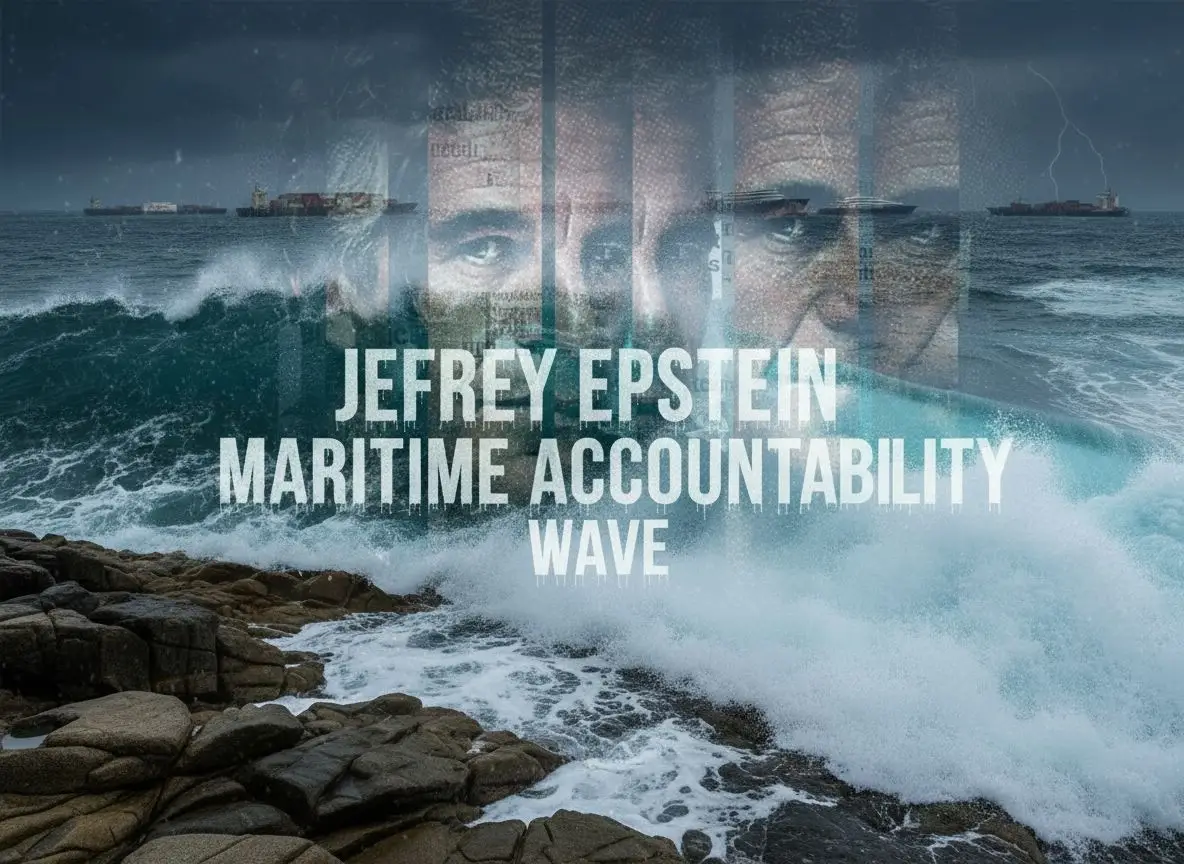
The maritime industry has historically operated in a world of discreet handshakes, private clubs, and high-level networking often shielded from the public eye. However, the early 2026 unsealing of the “Epstein Files”—millions of pages of Department of Justice (DOJ) records, personal correspondence, and flight logs—has acted as a Category 5 storm surge. For maritime professionals whose names appear in these documents, the impact has been more than just a reputational bruise; it has triggered a systemic overhaul of leadership and corporate governance across the global supply chain.
The Leadership Purge: The DP World Case Study
The most significant tremor hit on February 13, 2026, when DP World, the Dubai-based logistics giant responsible for approximately 10% of global container traffic, announced the immediate resignation of its long-standing Chairman and CEO, Sultan Ahmed bin Sulayem.
The resignation followed a week of intense pressure from international partners after DOJ disclosures revealed the depth of bin Sulayem’s relationship with Jeffrey Epstein. While no criminal charges were filed against bin Sulayem, the contents of the files—including over 4,700 mentions of his name—made his position untenable.+1
The Breakdown of Revelation and Reaction
The fallout was driven by two main factors: the nature of the correspondence and the swift response of institutional capital.
- The Content: Emails and text messages dating back to the early 2000s and continuing long after Epstein’s 2008 conviction showed a relationship of “business and pleasure.” Correspondence included discussions about “business opportunities” alongside highly graphic descriptions of sexual encounters. One 2013 message from bin Sulayem’s account reportedly boasted about “fresh 100% female Russians” on his yacht.+2
- The Capital Strike: On February 10 and 11, 2026, two of DP World’s primary financial partners—Canada’s La Caisse de dépôt et placement du Québec (CDPQ) and the UK government’s British International Investment (BII)—suspended all future investments. This “capital freeze” threatened multibillion-dollar projects, including the Port of Montreal expansion and major infrastructure projects in Africa.
Table 1: DP World Leadership Transition (February 2026)
| Position | Outgoing | Incoming | Background of Successor |
| Group Chairman | Sultan Ahmed bin Sulayem | Essa Kazim | Governor of Dubai International Financial Centre (DIFC) |
| Group CEO | Sultan Ahmed bin Sulayem | Yuvraj Narayan | Former DP World CFO/Deputy CEO (since 2004) |
| PCFC Chairman | Sultan Ahmed bin Sulayem | New Appointee | Oversees Dubai Ports, Customs, and Free Zones |
Systemic Shift: From “E” to “S” and “G”
For the last decade, the maritime industry has focused its ESG (Environmental, Social, and Governance) efforts almost entirely on the “E”—decarbonization, $SO_x$ scrubbers, and fuel transitions. The Epstein files have forced a pivot toward the often-neglected “S” and “G”.
The “Governance” Reckoning
The “G” in ESG is no longer just about financial reporting; it is now about individual accountability. Boards of directors are moving away from the “Imperial CEO” model—where a single figurehead holds absolute power—toward more transparent, multi-layered leadership structures.
The Rise of “Reverse Morals Clauses”
Maritime law firms are reporting a surge in the inclusion of “Reverse Morals Clauses” in ship financing and chartering agreements. Traditionally, these allowed a company to fire a celebrity spokesperson for scandalous behaviour. Now, they are being drafted into B2B contracts, allowing:
- Lenders to recall loans if a shipowner’s past associations (even non-criminal) create a “material reputational risk.”
- Charterers to terminate long-term contracts if the vessel owner is named in future document leaks related to human trafficking or sexual misconduct.
Impact on the Superyacht and Private Maritime Sector
The superyacht industry, often seen as the epicentre of elite maritime networking, has faced its own “housekeeping year” in 2026. The association of vessels like the Lady Ghislaine with the Epstein-Maxwell circle has tarnished the sector’s image, leading to a new “Normal” for management.
Due Diligence 2.0: KYC vs. KYA
Standard KYC (Know Your Customer) protocols, which traditionally focused on Anti-Money Laundering (AML), have evolved into KYA (Know Your Associations).
- Data Pipelines: Management firms and refit yards are now utilizing AI-driven digital forensics to audit historical guest manifests and flight logs before signing high-value contracts.
- Regulatory Friction: In July 2024, the EU’s new AML package established a €10,000 cash ceiling for luxury goods, but in 2026, the real barrier is “thin files.” Any owner with an opaque social or financial background is finding it increasingly difficult to secure insurance or flag-state registration.
Maritime Professionals: Career Trajectories and the “Named” List
For the maritime professionals mentioned in the files—ranging from shipowners to port financiers—the impact follows a distinct pattern of “Survive or Exit.”
Table 2: Impact Levels for Professionals in the Files
| Severity Level | Impact on Professional | Industry Response |
| Direct Involvement | Resignation, Legal Action, Assets Frozen | Complete industry de-platforming. |
| Frequent Socializing | Board removals, mandatory “integrity audits” | Relegation to private/non-listed entities. |
| Incidental Mentions | Increased scrutiny, background re-vetting | Public distancing and “statement of values” required. |
“Presence in the files does not constitute evidence of criminal conduct, but in the modern maritime industry, it acts as a ‘Reputational Red Flag’ that triggers automated compliance protocols.” — Industry Compliance Report, 2026.
Conclusion: Navigating Toward Transparency
The fallout from the Epstein files has demonstrated that the maritime industry’s greatest asset is no longer its fleet but its integrity. The 2026 leadership changes at DP World and the widespread adoption of more stringent governance protocols suggest that the “Age of Discretion” is ending, replaced by an “Age of Radical Transparency.”
For maritime professionals, the message is clear: the digital and legal wakes left by personal associations can and will eventually catch up to the bridge of the ship.
Sources
- The Guardian: “Boss of P&O Ferries owner DP World leaves over Jeffrey Epstein links” (Feb 13, 2026).
- Maritime Executive: “Leadership Shift at DP World Following Disclosure Pressure” (2026).
- Lloyd’s List: “The ‘S’ in ESG: Why Personal Conduct is Now a Commercial Risk” (Feb 2026).
- CBS News: “CEO of Dubai’s largest port replaced after ties to Epstein revealed” (Feb 13, 2026).
- Foley & Lardner LLP: “Epstein Files Highlight Reputational and Legal Risks of Problematic Benefactors” (Feb 12, 2026).
