

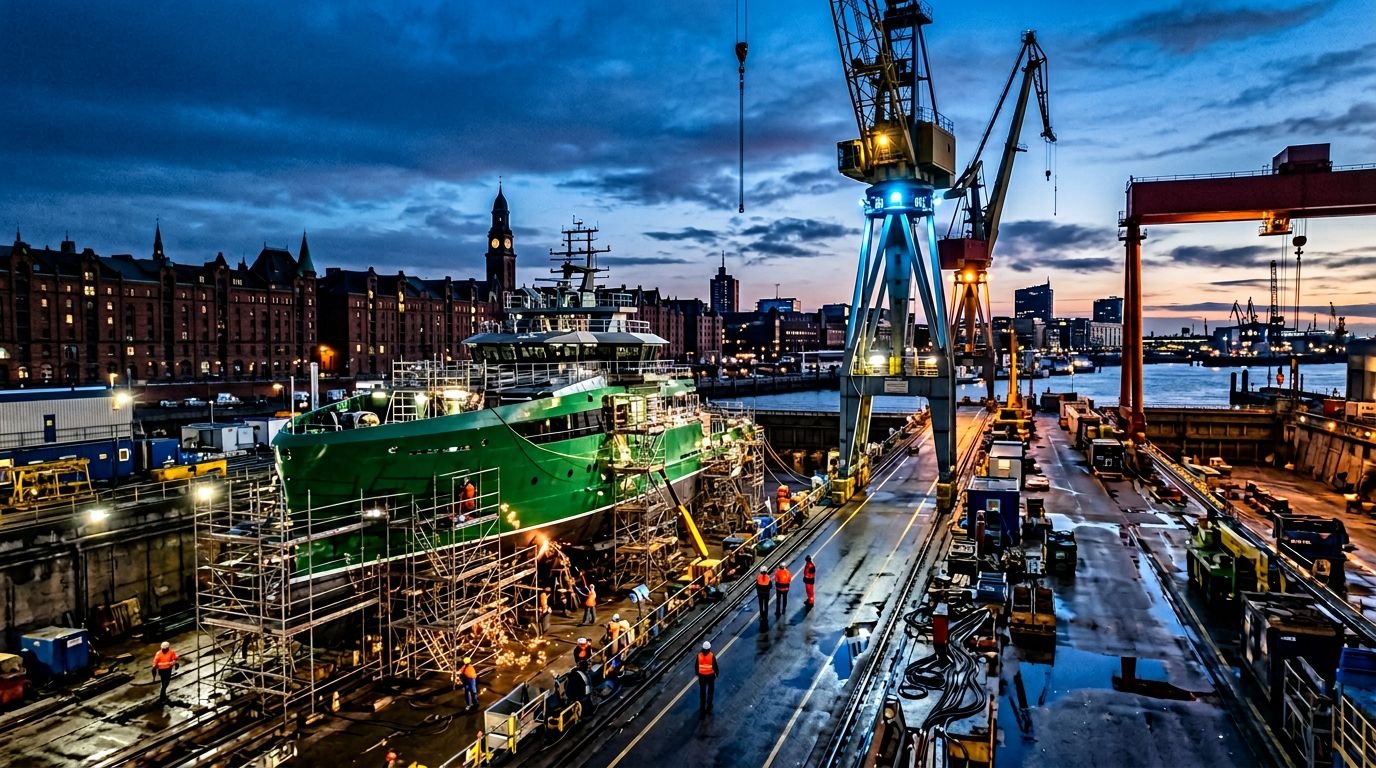
European shipbuilding is entering a decisive moment. While the industry is rooted in centuries of innovation and skilled craftsmanship, today it faces intense global competition, rising environmental demands, and rapid technological change. From historic shipyards that once powered global exploration to modern facilities building green and high‑tech vessels, Europe’s shipbuilding sector is being reshaped, and the decisions made now may define its future for decades.
This article explores how European shipbuilding evolved, where the industry stands today, and what lies ahead as shipyards adapt to sustainability goals, digitalisation, and shifting global markets.
Size and Economic Importance of European Shipbuilding
- The EU shipbuilding and repair sector generated €70.7 billion in turnover in 2022, representing a 5% increase year‑on‑year. Gross value added (GVA) reached €19.9 billion, up 7% compared with 2021. [op.europa.eu]
- In 2022, the sector directly employed approximately 316,000 people across the European Union, with an average annual wage of €46,400, reflecting the industry’s high‑skill nature.
- Estimates for 2023 indicate further growth of 8–10% in turnover and GVA, alongside continued increases in employment and wages.
History of European Shipbuilding
Europe’s Early Maritime Leadership
European shipbuilding has a long and distinguished history, recognised for innovation and craftsmanship. From ancient times, European nations led naval exploration, maritime trade, and maritime warfare. Over centuries, shipyards adapted to political change, economic pressures, and technological progress, allowing countries such as the United Kingdom, Germany, Italy, and France to establish strong maritime industries.
The Age of Exploration and the Rise of European Shipyards
During the 15th and 16th centuries, European shipbuilders played a vital role in enabling global exploration, the creation of new trade routes, and colonial expansion. Major shipbuilding centres such as Venice, Genoa, and Amsterdam became hubs of maritime innovation, producing warships, galleons, merchant vessels, and fishing boats.
How the Industrial Revolution Changed Shipbuilding
The Industrial Revolution of the 18th and 19th centuries transformed European shipbuilding through steam propulsion, iron and steel hulls, and mechanised production. These advances allowed shipyards to build larger, faster, and more efficient vessels, reinforcing Europe’s dominance in global trade and naval power.
European Shipbuilding in the 20th Century
The 20th century brought major changes driven by global conflicts, economic pressures, and evolving market demands. After World War II, European shipyards were rebuilt using prefabrication and modular construction techniques. Over time, the industry became increasingly specialised, focusing on container ships, cruise vessels, passenger liners, and naval ships.
European Shipbuilding Today
Europe is home to around 150 major shipyards involved in civilian and naval ship construction, repair, and the construction of offshore platforms. [op.europa.eu]When including smaller yards and the wider supply chain, Europe hosts approximately 300 shipyards and over 28,000 marine equipment manufacturers and technology providers. In 2023, around 1 in every 11 ships built worldwide was constructed in an EU shipyard, according to the European Maritime Safety Agency. While Europe holds a relatively small global market share by volume, it is the global leader in complex and high‑value vessels, including cruise ships, ferries, dredgers, naval ships, and mega‑yachts.
Dominance in Cruise Shipbuilding (Europe’s Strongest Segment)
- 97% of the world’s cruise ship fleet has been built in European shipyards, rising to 98% when measured by order value. [europe.cruising.org]
- Between 2024 and 2036, cruise lines are expected to invest €57 billion in new cruise ships built in Europe.
- Cruise ships account for approximately 80% of the total commercial ship order book value for European shipyards, making this segment strategically critical for the industry.
- Italy, Germany, France, and Finland dominate cruise ship construction, with Italy alone expected to build over half of all new cruise ships on order.
EU Fleet and Vessel Specialisation
As of Q2 2024, the EU‑flagged fleet represented approximately 14% of global gross tonnage and 13% of global deadweight tonnage, amounting to 236.3 million GT and 298.8 million tonnes, respectively. [op.europa.eu]
The EU fleet accounts for:
-
- 27% of the global Ro‑Pax passenger fleet
- 23% of global passenger vessels
- More than 18% of the global container ship fleet
European Shipbuilding at a Glance
- €70.7 billion annual turnover (2022)
- ~316,000 direct jobs in the EU
- ~150 major EU shipyards
- 97% of global cruise ships are built in Europe
- €57 billion cruise ship investment pipeline (2024–2036)
- Global leader in complex and high‑value vessels
Sources: European Commission, EMSA, CLIA Europe, SEA Europe
Innovation, Technology, and Sustainability
Modern European shipbuilding is defined by advanced engineering, sustainability, and digitalisation. Shipyards in Germany, Finland, Spain, and the Netherlands are leaders in constructing high‑tech vessels, offshore platforms, and maritime equipment that meet strict safety and environmental standards. Investment in research and development, automation, and clean technologies has become central to maintaining global competitiveness.

Current Challenges Facing European Shipbuilding
Competition from Asian Shipyards
European shipbuilders face strong competition from Asian shipyards, particularly in South Korea, China, and Japan. These competitors benefit from large‑scale production capacity and lower costs, placing pressure on European shipyards, especially in high‑volume market segments. Pricing pressure, overcapacity, and geopolitical uncertainty continue to affect profitability and market share.
Technological Development and Digital Shipbuilding
Despite competitive pressures, European shipyards remain leaders in automation, digital ship design, and advanced manufacturing. Digital tools improve efficiency, reduce construction time, and enhance vessel performance, helping European builders remain competitive in complex and high‑value projects.
Specialisation and High‑Value Niche Markets
European shipbuilders increasingly focus on specialised markets such as luxury yachts, cruise ships, naval vessels, and offshore wind infrastructure. These high‑value segments reward technical expertise, innovation, and quality rather than mass production, allowing European shipyards to differentiate themselves globally.
Sustainability and Green Shipbuilding
Environmental regulation and climate goals have made sustainability a core priority. European shipyards are adopting LNG propulsion, emission‑reduction systems, and energy‑efficient ship designs. As a result, Europe is widely recognised as a leader in green and environmentally responsible shipbuilding.
Collaboration Across the Maritime Ecosystem
Collaboration between shipbuilders, research institutions, and government bodies plays a key role in innovation and long‑term resilience. Shared research initiatives and public‑private partnerships help the industry address technological challenges and meet environmental targets.
Major European Shipyards Shaping the Industry
Some of the most prominent shipyards operating in Europe today include:
Fincantieri (Italy), one of Europe’s largest shipbuilding groups, specialising in cruise ships, naval vessels, and offshore units.
Meyer Werft (Germany), renowned for luxury cruise ships and technologically advanced vessels.
Navantia (Spain), a leading shipbuilder focused on naval ships, submarines, and offshore platforms.
Damen Shipyards Group (Netherlands) produces a wide range of vessels, including naval ships, offshore support vessels, and yachts.
STX France (France), known for cruise ships, ferries, and naval vessels.
Lürssen (Germany), a high‑end builder of luxury yachts and naval ships.
BAE Systems Maritime – Naval Ships (United Kingdom), specialising in naval vessels and maritime defence systems.
Blohm+Voss (Germany), with a long history of constructing naval ships, commercial vessels, and luxury yachts.
Uljanik Shipyard (Croatia), producing bulk carriers, tankers, and other commercial vessels.
Damen Shipyards Galati (Romania), part of the Damen Group, building offshore support ships and naval craft.
Together, these shipyards demonstrate the technical depth, diversity, and global importance of European shipbuilding.
The Future of European Shipbuilding
European shipbuilding faces a challenging but opportunity‑rich future as global markets evolve and technology advances.
Technological Innovation and Automation
Digital shipyards, automation, and advanced engineering will shape the next generation of European shipbuilding, improving efficiency and vessel performance.
Sustainability as a Competitive Advantage
Clean propulsion systems, low‑emission vessels, and energy‑efficient designs will increasingly determine competitiveness as environmental regulation tightens worldwide.
New Markets and Emerging Opportunities
Emerging sectors such as offshore wind energy, autonomous vessels, and maritime data services offer new growth opportunities for European shipyards.
Competing in a Global Market
To remain competitive, European shipyards must continue focusing on innovation, specialisation, and operational efficiency rather than competing on volume alone.
Collaboration and Long‑Term Resilience
Strong collaboration between industry, research institutions, and governments will be essential to ensure sustainable growth and long‑term resilience.
By embracing innovation, sustainability, and cooperation, European shipbuilders are well-positioned to navigate global challenges and continue shaping the future of maritime transport.
