

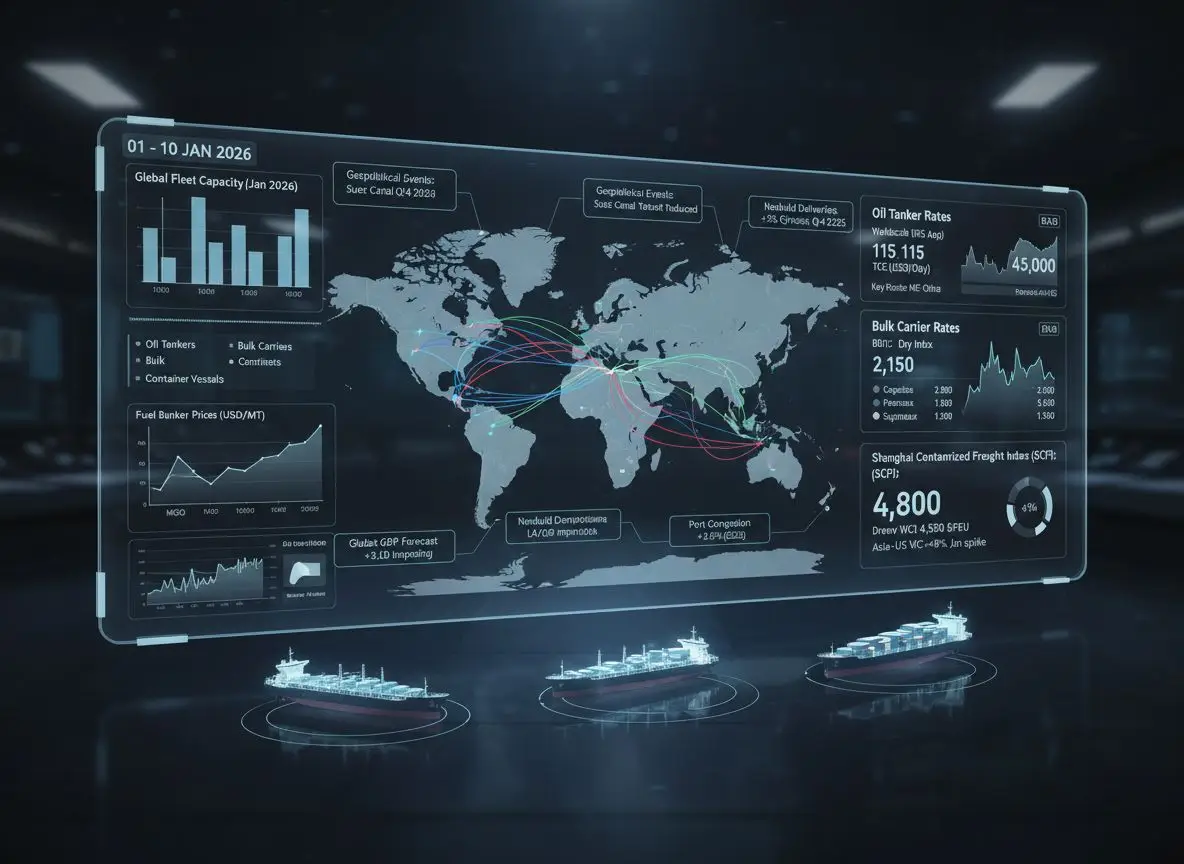
Global freight markets entered 2026 with mixed momentum. The first ten days of January saw tanker earnings ease from late‑December firmness, dry bulk selectively supported by Capesize demand, and container freight rates continue their post‑holiday correction. This article reviews freight rates performance across oil tankers, bulk carriers, and container vessels between 1 and 10 January 2026, presenting clear data tables and market context suitable for professional shipping and logistics audiences.
Oil Tankers: Softer Start to 2026 but Earnings Remain Healthy
The tanker market began 2026 on a more balanced footing following strong Q4 2025 earnings. A gradual return of available tonnage, combined with seasonal moderation in cargo programs, led to softer spot rates, particularly in crude tankers. Nevertheless, earnings remained well above long‑term averages.
Tanker Freight Rates (USD/day, indicative TCE)
| Segment | Typical Trades | 1–10 Jan 2026 Avg (USD/day) | Trend |
|---|---|---|---|
| VLCC | MEG–China | $38,000 – $44,000 | ▼ |
| Suezmax | WAF–Europe / US | $34,000 – $39,000 | ▼ |
| Aframax | Med / UK‑Cont | $28,000 – $32,000 | ↔ |
| LR2 (Clean) | MEG–Japan | $30,000 – $35,000 | ▼ |
| MR (Clean) | Atlantic Basin | $20,000 – $24,000 | ↔ |
Market Drivers (1–10 January 2026)
- Crude tankers: Increased VLCC availability in Asia pressured rates, though long‑haul economics capped the downside.
- Clean products: MR activity in the Atlantic remained relatively stable on winter gasoline demand, offsetting weakness in the East.
- Bunkers: Fuel prices stabilized early in January, helping preserve net TCE returns.
Outlook: A typically softer January market is expected to persist, with upside dependent on stronger Asian crude exports or weather‑related disruptions.
Dry Bulk Market: Capesize Support Carries Early‑Year Sentiment
Dry bulk freight rates showed selective resilience in the first ten days of 2026. Capesizes benefited from iron‑ore activity, while Panamax and Supramax segments experienced steadier, range‑bound trading.
Dry Bulk Freight Rates (USD/day, TCE)
| Segment | Main Cargoes | 1–10 Jan 2026 Avg (USD/day) | Trend |
|---|---|---|---|
| Capesize | Iron ore / coal | $17,000 – $20,000 | ▲ |
| Panamax | Coal / grains | $12,000 – $14,000 | ↔ |
| Supramax | Minor bulks | $10,000 – $11,500 | ↔ |
| Handysize | Regional trades | $8,500 – $10,000 | ▼ |
Market Drivers
- Capesize: Strong Pacific cargo flows tightened prompt supply and underpinned rates.
- Panamax/Supramax: Seasonal grain movements provided baseline demand but lacked momentum.
- FFA sentiment: Forward markets suggested cautious optimism but no aggressive upside.
Outlook: Dry bulk markets are expected to remain technically supported, with Capesize volatility likely leading broader sentiment through Q1.
Container Shipping: Spot Rates Continue to Adjust Post‑Peak
Container freight markets extended their post‑holiday correction as cargo demand normalised following year‑end shipments. While carriers implemented capacity management strategies, spot rates remained under pressure.
Container Spot Freight Rates (USD/FEU)
| Trade Lane | 1–10 Jan 2026 Avg (USD/FEU) | Trend |
|---|---|---|
| Asia → North Europe | $2,200 – $2,400 | ▼ |
| Asia → Mediterranean | $2,600 – $2,900 | ▼ |
| Asia → US West Coast | $1,900 – $2,100 | ▼ |
| Asia → US East Coast | $2,500 – $2,700 | ▼ |
| Transatlantic | $1,500 – $1,700 | ↔ |
Market Drivers
- Demand: Seasonal demand drops after the holiday cargo rush.
- Supply: Continued use of blank sailings limited sharper rate falls.
- Contracts: Long‑term contract rates remained significantly higher than spot levels.
Outlook: Further near‑term softness is expected, with a potential floor emerging ahead of Lunar New Year demand and pre‑spring restocking.
Cross‑Sector Summary (1–10 January 2026)
| Segment | Market Tone | Key Theme |
|---|---|---|
| Oil Tankers | Stable to softer | Post‑Q4 normalization |
| Dry Bulk | Selective strength | Capesize‑led support |
| Containers | Weakening | Post‑holiday correction |
Geopolitical Risk Spotlight: Venezuela and Tanker Freight Volatility
Venezuela remains one of the most freight‑sensitive geopolitical variables in the tanker market, despite accounting for a relatively small share of global crude supply. Political instability, changing sanctions regimes, and operational constraints mean that even modest shifts in Venezuelan exports can trigger disproportionate reactions in tanker freight rates, particularly in the VLCC, Suezmax, and Aframax segments.
Sanctions and Compliance Constraints Distort Tonnage Supply
US and international sanctions on Venezuela do not simply restrict oil volumes; they segment the tanker fleet. Only a limited pool of vessels is willing or able to lift Venezuelan cargoes due to:
- Compliance risks
- Insurance and financing barriers
- Future trading restrictions after calling at Venezuelan ports
This reduces effective fleet availability in mainstream Atlantic and Mediterranean markets, tightening supply elsewhere. When sanctions enforcement intensifies, freight rates tend to rise as compliant tonnage becomes scarcer. Conversely, temporary license expansions or waivers can release pent‑up export demand, injecting short‑term volatility into tanker earnings.
Long‑Haul Crude Exports Boost VLCC Tonne‑Mile Demand
When Venezuelan crude exports increase, cargoes are typically directed to Asia—particularly China and India—rather than nearby Atlantic refiners. These movements are ultra‑long‑haul voyages, often exceeding distances between the Middle East and Asia.
From a freight perspective, this matters more than volume alone:
- Long voyages lock in VLCCs for extended periods
- Global tonne‑mile demand rises
- VLCC utilization increases even outside the Caribbean basin
As a result, VLCC spot earnings often respond positively to Venezuelan export growth, even if global oil demand remains stable.
Aframax Market Tightening in the Caribbean and Atlantic
Venezuelan crude flows rely heavily on Aframax tankers, particularly for:
- Ship‑to‑ship (STS) operations
- Blending and storage
- Regional Caribbean shuttles prior to long‑haul transfer
This concentrates Aframax tonnage in the Caribbean, removing ships from:
- Mediterranean
- Baltic–UK Continent
- US Gulf short‑haul markets
The knock‑on effect is higher Aframax rates across the Atlantic Basin, with charterers increasingly turning to Suezmaxes for replacement liftings. This substitution further tightens mid‑size tanker supply.
Indirect Support for Clean Product Tankers
Although Venezuela’s refining system remains constrained, the country continues to import diesel and gasoline, primarily from the US Gulf and occasionally from Europe. These flows support demand for:
- MRs
- LR1s
While the impact of clean tanker activity is secondary to crude, it provides regional earnings support, especially during winter demand periods.
Why Freight Markets React Strongly to Venezuelan Developments
The tanker market’s sensitivity to Venezuela stems from a unique combination of factors:
- Sanctions‑driven fleet fragmentation
- Operational inefficiencies (STS transfers, delays)
- Long‑haul routing patterns
- Limited substitution for heavy crude grades
Together, these amplify freight responses well beyond Venezuela’s share of global oil exports.
Segment‑by‑Segment Freight Impact
| Segment | Impact Level | Key Mechanism |
|---|---|---|
| VLCC | High | Long‑haul tonne‑mile growth |
| Suezmax | Medium–High | Atlantic Basin tightening |
| Aframax | Very High | Regional concentration of tonnage |
| LR2 / LR1 | Low–Medium | Product import flows |
| MR | Low–Medium | USG–Caribbean demand |
| Dry Bulk | Minimal | No direct exposure |
| Containers | Negligible | Limited trade linkage |