

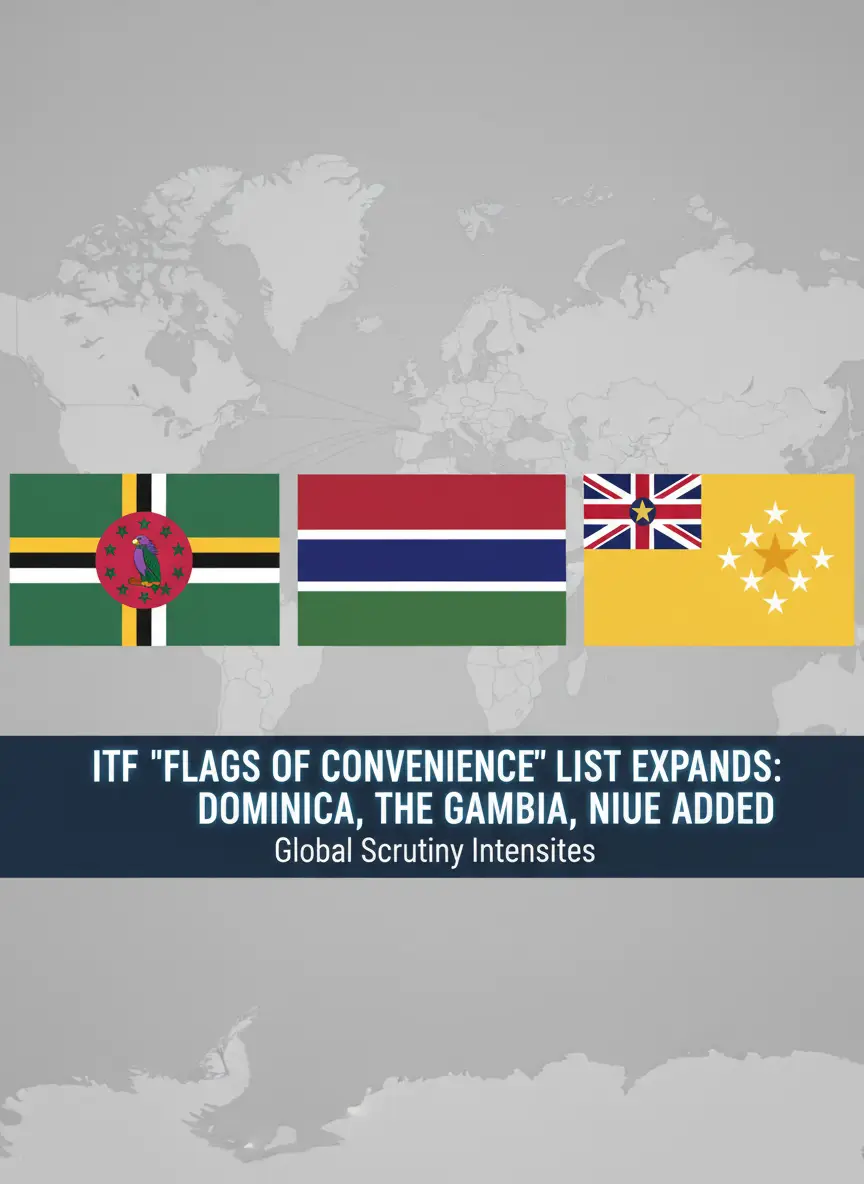
The International Transport Workers’ Federation (ITF) has significantly ramped up its long-standing campaign against substandard shipping practices, announcing the addition of three new flags—Dominica, The Gambia, and Niue—to its notorious ‘Flags of Convenience’ (FOC) list. This move, decided at a meeting of the ITF’s Fair Practices Committee (FPC) in Athens, Greece, brings the total number of FOC registries to 48 countries, signalling a global increase in the practice of vessels flying flags of nations other than their true ownership.
The decision to add the three new flags was the culmination of intensive monitoring and due diligence carried out by the ITF Inspectorate. “We’ve been monitoring ships sailing under these three flags this year, and after carrying out the necessary due diligence, we can confirm their designation as new Flags of Convenience,” stated Steve Trowsdale, ITF Inspectorate Coordinator. His remarks underscore the federation’s unwavering commitment to holding flag states accountable for the welfare of seafarers. He added a stern warning: “If you are a flag state and you take registration fees, then you have an obligation to ensure the rights of seafarers on vessels under your flag are respected – let there be no doubt that the ITF is watching and that our global network of inspectors will do everything in their power to protect the seafarers on these vessels.”The New Additions Under the Microscope
The specific details surrounding the three newly added flags reveal the critical reasons for their designation:
- The Gambia: This registry has seen a dramatic increase in tanker vessels, skyrocketing from zero in 2023 to more than 35 by early this year. Crucially, the registry is now strongly associated with the so-called ‘dark fleet.’ Research indicates that 99% of its tankers were either under sanctions or suspected of transporting sanctioned goods, raising serious concerns about regulatory oversight. Although The Gambia now claims to be actively vetting its registry, the association with the dark fleet highlights a severe lack of initial due diligence and control.
- Niue: Having opened its registry in 2012, Niue has amassed a fleet of 59 vessels. ITF data on the confirmed ownership of these ships shows a broad international spread, with a significant concentration in Asian states. Ownership is confirmed across 16 vessels in Singapore, seven in Indonesia, two each in Malaysia and Japan, and one each in India, Hong Kong, and Thailand, in addition to one vessel owned in the Netherlands. This dispersion of ownership, far removed from the flag state itself, is a classic characteristic of an FOC.
- Dominica: The registry, with 43 ships, exhibits a similarly broad range of ownership. Thirty of its ships are registered in the UAE (7), India (7), Kazakhstan (3), Saudi Arabia (2), the USA (2), Barbados (2), and Norway (2). Other owning nations include Australia, Cyprus, Finland, Great Britain, and Guinea-Conakry, each with a single vessel. This confirms a clear pattern in which the flag is utilised by owners in multiple jurisdictions worldwide.
Defining the ‘Flag of Convenience’
The cornerstone of the ITF’s campaign is a clear definition: An FOC ship is one flying the flag of a country other than its actual ownership. This practice is not merely an administrative detail; it often allows shipowners to circumvent national labour laws and tax obligations in their country of operation, potentially leading to exploitation and substandard working conditions for seafarers. The FPC, a joint committee composed of ITF seafarers’ and dockers’ unions, governs the FOC campaign, including the process for both adding and removing flag states from the list.
FOC vessels represent a significant portion of global shipping, accounting for approximately 30% of the over 100,000 merchant vessels operating worldwide. The proliferation of FOCs poses a direct challenge to maintaining decent standards in the maritime industry. The ITF’s Counter-Measures and Global Standards
To combat the challenges posed by FOCs, the ITF’s maritime unions have established a comprehensive set of policies. These policies are designed to enforce a non-negotiable floor for acceptable standards for seafarers working on these vessels. These standards are codified within the ITF Collective Bargaining Agreements (CBAs).
The CBAs are a vital instrument, setting the wages and working conditions for crews on FOC vessels irrespective of their nationality. The reach of these agreements is substantial, with just over 47% of all FOC vessels currently covered by an ITF collective bargaining agreement.
Compliance with these agreements is not left to chance. The ITF maintains a robust international monitoring apparatus comprising a network of 130 inspectors and contacts stationed at more than 125 ports worldwide. This extensive network is essential to ensuring that agreed-upon standards are upheld in practice, providing a critical layer of protection for seafarers who might otherwise be vulnerable to exploitation under the FOC system. The ITF Fair Practices Committee governs the ITF’s FOC campaign – first launched in Oslo in 1948 – including the addition and removal of flag states from the FOC list.
The following 48 countries have been declared FOCs by the ITF’s Fair Practices Committee:
- Antigua and Barbuda
- Bahamas
- Barbados
- Belize
- Bermuda
- Bolivia
- Cameroon
- Cayman Islands
- Comoros
- Cook Islands
- Curacao
- Cyprus
- Dominica
- Equatorial Guinea
- Eswatini
- Faroe Islands
- French International Ship Registry (FIS)
- Gabon
- Gambia
- German International Ship Registry (GIS)
- Georgia
- Gibraltar
- Guinea-Bissau
- Honduras
- Jamaica
- Lebanon
- Liberia
- Malta
- Madeira
- Marshall Islands
- Mauritius
- Moldova
- Mongolia
- Myanmar
- North Korea
- Niue
- Palau
- Panama
- San Marino
- Sao Tome and Príncipe
- Sierra Leone
- St Kitts and Nevis
- St Vincent
- Sri Lanka
- Tanzania (Zanzibar)
- Togo
- Tuvalu
- Vanuatu
The continued addition of flags, reaching a total of 48, highlights the ongoing nature of the problem and the need for the ITF’s global efforts. By listing Dominica, The Gambia, and Niue, the ITF delivers a clear, renewed message: the commitment to safeguarding seafarers and enforcing minimum standards across the worldwide merchant fleet remains firm.
