

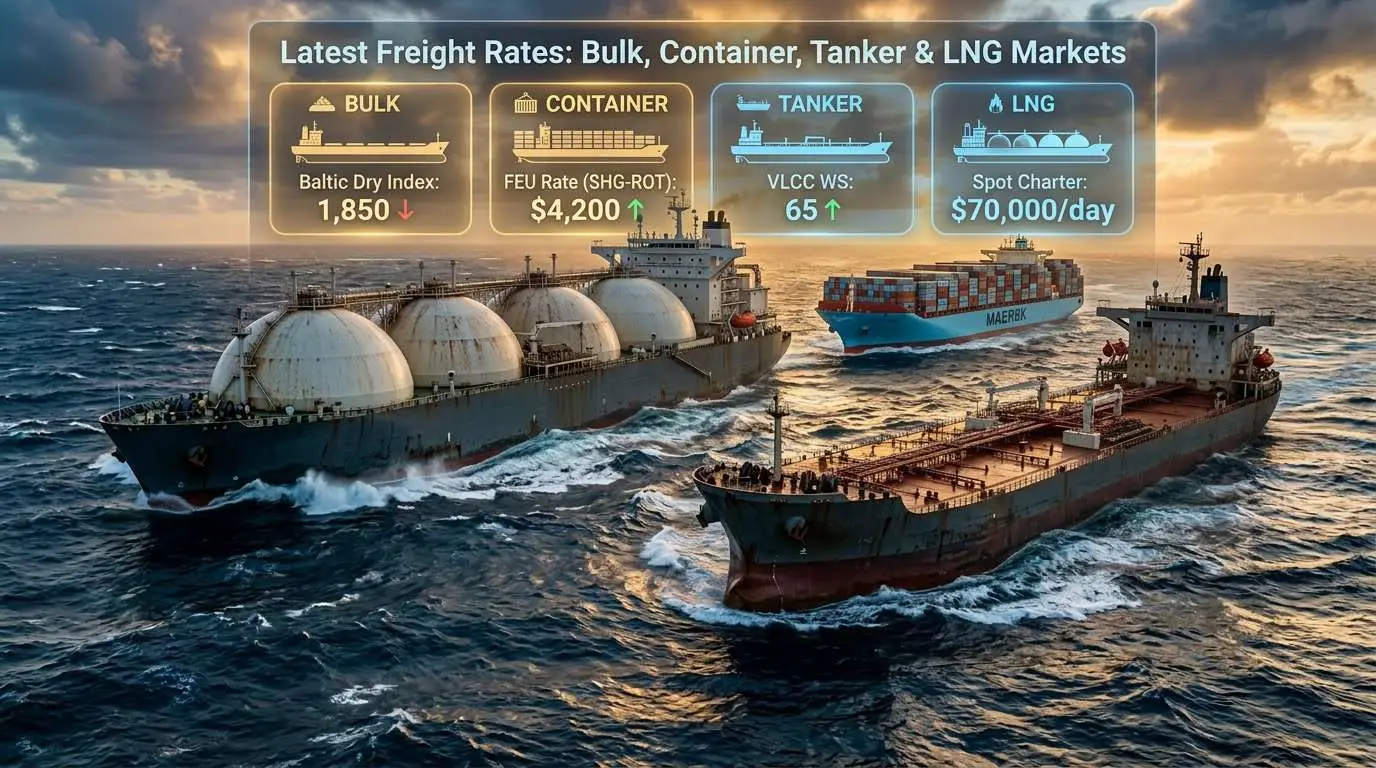
Global freight rates remain volatile, influenced by geopolitical risks, fuel costs, and seasonal demand across dry bulk, container, tanker, and LNG markets.
As of 22 March 2026, published indices show strong tanker and LNG markets, mixed container rates, and a stabilizing dry bulk sector.
This article offers a sector-by-sector overview of current freight rates, based on recent official indices and broker assessments.
Dry Bulk Freight Rates: Baltic Dry Index Holds Above 2,000
The Baltic Dry Index (BDI), the dry bulk shipping benchmark, was last reported at about 2,057 points, indicating firm conditions despite short-term volatility.
According to the Baltic Exchange daily assessment:
- Capesize vessels are earning around $23,000–23,500 per day, supported by iron ore and coal trades.
- Panamax rates average about $17,000 per day, driven by grain and minor bulk demand.
- Supramax earnings stand near $15,500 per day, while
- Handysize vessels are earning roughly $13,500 per day.
Although daily movements are uneven, the BDI remains over 20% higher year-on-year, reflecting stronger fundamentals than in early 2025.SCFI Edges Lower
The Shanghai Containerised Freight Index (SCFI), a key spot container rate benchmark, was last published at 1,706.95 points, a 0.2% decline week-on-week.
Despite the slight decline in the index, major east–west trade lanes remain elevated, especially those impacted by fuel surcharges and rerouting risks.
Indicative spot rates show:
- China / East Asia to North Europe: around $2,880 per FEU, up roughly 10% week‑on‑week
- China to US West Coast: approximately $2,300–2,400 per FEU
- China to US East Coast: approximately $3,200–3,300 per FEU
Recent increases are partly due to emergency bunker and fuel surcharges imposed by major carriers in response to Middle East disruptions and longer voyage distances.
Tanker Freight Rates: Crude Tankers Remain Exceptionally Strong
The tanker market continues to outperform other shipping segments, with crude tanker freight rates staying elevated.
Based on the latest Baltic Exchange and broker reports:
- VLCCs (Middle East Gulf–China) are earning around $130,000 per day.
- Suezmax tankers are averaging $90,000–95,000 per day.
- Aframax tankers are trading near $30,000–32,000 per day.
Product tanker markets also remain firm, with:
- LR2 rates around $36,000 per day
- MR tankers earn approximately $37,000 per day.
These rates reflect ongoing tight vessel availability, strong oil flows, and increased security risks on key routes.
LNG Freight Rates: Spot Charter Rates Surge to Extreme Levels
The LNG shipping market is currently the most volatile, with spot charter rates reaching record highs due to geopolitical uncertainty and supply disruptions.
Recent broker and industry reports indicate:
- US Gulf to Europe: approximately $300,000 per day
- US Gulf to Asia: approximately $300,000 per day
- Australia to Asia: around $250,000–260,000 per day
These rates have surged compared to February and are directly linked to Strait of Hormuz risks, longer routes, and limited vessel availability. Market participants note that LNG freight pricing remains highly sensitive to security developments.
Market Outlook: Volatility Likely to Persist
Current freight rates highlight a shipping market operating under exceptional conditions:
- Tanker and LNG rates remain historically high.
- Container markets are supported by surcharges despite softer index movements.
- Dry bulk shipping shows signs of stabilising but remains sensitive to commodity demand. At present, geopolitical risks unresolved, freight rate volatility is expected to continue into the second quarter of 2026.
Key Freight Rate Summary (Latest Available)
| Sector | Latest Level |
| Baltic Dry Index | ~2,057 points |
| SCFI (Container) | 1,706.95 points |
| VLCC Tanker | ~$130,000/day |
| Suezmax Tanker | ~$90,000/day |
| LNG Carrier (Spot) | ~$300,000/day |
Source note: All figures are based on the most recent official index releases and broker assessments available as of 22 March 2026.
References
Dry Bulk Freight Rates
- Baltic Exchange – Baltic Dry Index (BDI)
Official daily benchmark for dry bulk shipping rates.
Source: Baltic Exchange / Trading Economics
https://www.balticexchange.com/en/data-services/market-information0/indices.html - HandyBulk – Baltic Dry Index Daily Updates
Detailed breakdown of Capesize, Panamax, Supramax, and Handysize earnings.
https://www.handybulk.com/baltic-dry-index/
Container Freight Rates
- Shanghai Shipping Exchange – Shanghai Containerized Freight Index (SCFI)
Official weekly index tracking spot container rates from Shanghai.
https://en.sse.net.cn/indices/scfinew.jsp - Trading Economics – Containerized Freight Index
Aggregated container freight index with historical and weekly changes.
https://tradingeconomics.com/commodity/containerized-freight-index - Freightos Baltic Index (FBX)
Weekly spot container rates on major global trade lanes.
https://fbx.freightos.com/
Tanker Freight Rates
- Baltic Exchange – Tanker Market Information
Official Worldscale and Time‑Charter Equivalent (TCE) assessments for crude and product tankers.
https://www.balticexchange.com/en/data-services/market-information0/tankers-services.html - IndexBox – Weekly Tanker Freight Market Report
Broker‑based analysis covering VLCC, Suezmax, Aframax, LR2, and MR segments.
https://www.indexbox.io/blog/weekly-tanker-freight-report-mixed-rate-movements-across-segments/
LNG Freight Rates
- OilPrice.com – LNG Shipping Rates Surge
Report on spot LNG carrier charter rates amid Middle East disruptions.
https://oilprice.com/Latest-Energy-News/World-News/LNG-Shipping-Rates-Soar-650-to-300000-Per-Day.html - Fearnleys / Riviera Maritime Media (via OilPrice)
Broker‑sourced LNG spot charter assessments for Atlantic and Pacific routes.
(Referenced within OilPrice LNG report)
Air Freight (Supplementary Reference)
- TAC Index / Baltic Air Freight Index (BAI)
Weekly air freight rate benchmark used for global logistics comparisons.
https://www.tacindex.com/