

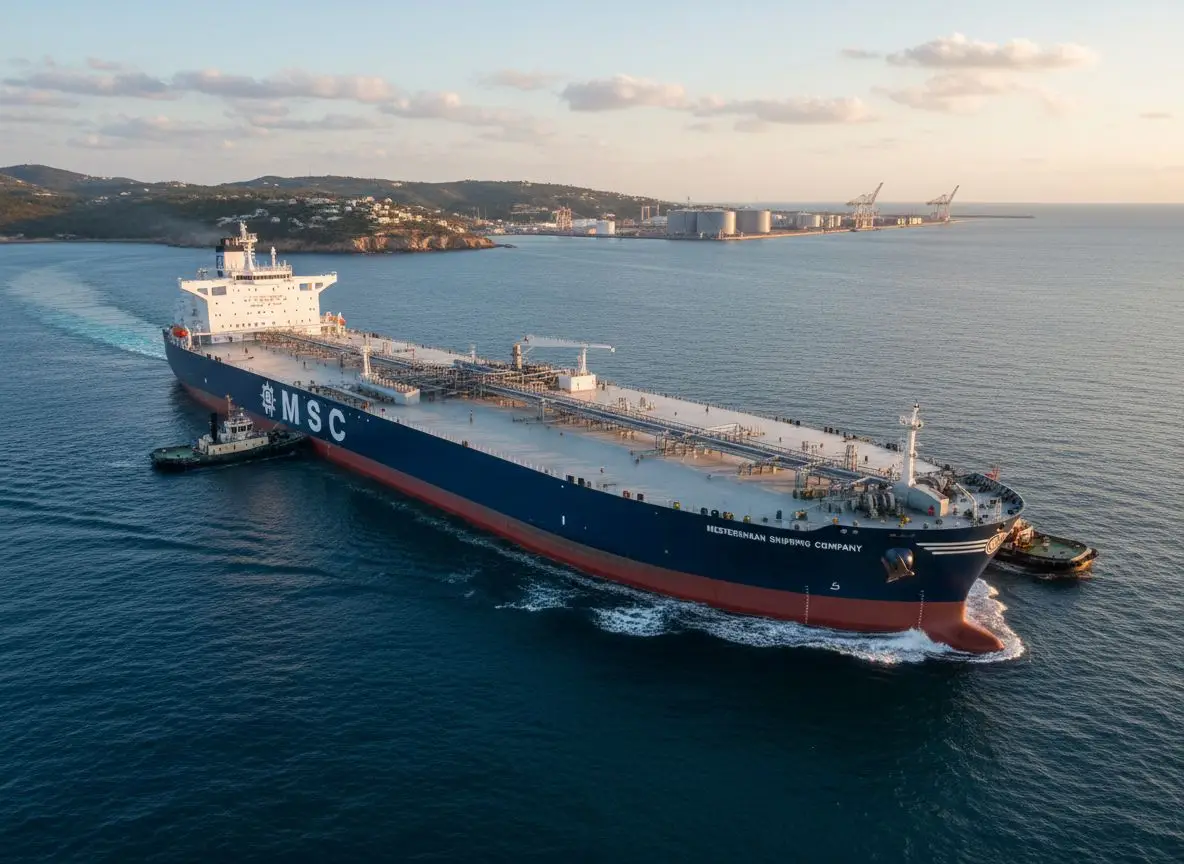
Please note: The featured image is a conceptual illustration and does not reflect a real MSC or Sinokor vessel
Mediterranean Shipping Company is ready to place a record-breaking order for multiple Very Large Crude Carriers (VLCCs), marking a significant strategic expansion into the crude oil shipping sector. The unprecedented move by the world’s largest container shipping operator represents a major diversification beyond its traditional business model. Additionally, MSC’s VLCC order signals the company’s ambition to establish a substantial presence in the global energy transportation market.
Industry analysts note that this expansion comes at a pivotal time for the tanker sector, with volatile crude oil prices and shifting global trade patterns. Furthermore, the deal involves a strategic partnership with Sinokor Maritime, building upon previous collaborations between the two companies. Chinese shipyards have consequently secured the newbuilding contracts, though specific details regarding vessel specifications, delivery timelines, and total investment remain closely guarded.
Despite MSC’s remarkable success in container shipping under the leadership of founder Gianluigi Aponte, this move into crude oil transportation represents perhaps the company’s boldest diversification strategy to date. The timing of the order has drawn particular attention from market observers, as it comes amid concerns about potential oversupply in the VLCC segment.
MSC Places Record VLCC Order in Strategic Expansion
Gianluigi Aponte, owner of MSC Mediterranean Shipping Company, has initiated an unprecedented expansion into crude oil transportation with a significant order for multiple Very Large Crude Carriers (VLCCs). This strategic move marks a major shift for the shipping giant as it ventures beyond its container-shipping roots.
Order includes multiple Very Large Crude Carriers
According to shipping industry sources, MSC has approached shipbuilders to secure a series of newbuilding contracts for VLCCs. Multiple shipbuilding players have confirmed that the liner giant is actively working to establish its own crude oil tanker fleet. The company has maintained strict confidentiality regarding the exact number of vessels ordered and their specifications.
This VLCC acquisition strategy aligns with MSC’s historical approach of strategic fleet expansion in sectors with long-term growth potential. VLCCs, capable of carrying approximately 2 million barrels of crude oil, are the largest class of oil tankers in operation globally and require substantial capital investment and operational expertise.
Industry analysts speculate that this move might be timed to capitalise on favourable shipbuilding prices at Chinese yards, where most large tanker construction occurs. The VLCC market has experienced significant volatility in recent years, with rates fluctuating dramatically due to geopolitical tensions, oil production levels, and shifts in trade patterns.
Moreover, the decision to invest in VLCCs suggests MSC anticipates continued demand for crude oil transportation despite global energy transition efforts. These vessels typically have operational lifespans exceeding 20 years, underscoring the company’s confidence that fossil-fuel shipping will remain viable for decades.
Move marks MSC’s entry into the crude oil shipping sector
This fleet acquisition decisively marks MSC’s formal entry into the crude oil shipping sector. Until now, the company has predominantly focused on container shipping, where it has grown to become the world’s largest carrier. Essentially, this diversification represents one of the most significant strategic pivots in the company’s history.
The move into VLCCs appears to be part of a broader collaboration with South Korean tanker operator Sinokor Maritime. Shipping industry insiders suggest this partnership allows MSC to leverage Sinokor’s established expertise in tanker operations while providing the financial resources needed for fleet expansion.
In fact, this development follows MSC’s pattern of calculated expansion into complementary maritime sectors. The company has previously ventured into cruise operations, terminal management, and logistics services, steadily building a comprehensive shipping empire under Aponte’s leadership.
Significantly, MSC’s entry into crude oil shipping occurs amid growing concerns about potential overcapacity in the VLCC segment. Several major shipowners have placed substantial orders in recent years, raising questions about future supply-demand balance. However, MSC’s financial strength and diversified revenue streams potentially position it to weather market fluctuations better than traditional tanker-focused operators.
The decision to secure dedicated VLCC tonnage rather than chartering existing vessels indicates MSC’s long-term commitment to this segment. It also suggests the company sees strategic advantages in controlling its own crude oil transportation assets rather than relying on third-party providers.
This bold expansion by one of shipping’s most successful operators will likely influence industry dynamics across both the container and tanker sectors in the years ahead.
MSC Partners with Sinokor Maritime for Tanker Venture
The strategic partnership between Mediterranean Shipping Company and South Korean tanker specialist Sinokor Maritime stands at the center of MSC’s bold entry into crude oil transportation. The collaboration represents a calculated move by both companies to combine their respective strengths in the highly competitive shipping industry.
Sinokor’s role in the VLCC collaboration
Sinokor Maritime, a well-established South Korean shipping enterprise with extensive tanker operations experience, brings crucial technical expertise to this venture. The partnership structure positions Sinokor as the operational knowledge provider for MSC’s ambitious VLCC fleet expansion. Specifically, industry sources confirm that MSC’s newbuilding orders are widely viewed as part of this collaborative effort with the tanker-focused South Korean company.
“The liner giant has turned to the shipbuilding market to secure its own tonnage,” noted multiple shipbuilding players familiar with the arrangements. This strategic decision highlights how MSC values Sinokor’s established presence in the tanker sector as the container shipping powerhouse ventures into unfamiliar waters.
Sinokor’s contribution extends beyond merely operational guidance. Indeed, the South Korean firm’s longstanding relationships with Asian shipyards potentially provide valuable leverage in securing favorable terms for the substantial newbuilding program. Given that VLCCs represent significant capital investments—often exceeding $100 million per vessel—such industry connections prove invaluable.
Throughout maritime circles, the collaboration is viewed as mutually beneficial: MSC gains immediate access to specialized tanker management capabilities, whereas Sinokor secures backing from one of shipping’s financial powerhouses. Notably, this arrangement allows both companies to mitigate risks associated with entering new market segments or expanding rapidly in volatile shipping sectors.
Past collaborations between MSC and Sinokor
The VLCC venture builds upon an existing relationship between the two shipping companies. In this context, the current collaboration extends previous business interactions rather than constituting an entirely new partnership. Nevertheless, the scale of the current VLCC project marks a significant escalation in the scope of their joint activities.
Prior to this tanker initiative, MSC and Sinokor had established working relationships across various shipping segments. The progression toward a more formalised partnership in the VLCC sector indicates a successful track record in their earlier joint endeavours. Experienced industry analysts observe that such high-stakes collaborations typically develop only after companies have established mutual trust through smaller-scale projects.
MSC’s strategic decision to partner with an established tanker operator, rather than developing in-house expertise, demonstrates Gianluigi Aponte’s pragmatic approach to business expansion. By aligning with Sinokor, MSC effectively accelerates its learning curve in the specialised crude carrier segment.
As a result of these combined strengths, the MSC-Sinokor partnership positions both companies to potentially capture significant market share in the VLCC sector despite concerns about oversupply. Their collaboration model—pairing financial strength with operational expertise—may inspire similar strategic alliances among other shipping companies seeking diversification without assuming excessive risk.
The carefully structured partnership underscores how even dominant players like MSC recognize the value of specialized knowledge when entering new shipping segments. Primarily, this approach allows for faster market penetration while minimizing operational missteps that often plague companies expanding beyond their core competencies.
Chinese Shipyards Secure Newbuilding Contracts
Chinese shipyards have emerged as the primary beneficiaries of Mediterranean Shipping Company’s strategic expansion into the crude oil transportation market. The selection of these yards marks a crucial development in the global shipbuilding industry, reflecting both MSC’s strategic priorities and current market dynamics.
Shipyards involved in the deal
Multiple Chinese shipbuilding facilities have secured contracts in this landmark VLCC order, although specific yard names remain undisclosed in official announcements. Industry sources indicate that MSC has approached several major Chinese shipbuilders with established track records in constructing large tankers. The decision to award these contracts to Chinese yards instead of South Korean or Japanese alternatives underscores China’s growing dominance in global shipbuilding, particularly in the tanker segment.
Construction of Very Large Crude Carriers requires specialized expertise and substantial infrastructure—factors that have increasingly concentrated VLCC production in Chinese facilities. These shipyards offer competitive advantages in terms of production capacity, construction costs, and delivery schedules. MSC’s choice aligns with broader industry trends as numerous major shipping companies have turned to Chinese yards for VLCC orders in recent years.
Estimated delivery timelines and capacity
While precise delivery schedules remain confidential, industry standard practices suggest these VLCCs will likely join MSC’s fleet over a 2-3 year horizon. Shipbuilding players familiar with the arrangements have confirmed that MSC “has turned to the shipbuilding market to secure its own tonnage,” indicating a commitment to building a substantial crude oil transportation capacity.
Standard VLCC specifications point to vessels with approximately 300,000-320,000 deadweight tonnage capacity, capable of carrying around two million barrels of crude oil. Modern VLCCs typically feature dual-fuel propulsion systems to comply with increasingly stringent environmental regulations. The vessels will almost certainly incorporate energy efficiency technologies and emissions reduction systems to meet future regulatory requirements.
The staggered delivery schedule commonly employed for such large orders allows MSC to gradually integrate these sophisticated vessels into their operations while spreading capital expenditure across multiple fiscal periods.
Cost and financing details of the order
Financial terms of the newbuilding program remain closely guarded, following standard industry practices for deals of this magnitude. Typically, current market rates place new VLCC construction costs between $90-110 million per vessel, depending on specifications and equipment choices. The total investment would thus represent one of the largest capital commitments in MSC’s recent history, reflecting Gianluigi Aponte’s confidence in the crude oil shipping sector.
Financing arrangements likewise remain undisclosed, though MSC’s strong financial position suggests multiple options including traditional bank financing, export credit agency support, or direct capital allocation. The company’s established relationship with major financial institutions provides considerable flexibility in structuring such significant investments.
The strategic importance of this order extends beyond MSC to impact global shipyard capacity allocation and potentially influence future newbuilding prices across all maritime sectors. Essentially, this substantial order reinforces Chinese shipbuilders’ position in the highly competitive global shipbuilding market.
VLCC Market Faces Pressure from New Tonnage
The entry of Mediterranean Shipping Company into the crude oil transportation sector raises substantial questions about market equilibrium. MSC’s massive VLCC order arrives at a time when market analysts are already watching tanker supply dynamics closely. This unexpected move by a container shipping giant now adds another dimension to existing tanker market concerns.
Impact on global tanker supply and rates
MSC’s forthcoming VLCC fleet will inevitably alter global tanker supply calculations. The addition of multiple new vessels represents significant tonnage entering an already complex market. Currently, freight rates for crude oil transportation fluctuate based on numerous factors including oil production levels, geopolitical tensions, and seasonal demand patterns.
By comparison, traditional tanker owners typically coordinate newbuilding programs carefully to avoid market disruption. Yet MSC’s entry introduces a new competitor with substantial financial resources and potentially different operational priorities. Subsequently, this could reshape rate dynamics as these vessels progressively enter service over the next few years.
Simultaneously, oil trade routes continue evolving in response to shifting production centers and consumption patterns. MSC’s timing suggests confidence in long-term crude oil shipping demand, even as the global energy transition advances. The company appears positioned to leverage potential volatility rather than viewing it as a deterrent.
Concerns over oversupply in the VLCC segment
Undoubtedly, MSC’s order amplifies existing concerns about potential VLCC oversupply. The shipping industry has witnessed several cycles of boom and bust driven by overbuilding, followed by painful corrections. In this situation, the addition of numerous new vessels from a non-traditional player complicates fleet growth projections.
Alongside MSC’s order, several established tanker companies have their own newbuilding programs underway. This collective expansion creates legitimate questions about future supply-demand balance in the VLCC segment. The tanker market typically requires several years to absorb significant new capacity, often through a combination of trade growth and vessel scrapping.
Reactions from industry analysts and competitors
The announcement of MSC’s VLCC venture has triggered mixed responses across the shipping community. Under those circumstances where a container giant diversifies into tankers, established crude carriers must reconsider their strategic positioning. Some view this development with apprehension, fearing intensified competition from a well-capitalized new entrant.
Nonetheless, others see potential benefits from MSC’s market entry. The company brings fresh perspectives and possibly new operational approaches to the tanker segment. Their participation might ultimately strengthen industry standards and practices through cross-sector innovation.
Market analysts are closely monitoring how this unprecedented expansion will affect investor sentiment toward publicly traded tanker companies. Above all, MSC’s move underscores the interconnectedness of different shipping sectors despite their operational distinctions.
MSC’s Fleet Strategy Signals Long-Term Diversification
Gianluigi Aponte’s Mediterranean Shipping Company has established itself as a formidable force beyond its initial focus on container shipping. This strategic move into the VLCC market highlights the company’s broader ambitions within global maritime transportation.
Background on MSC’s container shipping dominance
Beginning as a modest operator with a single vessel in 1970, MSC has grown into the world’s largest container shipping company. The family-owned business currently operates over 700 vessels with combined capacity exceeding 4 million TEU, surpassing even Maersk in global rankings. Throughout its history, MSC has maintained a privately-held status, allowing for agile decision-making without shareholder pressure. This independence has enabled Aponte to pursue bold expansion strategies that publicly-traded competitors often hesitate to undertake.
Recent diversification into other shipping segments
Beyond containers, MSC has steadily expanded its maritime footprint. The company acquired a significant stake in Italian towage operator Rimorchiatori Mediterranei and purchased Bolloré Africa Logistics for €5.7 billion. MSC has likewise ventured into cruise operations through MSC Cruises, established terminal operations worldwide, and invested in logistics services. This systematic diversification across maritime sectors follows Aponte’s philosophy of building complementary business units that can weather industry-specific downturns.
How VLCCs fit into MSC’s long-term vision
The VLCC acquisition represents MSC’s calculated entry into energy transportation, potentially positioning the company for involvement in emerging fuel markets. MSC’s long-term vision apparently encompasses becoming a comprehensive maritime service provider across multiple segments. These crude carriers offer stable, long-term contract opportunities unlike the volatile container market, thereby balancing MSC’s revenue streams. Since energy transportation requires specialized expertise, the partnership with Sinokor exemplifies MSC’s pragmatic approach toward entering new sectors through strategic collaborations.
Conclusion
Gianluigi Aponte’s strategic decision to enter the VLCC market undoubtedly represents one of the most significant expansions in MSC’s five-decade history. This bold move from container shipping into crude oil transportation demonstrates the company’s commitment to diversifying its maritime portfolio beyond its traditional strongholds. Additionally, the partnership with Sinokor Maritime provides MSC with crucial operational expertise while allowing both companies to leverage their respective strengths in this highly specialized sector.
The selection of Chinese shipyards for this massive order further confirms China’s dominance in global shipbuilding, particularly for large tanker vessels. Despite concerns regarding potential oversupply in the VLCC market, MSC appears confident that long-term demand for crude oil transportation will justify this substantial investment. The timing of this order suggests the company sees strategic advantages that outweigh the risks associated with market volatility.
MSC’s systematic approach to diversification has previously proven successful across various maritime sectors, including cruise operations, terminal management, and logistics services. Therefore, this calculated entry into energy transportation aligns perfectly with Aponte’s vision of creating a comprehensive maritime empire capable of weathering industry-specific downturns. The VLCC fleet will consequently provide MSC with more balanced revenue streams while positioning the company as a truly integrated shipping powerhouse across multiple segments.
The shipping world will certainly watch closely as these vessels progressively enter service over the coming years. MSC’s unprecedented move may ultimately reshape competitive dynamics not just within the tanker sector but across the entire maritime industry. Though questions remain about market equilibrium and rate stability, one thing stands clear – MSC’s strategic expansion into VLCCs signals its ambition to dominate not just container shipping but the global maritime transportation landscape as a whole.
