

Executive Summary
The Strait of Hormuz remains effectively closed to routine commercial traffic amid the U.S.–Iran conflict, with Iranian forces threatening and carrying out attacks on vessels that attempt passage. Recent reporting and maritime intelligence show traffic has collapsed, and hundreds of ships are stranded or rerouted. Naval escorts are under consideration, but officials signal they will begin only when “militarily possible,” potentially weeks away. For crews already in theatre, the human impact is severe, even as some vessels undertake high-risk passages with increased precautions.
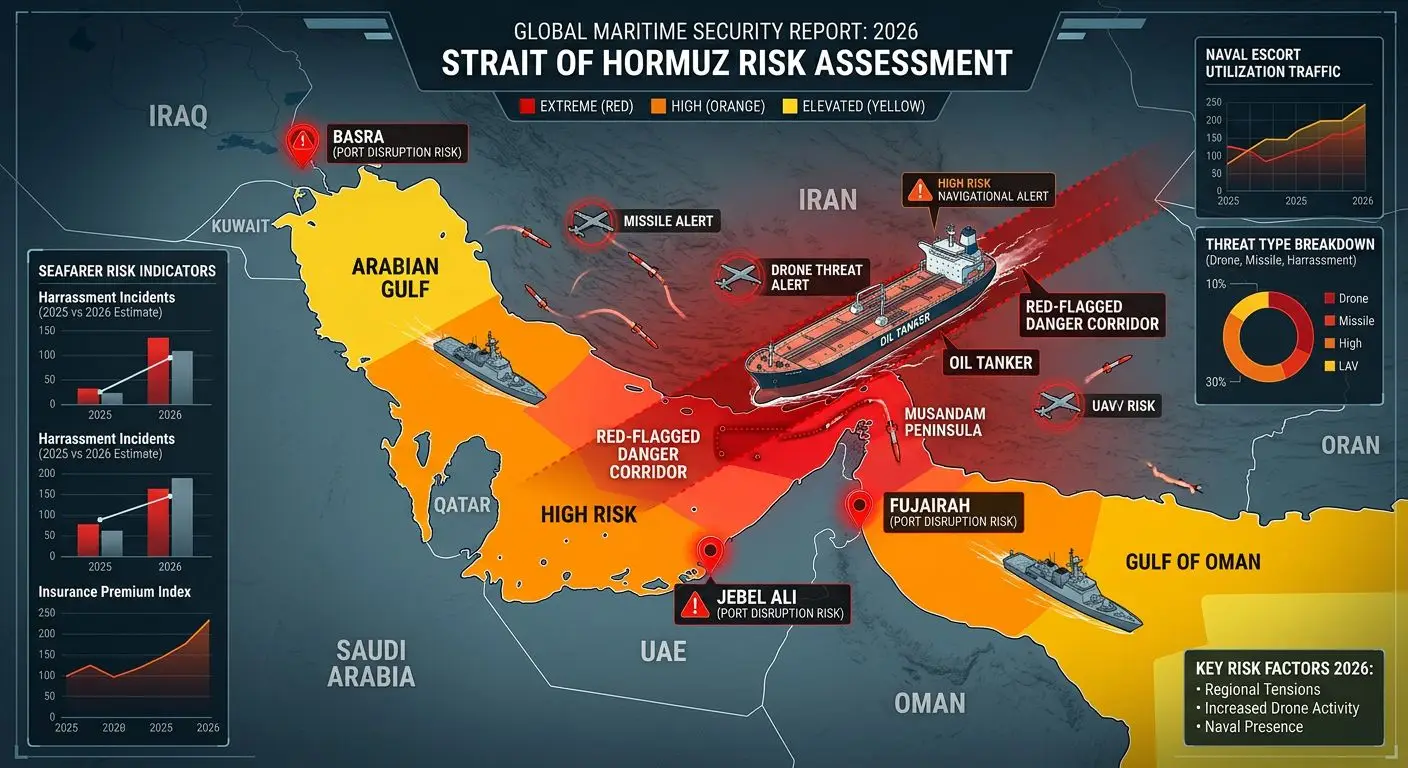
Situational Risk Map — Assessment for 17 March 2026

Methodology (qualitative): This map reflects a synthesis of the latest public briefings and maritime reporting on attacks, declared threats, port disruptions, and stranded vessels across Hormuz and adjacent waters. It weighs: (1) declared closure/intent, (2) verified strikes or port suspensions, (3) volume of stranded ships, (4) near‑term feasibility of naval escorts, and (5) operational advisories (UKMTO/industry). Sources include U.S. Congressional analysis via USNI, mainstream defence reporting, maritime trade outlets, and live trackers.
What’s Happening Right Now (and Why It Matters)
A chokepoint under sustained threat
Iranian authorities declared the strait “closed” and have mounted repeated attacks on merchant vessels, causing a dramatic fall in transits and prompting major liners to suspend passages. This is the world’s most critical energy chokepoint—roughly one‑fifth of global oil shipments move through these waters—and the knock‑on effects across shipping, insurance, and commodity markets are already significant.
Traffic collapse & stranded ships
Live trackers and trade intelligence indicate transits slumped from typical daily levels to near zero for extended periods, with hundreds of vessels stranded inside the Gulf and only isolated transits permitted. Several recent ship strikes—including fires and casualties—underscore the operational danger for crews.
Escorts: not yet, and not simple
U.S. officials have said convoys will start only when militarily possible, while separate reporting suggests escort operations could be a month or more away, depending on conditions and force posture. Historical context (Earnest Will) shows escorts can work, but require substantial assets and robust rules of engagement to manage mines, missiles, drones, and misidentification risks.
Regional Risk Breakdown (17 March 2026)
1) Strait of Hormuz — Extreme
- Declared closure & active attacks: Iranian threats to “set ablaze” vessels attempting passage have been accompanied by multiple strikes, fires, and crew casualties in and around the strait.
- Traffic near standstill: Real‑time monitors show transits down to a tiny fraction of normal, with a large backlog of vessels waiting.
Implication: Routine commercial transits remain untenable without state protection and robust deconfliction protocols.
2) Persian Gulf (central) — High
- Stranded vessels & spillover risk: Intelligence notes hundreds of ships holding positions; missile and UAV activity has also affected ports and offshore areas beyond the strait.
Implication: Elevated vigilance for crews; dynamic routing and readiness to reposition on short notice.
3) Gulf of Oman — High
- Threat vector extension: Attacks and debris incidents have extended into the Gulf of Oman; UKMTO warns of misidentification risks near military units.
Implication: Risk remains high even outside the narrow strait; an overt military presence can increase the risk of miscalculation if communication protocols are weak.
4) UAE: Fujairah (export hub) — High
- Port disruption: A drone attack recently halted oil loadings at Fujairah, with temporary suspensions as authorities assessed damage and safety.
Implication: Schedules and crew rotations are disrupted; charterers face delays and last‑minute changes. [cnbc.com]
5) UAE: Jebel Ali approaches — High
- **A projectile strike near Jebel Ali was reported just days ago, underscoring risks even near major logistics hubs.
Implication: Crew exposure increases during port entries/exits; bridge teams must be briefed on shelter and abort options. [msn.com]
6) Northern Arabian Gulf / Basra approaches — High
- Fatality reported: An Indian seafarer was killed in an attack on a tanker near Basra on 13 March.
Implication: High threat to crews on approach routes to Iraqi terminals; operators should evaluate delays, diversions, or postponements. [msn.com]
7) Arabian Sea approaches to Hormuz — Elevated
- Spillover & rerouting: Vessel rerouting and advisory regimes have extended into the Arabian Sea; risk remains elevated due to possible long‑range strikes and misidentification.
Implication: Maintain standoff distances from naval units; adhere strictly to reporting protocols and safety corridors where established.
Seafarers: Human Impact and Notable Developments
- Recognition for crews making high‑risk transits: Today, India’s Ports & Shipping Minister honoured the crews of MT Shivalik and MT Nanda Devi after they safely crossed the Strait of Hormuz carrying critical LPG cargo, highlighting the resilience and professionalism of seafarers operating under extreme pressure.
- Missing and injured seafarers: Reports continue of crew members killed, missing, or trapped following attacks around Hormuz in recent days, emphasising the need for robust mental‑health support and crisis communication for crews and families.
Will Naval Escorts Reopen the Strait? Timeline and Constraints
Not immediate. U.S. officials indicate escorts will begin only when “militarily possible”, following ongoing efforts to degrade Iranian offensive capabilities. Separate reporting suggests an escort program’s start could be weeks away, depending on threat reduction and coalition formation. [newsweek.com]
Operational complexity. Historical analysis notes a “basic” convoy could require 8–10 destroyers to cover 5–10 merchant ships, with priorities set to evacuate stranded vessels first before normalising inbound flow—an enormous logistics and deconfliction task under active missile/USV/drone threats.
Insurance, Compliance, and Communication
- War risk premiums have surged to around 1% of hull value (vs the typical ~0.15%), compounding voyage economics and complicating chartering decisions.
- Advisories emphasise deconfliction: Operators should adhere to UKMTO/JMIC/NCAGS guidance regarding reporting, standoff distances from naval vessels, and routing adjustments due to elevated misidentification risks.
Practical Guidance for Masters, DPA/CSO, and Fleet Ops
- Assume dynamic risk within the entire Hormuz–Gulf of Oman–Arabian Sea continuum; do not treat safety as binary “inside vs outside” the strait.
- Escorts’ ≠ immunity: Even under naval protection, the environment will remain hostile initially; plan for degraded comms, GPS jamming/spoofing, and rapid manoeuvre directives from escort commanders.
- Crew welfare first: Ensure trauma‑informed communications, rest periods, and family liaison processes are activated for ships in or near the theater.
- Insurance & contracts: Engage underwriters early; document routing rationales, war risk notices, and force majeure triggers to protect both crew and commercial positions.
- Port calls: Validate port status (e.g., Fujairah loadings) and approaches (e.g., Jebel Ali) within 24 hours of ETA; require written confirmation from agents on safety status and terminal readiness.
Outlook: Weeks of Elevated Danger, Gradual Normalisation Only If Threats Subside
Given current statements and force dispositions, naval escorts—if launched—are likely weeks away, and even then, throughput will remain limited for a period as convoys clear backlogs and establish safe transit rhythms. Meanwhile, vessels will continue to face high to extreme risk across Hormuz and adjacent waters, with periodic port disruptions and sporadic strikes. The pace of normalization will depend on Iran’s operational posture, coalition readiness, and effective deconfliction across crowded sea lanes.
Notes & Responsible Use
- This analysis is informational and not a substitute for official routing orders. For voyage decisions, consult UKMTO/NCAGS, flag‑state circulars, and company SMS.
- The risk map is a qualitative synthesis built from today’s reporting and will change as events evolve.
