
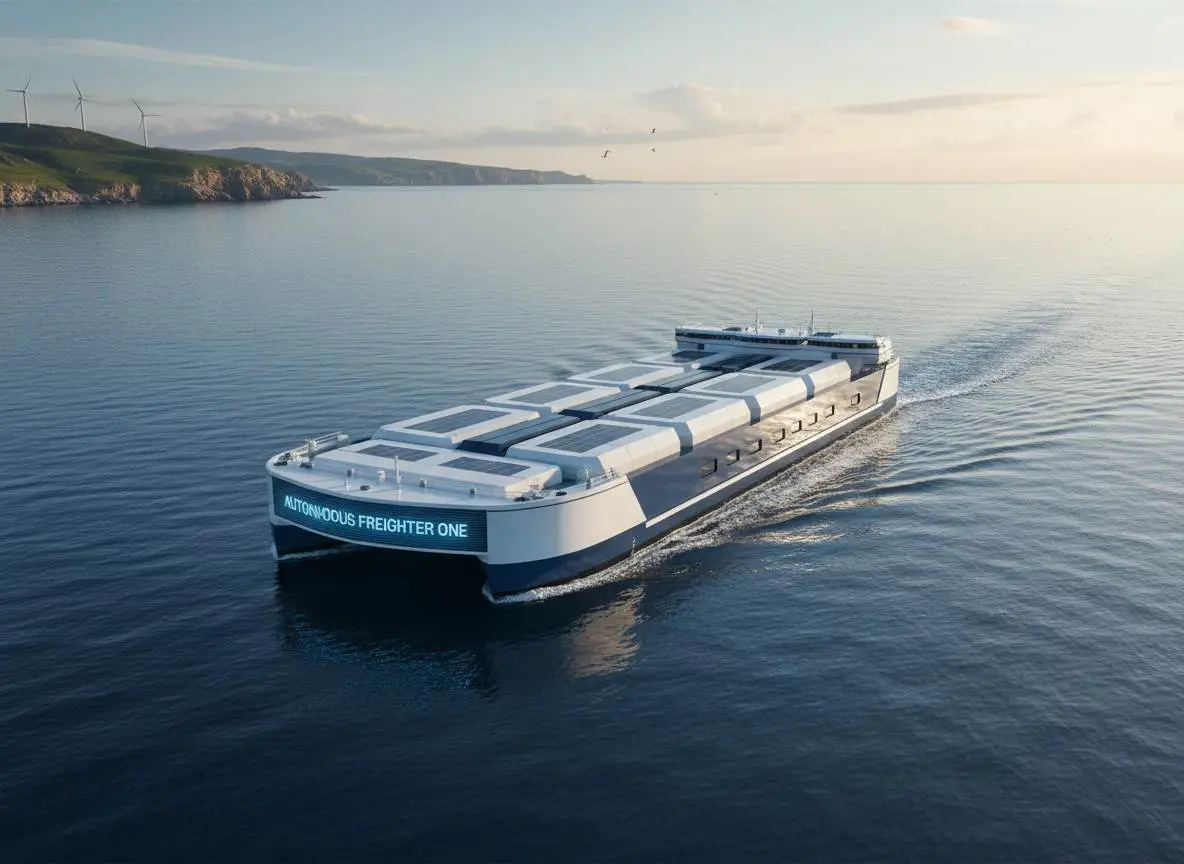
Can autonomous vessels operate safely and economically, reducing costs and minimising the risks faced by crew during port operations? Theoretically, the answer is yes. We have the knowledge and capability to achieve this, but it requires substantial investments in research and development for new engineering, cargo handling equipment, port infrastructure, and crew training.
The maritime industry is undergoing one of the most significant technological shifts in its modern history. What was once a distant ambition is steadily becoming an operational reality: autonomous vessels navigating global waters with increasing precision, safety, and regulatory acceptance. By 2026, the conversation is no longer about whether autonomous ships can operate, but rather how far the industry is willing — and allowed — to push the autonomy spectrum.
Across both commercial and defence sectors, new systems integrating artificial intelligence, sensor fusion, remote‑operation capabilities, and machine learning are creating autonomous maritime solutions that reduce human error, optimise operations, and push the boundaries of what a ship can do without direct human control. This article explores what makes a vessel autonomous, what is already possible in 2026, and how the industry’s future is being shaped by rapid innovation and evolving international regulation.
Understanding the Autonomous Vessel Spectrum
A vessel does not need to be fully unmanned to be considered autonomous. According to the International Maritime Organization (IMO), Maritime Autonomous Surface Ships (MASS) operate along four defined levels of autonomy:
Degree 1: A crew is still onboard, but systems provide automated processes and decision support — often seen as the “bridge” stage toward more advanced autonomy.
Degree 2: A vessel is remotely controlled but still carries seafarers onboard to intervene when necessary.
Degree 3: A vessel is fully remote‑controlled with zero crew onboard, operated entirely from a shore‑based control centre.
Degree 4: A fully autonomous vessel that makes decisions independently, relying on advanced sensors and AI systems.
In 2026, most commercial applications fall under Degree 1 and 2. However, rapid technological progress and military adoption are accelerating real‑world testing of Degree 3 ships.
Absolutely — here are clear, real‑world examples of ships operating under Degree 1 and Degree 2 autonomy, based on the most recent developments in 2025–2026.
Degree 1 (Automated Processes & Decision Support — Crew Onboard)
These vessels still carry a full crew, but use automation, AI decision‑support, and advanced sensors to assist navigation, watchkeeping, and machinery operations.
Autonomy enhances safety and efficiency but does not replace human control.
1. Smart Ships Using AI‑Based Navigation (General Cargo & Container Fleets)
AI‑controlled “smart ships” in 2026 routinely use autonomous systems for route optimization, anomaly detection, performance monitoring, and collision‑avoidance — all while crews remain fully onboard.
➡ Example: Large cargo carriers equipped with AI‑powered navigation and predictive maintenance systems. These vessels automatically adjust course, trim, and engine settings, but officers oversee and override when needed.
2. Yara Birkeland (Norway — current supervised autonomous operations)
The Yara Birkeland, originally developed as a fully autonomous container ship, is currently operating with human supervision onboard due to regulatory requirements. The vessel sails autonomously from quay to quay, but a small crew remains onboard.
➡ Why Degree 1?
It performs autonomous functions but still requires human presence to comply with safety rules.
3. Japanese Ferries with Autonomous Navigation Retrofits
Japan’s ferry industry has implemented autonomous docking and navigation systems that manage collision avoidance and precise maneuvering, while crew oversee the systems.
➡ Why Degree 1?
Automation assists heavily, but humans remain responsible for the voyage.
4. Majority of Commercial Vessels Testing AI‑Driven Watchkeeping
2026 industry data shows most global ships using autonomy are in Degree 1, where automated lookout and collision‑risk prediction systems assist bridge teams.
Degree 2 (Remotely Controlled With Crew Onboard)
These vessels still have crew physically onboard, but can be partially or fully controlled from a shore‑side Remote Operations Centre (ROC) during specific phases of the voyage.
1. Yara Birkeland (Remote Control Capable)
Although supervised autonomy qualifies it for Degree 1 in daily use, the Yara Birkeland is also equipped for periodic remote operation, allowing Degree 2 functionality.
➡ Why Degree 2?
It can be remotely controlled while the crew remain onboard as safety observers.
2. Autonomous Ferries (Norway & Finland — Remote Mode Active)
Several autonomous urban ferries use shore‑based operation centres for remote navigation during docking or congested areas, while a minimal crew remains onboard.
➡ Examples include:
- Zeabuz urban autonomous ferries (remote‑supervised docking)
- Coastal short‑route ferries using AI + remote‑override capability
3. Smart Tugs & Workboats With Remote Override
Many port authorities and tug operators deploy semi‑autonomous tugboats that can switch from crewed manual operation to remote assistance/control for berthing manoeuvres.
➡ Why Degree 2?
Remote control is available, but personnel remain onboard for safety and intervention.
4. Commercial Vessels With Remote Operation Centres (ROC) Support
2026 operations increasingly use ROCs to guide vessels, troubleshoot, or assume partial control on demand — while crew still monitor onboard.
➡ Examples include:
- Fleet operators using remote‑enabled bridge systems
- Offshore supply vessels with remote support during dynamic positioning
Summary Table
| Degree | Definition | Real Ships (Examples) |
|---|---|---|
| Degree 1 | Automated processes + decision support; full crew remains onboard | Remote control is possible but crew remain onboard |
| Degree 2 | Remote control is possible, but the crew remain onboard | Yara Birkeland (remote‑control capable), autonomous ferries with remote docking, remote‑assist tugboats, commercial ships using ROCs for partial control |
The Regulatory Framework: The MASS Code Arrives in 2026
The single biggest catalyst for the rise of autonomous vessels is the IMO’s upcoming MASS Code, a landmark regulatory framework being finalized in May 2026. This non‑mandatory code will act as global guidance for autonomous ship operations, providing the legal foundation the industry has been waiting for. By 2030–2032, the MASS Code is expected to become fully mandatory, creating global uniformity in how autonomous vessels are certified, operated, and inspected.
This is a critical turning point. For years, autonomous ships advanced faster than regulations could adapt. With the MASS Code, shipbuilders, operators, insurers, port authorities, and classification societies finally gain clarity on responsibilities, liability, certification, and operational boundaries. The result is a stronger push toward real‑world deployment, investment, and commercialization of autonomous maritime technologies.
2026: The Breakthrough Year for Operational Autonomy
By 2026, the industry has moved beyond trials. Autonomous systems are now installed on a wide range of vessels, from ferries and tugs to logistics craft and navy ships. The biggest leap forward lies in supervised autonomy, where vessels navigate semi‑independently with shore‑based support centres standing by to take over when needed.
This shift mirrors aviation: autopilot systems are deeply trusted, but human oversight remains in place. Similarly, autonomous ships in 2026 rely on AI‑driven systems that detect targets, predict collision risks, and perform manoeuvring with speed and consistency that far surpasses human reaction time. Prudent bridge operators and remote supervisors intervene only when conditions demand human judgment.
High‑value commercial cases include:
- Short‑sea shipping routes with predictable patterns
- Urban ferry services, where autonomous docking improves precision and safety
- Offshore and survey vessels, reducing risk exposure in hazardous waters
- Inland waterway craft, ideal for remote and autonomous operation
The success of these deployments confirms that autonomy does not need to eliminate crews entirely to provide operational value.
Military Innovation: Fully Autonomous Warships Emerge
While the commercial sector advances cautiously, the defense industry is aggressively embracing autonomous vessels. In early 2026, the U.S. Navy unveiled the Liberty‑class autonomous warship, designed for long‑range missions without crew. Built for endurance, surveillance, and payload operations, it marks a new era of naval capability in which unmanned surface vessels (USVs) perform duties ranging from mine countermeasures to tactical missions.
The defense sector’s willingness to deploy fully autonomous systems accelerates innovation across the maritime ecosystem. Many technologies used in these advanced warships — AI navigation, long‑range situational awareness, and sensor redundancy — will eventually transfer to commercial fleets as systems mature and regulations approve wider use.
Technological Drivers Behind Autonomous Fleet Expansion
The rapid evolution of autonomous vessels is powered by five major technological pillars:
1. Multi‑Sensor Fusion
Modern MASS platforms integrate radar, AIS, cameras, infrared sensors, and sometimes lidar. Together, they create a continuous 360‑degree situational awareness layer that dramatically reduces human error.
2. Artificial Intelligence (AI) Navigation
AI systems process millions of data points per second, assessing risk and adjusting courses in real time. Their consistency and fatigue‑free operation are key to safer navigation.
3. Remote Operations Centres (ROCs)
Highly trained shore teams supervise multiple vessels simultaneously, reducing operational costs and centralizing expertise.
4. Predictive Maintenance
Autonomous ships rely heavily on machinery health monitoring to avoid breakdowns. AI‑driven analytics predict failures long before they occur.
5. Robust Communication Networks
Space‑based connectivity solutions are enabling stable command links even in challenging oceanic environments — a major enabler for Degrees 3 and 4 autonomy.
Why Autonomous Vessels Are Becoming a Commercial Imperative
The move toward autonomous operation is not driven only by innovation, but necessity. Several global challenges are pressing operators to modernize:
- Seafarer shortages, projected to reach critical levels
- Increasing pressure to reduce emissions and fuel waste
- The need for safer and more consistent operations
- Rising insurance expectations for modern navigation aids
- Strong demand for real‑time data and digital fleet management
Autonomy addresses all of these, making adoption not just advantageous but strategically essential.
Looking Ahead: What Comes Next for Autonomous Shipping?
As 2026 progresses, the industry stands at the threshold of its next major transformation. The combination of regulatory clarity, maturing technology, and military‑driven innovation is creating a market ready for accelerated adoption of autonomous solutions. Over the next decade, we can expect:
- Commercial remote‑controlled ships on fixed corridors
- Hybrid smart fleets mixing traditional and autonomous vessels
- Mandatory MASS standards pushing safety and operational uniformity
- Fully autonomous short‑sea cargo vessels by early 2030s
- Greater integration of AI into every layer of ship operation
- Ports upgrading to handle autonomous arrivals and berthing
What remains certain is this: the era of autonomous shipping has already begun. The question is no longer if these vessels will transform global trade, but how fast the world will adapt to them.
