

Introduction
In December 2025, Portugal’s maritime community was shaken by the loss of two fishing vessels—Carlos Cunha and Vila de Caminha—within just two days. The tragedies not only underscored the dangers of commercial fishing but also showcased the extraordinary efforts of Portuguese and Spanish rescue teams. To put these events in context, it’s important to understand the broader landscape of maritime safety in Portugal.
Maritime Accident Statistics in Portugal
According to the European Maritime Safety Agency (EMSA), which is headquartered in Lisbon, Portugal, the country is part of the EU-wide reporting system for marine casualties and incidents. Here are the key statistics:
- 2023 Data:
- 2,676 marine casualties and incidents were reported in 2023 across EU Member States, including Portugal. This was an increase of 49 relative to 2022 but a decrease of 66 relative to 2021.
- Over the period 2014–2023, a total of 26,595 incidents were reported, with an annual average of 2,660.
- In 2023, 2,896 ships were involved in marine casualties and incidents. There is a downward trend for cargo ships and fishing vessels.
- The number of very serious casualties has declined: 106 in 2018, 52 in 2020, 61 in 2021, 57 in 2022, and 45 in 2023.
- From 2014 to 2023, 650 lives were lost in 444 marine casualties, with a decreasing trend observed over the period. In 2023, 89.7% of the victims were crew members.
- The primary causes of fatalities in 2023 were ‘slipping/stumbling and fall’ for occurrences with persons and ‘collision’ for occurrences with ships.
- From 2014 to 2023, there were 7,604 injuries resulting from 6,623 marine casualties and incidents, with an average of 760 injuries per year.
- Geographical Distribution:
- Over half of marine casualties and incidents occurred in internal waters (port areas and other), followed by territorial seas and high seas.
- The North Atlantic and Mediterranean are the geographical areas with the highest occurrences.
- Fishing Vessel Trends:
- Fishing vessels have one of the lowest average occurrence indicators (63) compared to other ship types.
- There is a downward trend in incidents involving fishing vessels, but they remain vulnerable due to the nature of their operations.
- Safety Investigations:
- Between 2014 and 2023, EU Accident Investigative Bodies launched 1,196 investigations and published 1,001 safety reports. In 2023, 75 investigations were launched, a 21.9% decrease compared to 2022.
For more details, see the EMSA Annual Overview of Marine Casualties and Incidents 2024.
The Carlos Cunha Disaster: Search and Rescue at Sea
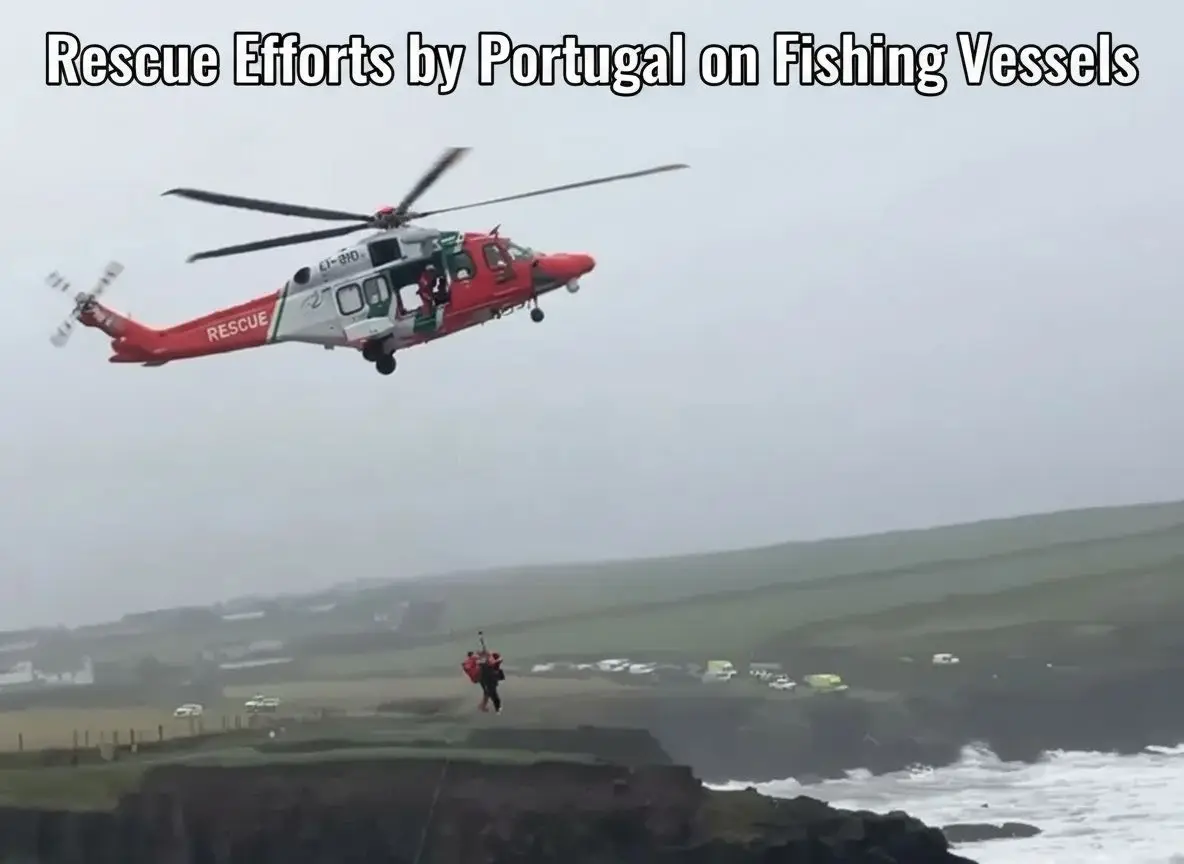
On a Tuesday morning, the Carlos Cunha sent a distress signal from 200 nautical miles off Portugal’s coast. The vessel, with seven Indonesian crew members, was in grave danger. The rescue operation was swift and multi-faceted:
- Immediate Response:\ The vessel’s Emergency Position Indicating Radio Beacon (EPIRB) was activated, alerting authorities to the emergency.
- Nearby Vessel Assistance:\ A nearby fishing vessel responded to the distress call, rescuing three crew members who had managed to board a life raft. Tragically, one of the rescued later died.
- Aerial and Naval Search:\ The Portuguese Navy and Air Force deployed aircraft and ships to scour the area for the four missing crew members. Search patterns were coordinated to maximise coverage, despite challenging winter sea conditions.
- Ongoing Search:\ The search continued for days, with authorities refusing to give up hope. The local government and fishing community provided support to the families, and the incident drew national attention to the risks faced by migrant workers in the industry.
Vila de Caminha: A Race Against Time
Just two days earlier, the Vila de Caminha capsized near the mouth of the Miño River. The rescue efforts here were equally intense:
- Spanish-Portuguese Coordination:\ Spain’s Salvamento Marítimo led the initial response, deploying a fixed-wing aircraft, a helicopter, and a rescue boat. Portuguese authorities joined the search, highlighting cross-border cooperation.
- Survivor Recovery:\ Two crew members, including the Portuguese skipper, were rescued and treated for hypothermia. The search for the three missing Indonesian crew members continued, with both nations’ maritime agencies working together.
- Vessel Recovery:\ The Vila de Caminha remained afloat, upside down, and eventually washed ashore, where it was secured and later removed from the beach.
Conclusion
The loss of the Carlos Cunha and Vila de Caminha is a sobering reminder of the perils of life at sea. While the number of maritime accidents in Portugal and across the EU has shown a downward trend in recent years, fishing vessels remain particularly vulnerable. The heroic rescue efforts, though not able to save all, demonstrated the dedication and professionalism of maritime authorities. As the industry reflects on these tragedies, the call for improved safety and international cooperation grows ever stronger.
