

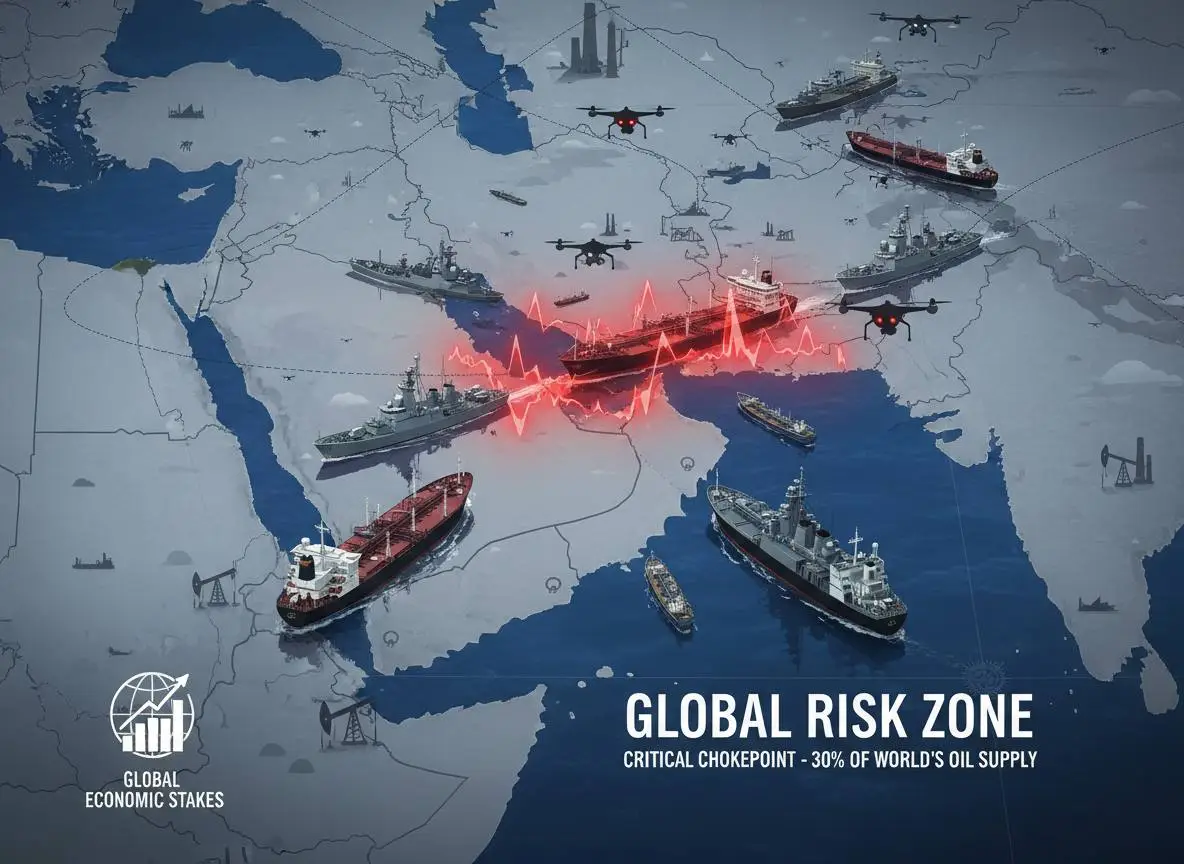
The new US-Iran crisis raises the geopolitical barometer in the Persian Gulfin in the red zone. As of February 2026, the rhetoric between Washington and Tehran has made all scenarios possible except for peace.
For the maritime industry, this situation is not just about headlines; it impacts operational costs, route viability, and the safety and security of ships passing through the area, as well as global energy stability. For many major players in the maritime industry, it also presents an opportunity for more profitable business, as freight rates will likely increase, along with their profit margins.
The State of Play: How Close Are We?
The current tension is characterised by a “dual-track” reality. On one hand, high-stakes negotiations are underway in Geneva; on the other, a massive naval buildup suggests that the window for diplomacy is closing.
- Military Presence: The deployment of the USS Abraham Lincoln and the USS Gerald R. Ford carrier strike groups to the Arabian Sea represents the largest concentration of Western naval power in the region since 2003.
- The Deadline: U.S. President Donald Trump has signalled a late-February 2026 deadline for Iran to meet substantive nuclear and ballistic missile concessions.
- The Counter-Signal: In a display of “guarded continuity,” the Iranian Revolutionary Guard (IRGC) recently conducted live-fire exercises in the Strait of Hormuz, practising the “hijack and recovery” of commercial vessels—a move clearly intended to demonstrate their ability to hold the world’s most critical chokepoint hostage.
Probability of Conflict
While full-scale war remains a “tail risk” (estimated at 3–7%),
According to Reuters, the probability of conflict today is very high, potentially approaching the 90% estimate cited by U.S. advisers.
This does not guarantee conflict today, but the situation is on the edge, with both sides:
- Expecting a potential strike
- Preparing military assets
- Issuing threats and warnings
- Failing to reach diplomatic progress
The Maritime Chokepoint: The Strait of Hormuz
The Strait of Hormuz is the jugular vein of the global energy market. Only 21 nautical miles wide at its narrowest point, it handles a staggering volume of traffic.+1
Key Statistics of the Strait (2025-2026 Data)
| Metric | Value |
| Daily Oil Flow | ~20.5 Million Barrels per Day (mb/d) |
| Global Seaborne Oil % | ~35% |
| LNG Traffic | ~20% of global liquefied natural gas |
| Tightest Passage | 2 nautical miles (Traffic Separation Scheme) |
If the Strait were to be closed, even partially, the maritime industry would face an immediate systemic shock. There is no easy “Plan B.” Alternative pipelines through Saudi Arabia and the UAE can only handle a fraction of the total volume, leaving over 15 mb/d stranded.
Consequences for the Maritime Industry
A conflict with Iran would not just be a “regional” problem. It would affect the global trade and certainly every shipowner and charterer globally.
1. The Insurance “Explosion”
In the maritime world, risk has a price tag. Within hours of a kinetic engagement, War Risk Premiums would skyrocket. We saw this in the Red Sea crisis of 2024, but a Persian Gulf conflict would be orders of magnitude more severe.
- Premium Hikes: Current estimates suggest premiums could jump 200-400% above baseline rates.
- Blocking and Trapping: Insurers are already advising owners to secure “Blocking and Trapping” (B&T) coverage, which protects against vessels being stuck in the Gulf for more than 12 months due to a blockade.
2. Operational Hazards: Beyond the Missile
Conflict in 2026 isn’t just about torpedoes. The “Shadow War” tactics already being deployed include:
- GPS Spoofing & Jamming: Forcing vessels into Iranian territorial waters to justify “legal” seizures.
- Sea Mines: The IRGC’s “smart” naval mines are low-cost, high-impact tools that can paralyze shipping lanes for weeks.
- UAV Swarms: Coordinated drone strikes on tanker superstructures to disable bridge operations.
3. Economic and Freight Volatility
The “War Premium” isn’t just for insurance; it’s for fuel. If Brent crude hits the projected $100–$120 per barrel scenario, bunker costs will decimate the margins of dry bulk and container fleets.
“A vessel diverted around the Cape of Good Hope to avoid the Gulf adds approximately 25–30 days to a voyage and $1.5–$2.5 million in additional costs per VLCC (Very Large Crude Carrier) shipment.”
Additional Costs from Rerouting Away from the Strait of Hormuz
| Vessel Type | Extra Days (approx.) | Extra Fuel Cost | Extra Hire / Time-Charter Cost | War‑Risk Insurance Increase | Total Additional Cost per Voyage |
|---|---|---|---|---|---|
| VLCC (Very Large Crude Carrier) | +16 days | $480,000–$735,000 (fuel at $30–35k/day) [eia.gov] | $350,000–$450,000 (typical TCE range) | $200,000–$360,000 (0.2–0.4% vs 0.125%) [bertling.com] | $1.0M–$1.5M |
| Aframax Tanker | +16 days | $320,000–$450,000 | $200,000–$300,000 | ~$110,000 increase (110% total cost rise reported) | $650k–$850k |
| Large Container Ship | +14–16 days | $500,000–$700,000 | $250,000–$400,000 | $150,000–$250,000 (higher WRS exposure for flagged vessels) | $900k–$1.3M |
How These Values Were Derived (for transparency in your article)
1. Longer voyage time
Rerouting adds ~16 days to Gulf–Europe routes, dramatically increasing fuel consumption and hire rates.
2. Fuel cost impact
Large vessels burn $30–35k/day in bunkers, pushing additional fuel costs into the hundreds of thousands.
3. Hire / time-charter
Freight markets tighten due to longer transit times, requiring more vessels to achieve the same fleet throughput, elevating hire costs.
4. War‑risk insurance
Premiums surged from 0.125% → 0.2–0.4%, and up to 0.7% for some vessels, adding $200k–$360k for large crude carriers.
Conclusion
The maritime industry currently sits in a state of “guarded continuity.” While AIS data shows that tankers are still transiting the Strait, the “wait-and-see” approach is being replaced by active contingency planning. The industry is better prepared than it was five years ago, thanks to experience in the Red Sea and Ukraine, but the scale of a potential Iran conflict remains unparalleled.
For now, the anchor is holding, but the chain is under immense tension.
Sources
- Maritime Administration (MARAD) Advisory 2026-001.
- BloombergNEF Oil Market Outlook (Q1 2026).
- Lloyd’s List Intelligence: Middle East Risk Assessment.
- Center for Strategic and International Studies (CSIS): Mapping Disruption Scenarios.
