
The article was primarily developed using technical data, acquisition reports, and strategic analyses from the U.S. Department of Defense and legislative oversight bodies (see references).
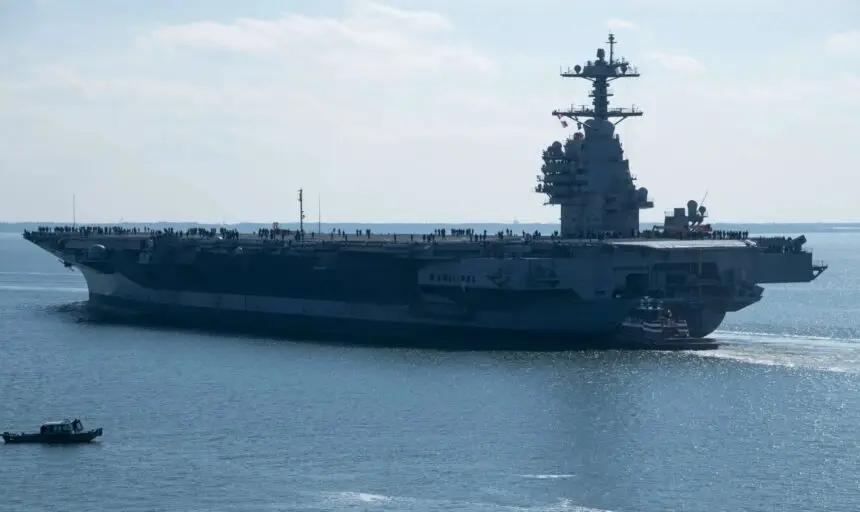
The U.S. Navy and shipbuilding giant Huntington Ingalls Industries (HII) have officially kicked off a new chapter in naval aviation with the commencement of builder’s sea trials for the USS John F. Kennedy (CVN-79). Departing from Newport News Shipbuilding in Virginia on January 28, 2026, the second-in-class Gerald R. Ford-class aircraft carrier has begun its crucial initial phase of testing in the open waters of the Atlantic. This momentous event marks a significant milestone, bringing the nation closer to adding another formidable asset to its carrier strike group capabilities.
What Are Builder’s Sea Trials and Why Do They Matter?
Builder’s Sea Trials represent the first comprehensive operational assessment of a newly constructed warship at sea. During this rigorous period, the shipbuilder, in this case, HII’s Newport News division, meticulously tests virtually every system aboard the carrier. From its complex propulsion systems to its cutting-edge combat electronics, the trials ensure the vessel meets its stringent design specifications and is fit for naval service.

Key aspects being tested include:
-
Propulsion and Maneuvering: Pushing the two A1B nuclear reactors to their limits, assessing steering, speed, and emergency maneuvering capabilities.
-
Hull Integrity: Verifying the structural soundness of the massive 100,000-ton hull under dynamic conditions.
-
Navigation Systems: Calibrating and testing all navigation and communication equipment.
-
Habitability and Life Support: Ensuring all crew support systems, from galleys to berthing, are fully functional.
Successful completion of these trials is paramount before the ship can proceed to acceptance trials, where the U.S. Navy officially evaluates the vessel for delivery.
Advanced Technology on Display: The SPY-6(V)3 Radar and F-35C Integration
One of the most anticipated aspects of the Kennedy’s trials is the at-sea evaluation of its sophisticated AN/SPY-6(V)3 Enterprise Air Surveillance Radar (EASR). This state-of-the-art radar system is a significant upgrade from the previous generation found on the lead ship, USS Gerald R. Ford (CVN-78), promising enhanced air and missile defence capabilities. Its debut on CVN-79 is a critical step in integrating next-generation sensing into the carrier fleet.
Furthermore, the Kennedy boasts seamless integration for the F-35C Lightning II stealth fighter from its inception. Unlike its predecessor, which required post-delivery modifications, CVN-79 was designed and built with F-35C compatibility embedded from day one. This forward-thinking approach ensures the Kennedy can immediately deploy the Navy’s most advanced strike fighter upon commissioning, maximizing its combat readiness.
Overcoming Challenges: Lessons Learned from the Ford Class
The journey to sea trials for CVN-79 has not been without its complexities. The program experienced delays, notably pushing its estimated delivery to March 2027. These delays were largely strategic, aimed at incorporating crucial lessons learned from the USS Gerald R. Ford and mitigating future issues.
A primary driver for the extended timeline was the mandated integration of the F-35C during construction. This required significant design adjustments and system recalibrations. Additionally, the Navy utilized this period to further refine the Electromagnetic Aircraft Launch System (EMALS) and the Advanced Weapons Elevators (AWEs) – technologies that famously presented challenges during the Ford’s initial operational phases. The goal is a more mature and reliable system upon the Kennedy’s entry into service, ensuring smoother operations and higher sortie generation rates.
The Future Fleet: Where CVN-79 Fits In
The USS John F. Kennedy is the second ship of the Gerald R. Ford-class, designed to replace the venerable Nimitz-class carriers. With the USS Nimitz (CVN-68) slated to begin its decommissioning process in May 2026, the timely delivery and operationalization of CVN-79 are more critical than ever. The U.S. Navy legally requires 11 operational aircraft carriers, and the Kennedy’s successful trials will help maintain this vital force structure.
Here’s a quick look at the Ford-class fleet:
-
USS Gerald R. Ford (CVN-78): Fully operational, currently deploying worldwide.
-
USS John F. Kennedy (CVN-79): Currently undergoing Builder’s Sea Trials. Expected delivery: March 2027.
-
USS Enterprise (CVN-80): Under construction at Newport News Shipbuilding. Expected delivery: July 2030.
-
USS Doris Miller (CVN-81): Also under construction. Expected delivery: 2032.
What’s Next for CVN-79?
Following the successful conclusion of Builder’s Trials, the Kennedy will undergo Acceptance Trials, where the Navy’s Board of Inspection and Survey (INSURV) will conduct its final comprehensive evaluation. Once accepted, the ship will be officially delivered to the U.S. Navy, moving closer to its commissioning and eventual deployment. Upcoming tests will include “dead load” launches, where weighted sleds are propelled from the catapults to rigorously test the EMALS system before manned aircraft operations begin.
The USS John F. Kennedy represents the pinnacle of modern naval engineering and a testament to American shipbuilding prowess. Its sea trials are not just a technical exercise; they are a vital step in ensuring the United States maintains its global maritime superiority for decades to come.
References
Congressional Research Service. (2021). Navy Ford (CVN-78) Class Aircraft Carrier Program: Background and Issues for Congress. https://www.congress.gov/crs_external_products/RS/PDF/RS20643/RS20643.247.pdf
Government Accountability Office. (2014). FORD-CLASS AIRCRAFT CARRIER: Congress Should Consider Revising Cost Cap Legislation to Include All Construction Costs (GAO-15-22). https://www.gao.gov/assets/gao-15-22.pdf
U.S. Navy. (2015). Selected Acquisition Report (SAR): CVN 78 Gerald R. Ford Class Nuclear Aircraft Carrier. Defense Technical Information Center. https://www.esd.whs.mil/Portals/54/Documents/FOID/Reading%20Room/Selected_Acquisition_Reports/FY_2015_SARS/16-F-0402_DOC_50_CVN_78_DEC_2015_SAR.pdf
