
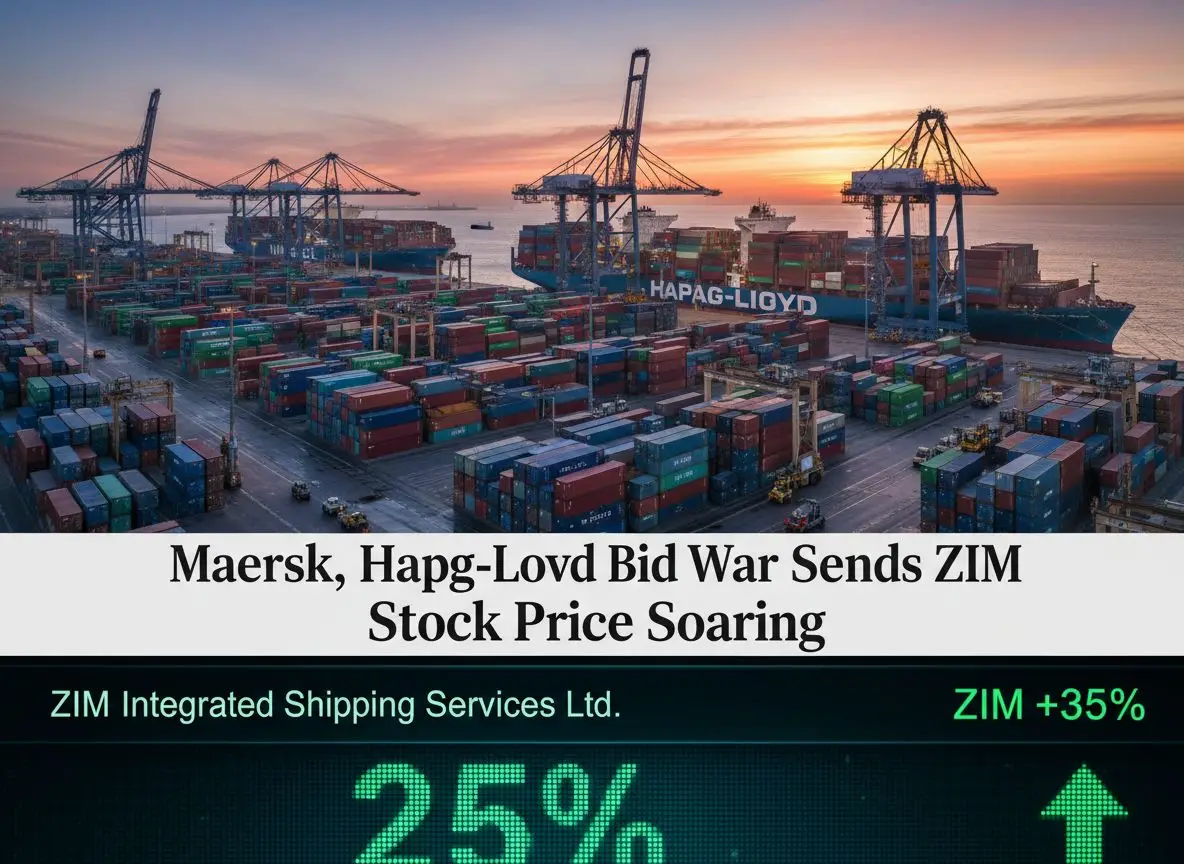
ZIM shares have gained 32% since January as Denmark’s Maersk and Germany’s Hapag-Lloyd submit final binding offers to acquire the Israeli container shipping company.
The acquisition battle positions Maersk, the world’s second-largest shipping company valued at approximately $34 billion, against Hapag-Lloyd, the fifth-largest maritime carrier with a market capitalization of about $24 billion. ZIM’s board is now evaluating the competing proposals submitted last week.
ZIM presents an unusual financial target, holding approximately $3 billion in cash while trading at a market capitalization of around $2.4 billion. The company’s shares climbed from $15 to $19.87 as of December 3, though this remains well below the $10.6 billion market value ZIM reached during its March 2022 peak.
The strategic review process, managed by investment bank Evercore, has attracted intense interest from major shipping lines seeking to capitalize on ZIM’s undervalued position. Industry observers are monitoring how the acquisition battle will reshape the consolidation of global container shipping.
Board Evaluates Competing Offers as Management Bid Falls Short
ZIM’s board has rejected a revised acquisition proposal from an entity owned by CEO Eli Glickman and businessman Rami Ungar, stating that the offer “significantly undervalued the Company.” The rejection comes as Evercore, the investment bank managing the strategic review, evaluates binding offers from the two shipping giants submitted last week.
Board chairman Yair Seroussi emphasized that all proposals are being evaluated with a focus on “delivering significant value to all the Company’s shareholders”. Evercore must now decide whether to conduct parallel negotiations or implement a competitive bidding process between Maersk and Hapag-Lloyd.
Reports suggest a third bidder may join the race next week. Mediterranean Shipping Company (MSC) previously denied submitting a bid to acquire ZIM.
ZIM cautioned that there is no guarantee that any transaction will result from the strategic review process. The board’s evaluation continues as the two leading contenders await a decision on the next phase of negotiations.
Political resistance emerges
Union and government officials have raised opposition to the foreign acquisition of ZIM, particularly targeting Hapag-Lloyd’s bid due to its Middle Eastern shareholders.
Union chairman Oren Caspi met with Transportation Minister Miri Regev to voice concerns about Hapag-Lloyd’s ownership structure, which includes Qatar’s investment authority holding 12.3% and Saudi Arabia’s Public Investment Fund owning 10.2%. “Foreign ownership, particularly from countries with historically tense relations with Israel, threatens national security,” Caspi argued, emphasizing that 98% of Israel’s trade by weight depends on maritime transport.
The acquisition faces a significant regulatory hurdle under Israel’s “golden share” provision, which grants the government a veto over transactions that exceed 24% of the company’s ownership. This mechanism requires ZIM to maintain a majority-Israeli board, an Israeli chairman, and keep 11 vessels available for emergency state use.
Both Prime Minister Benjamin Netanyahu and Transportation Minister Regev must approve any acquisition deal. Regev has expressed sympathy with the union’s position and pledged to bring the matter before the cabinet for discussion.
The National Emergency Authority has also opposed foreign control, favouring measures to keep ZIM ownership in Israeli hands to ensure continuity of state functions.
Financial dynamics drive acquisition interest
ZIM’s resilience during recent freight rate volatility has attracted institutional investors who increased their stakes ahead of acquisition announcements. The company maintained strong operational performance throughout global supply chain disruptions, according to financial analysts tracking the strategic review process.
Major shareholders have positioned themselves to benefit from either standalone growth or premium buyout offers. This institutional activity indicates confidence in ZIM’s prospects despite container shipping market uncertainties.
The acquisition structure must address Israel’s golden share mechanism, which requires any successful bidder to balance shareholder returns with national security considerations. Government veto power over transactions exceeding 24% ownership creates both leverage for improved offers and uncertainty in bidding strategies.
“The deal structure impacts valuation models significantly,” said one analyst familiar with the process. Both Maersk and Hapag-Lloyd must factor regulatory oversight into their pricing strategies, which could affect final offer timing.
The Israeli government’s approval requirements add complexity that could ultimately benefit shareholders by yielding higher premiums, though this government involvement introduces variables that complicate standard acquisition planning.
The ZIM acquisition contest demonstrates how regulatory frameworks and national security considerations shape the foremost shipping transactions. ZIM’s board continues to evaluate the competing proposals as political opposition mounts to foreign ownership.
Israel’s golden share mechanism gives the government decisive influence over any transaction exceeding 24% ownership. Both Prime Minister Benjamin Netanyahu and Transportation Minister Miri Regev must approve the final deal.
The eventual outcome will establish precedent for how nations balance commercial interests with strategic infrastructure protection. ZIM’s unusual cash position – holding $3 billion against a $2.4 billion market value – has already attracted institutional investors who increased their stakes in recent months.
The board, chaired by Yair Seroussi, emphasized that all proposals are being evaluated to “deliver significant value to all the Company’s shareholders.” However, ZIM has cautioned that there is no guarantee that any transaction will be completed as part of this strategic review.
This is a developing story and will be updated as more information becomes available.
Key Takeaways
The ZIM acquisition battle reveals how undervalued shipping assets can trigger intense corporate competition, with significant implications for investors and national security considerations.
• ZIM’s unique financial position drives bidding war: Company holds $3 billion cash against $2.4 billion market cap, creating attractive acquisition target for Maersk and Hapag-Lloyd
• Stock price surged 32% amid acquisition interest: ZIM shares climbed from $15 to $19.87 since January as global shipping giants submit binding offers
• Israeli government holds veto power through “golden share”: Any deal exceeding 24% ownership requires approval from Prime Minister and Transportation Minister, protecting national interests
• Labor unions resist foreign takeover citing security concerns: Opposition focuses on Hapag-Lloyd’s Qatari and Saudi shareholders, emphasizing Israel’s 98% maritime trade dependency
• Regulatory hurdles may benefit shareholders: Government oversight creates leverage that could drive higher acquisition premiums while adding deal uncertainty
This acquisition battle demonstrates how geopolitical considerations increasingly shape corporate transactions in critical infrastructure sectors, potentially setting new precedents for balancing shareholder value with national security interests.
