
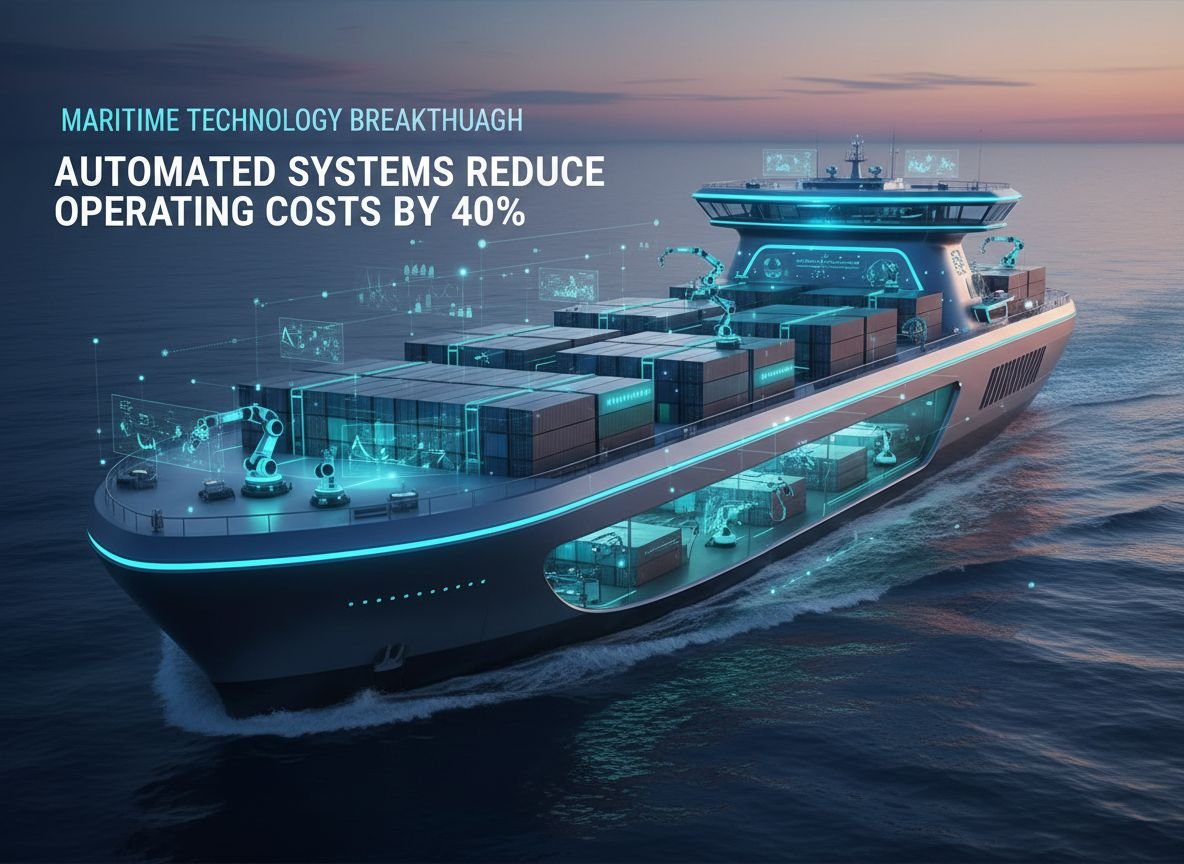
Automated maritime systems are reducing shipping operational expenditure by 40%, according to industry analysis of early deployment data. This development comes as the marine sector accounts for 3% of global greenhouse gas emissions, placing efficiency improvements under increased scrutiny from regulators and operators.
Recent surveys indicate that more than 60% of maritime professionals expect significant reductions in operational expenditure from autonomous shipping. The adoption rate reflects a fundamental shift in vessel operations and fleet management practices.
Industry data shows that 90% of newly built ships will incorporate AI capabilities by 2030, marking a substantial change in how vessels are designed and operated. Commercial operators identify crew reductions as the primary benefit of automation, cited by 29% of respondents, followed by enhanced safety protocols at 24% and fuel efficiency optimization at 22%.
The financial impact extends beyond personnel costs. AI-powered systems that adjust navigation using real-time weather and performance data reduce fuel consumption by 10%. IoT-based predictive maintenance systems have demonstrated a 20% reduction in vessel maintenance costs while improving operational uptime by 15%.
This analysis examines the specific technologies behind the 40% cost reduction, implementation challenges facing the maritime sector, and the outlook for an industry where automation is becoming standard practice rather than experimental technology.
Maritime Automation and Operating Cost Impact
Maritime automation encompasses technology-driven solutions that control the flow of goods, data, and resources throughout shipping operations. These systems range from freight processing and logistics management to warehouse robotics, all designed to reduce manual tasks and improve operational accuracy.
Automation versus autonomy
The International Maritime Organization distinguishes between automated and autonomous systems through its Maritime Autonomous Surface Ship (MASS) framework. The IMO defines MASS as vessels equipped with decision-support systems that operate with varying degrees of independence from human interaction.
The organization has established four degrees of autonomy:
- Ships with automated processes and decision support (seafarers on board)
- Remotely controlled ships with seafarers on board
- Remotely controlled ships without seafarers on board
- Fully autonomous ships where operating systems make decisions and determine actions independently
Port automation technologies include automated cranes, smart container tracking, and digital yard management systems that enhance throughput and enable terminals to handle higher volumes with greater accuracy.
Financial impact on vessel operations
DNV GL’s CEO reports that leading shipowners can reduce operating costs by approximately 30% or more through digital systems and processes implementation. McKinsey analysis indicates that companies implementing logistics automation achieve operational cost reductions of 20%.
Crew expenses typically represent 30-40% of vessel operating costs, making personnel reduction a primary economic driver for autonomous ship adoption. Additional cost reductions result from faster freight processing, with companies reducing cycle times by up to 50%. Automation also eliminates human errors in billing and shipment data while providing better scalability through cloud services and real-time tracking analytics.
Technology trends shaping adoption
Digital technology implementation serves dual purposes: increasing operational efficiency and supporting industry decarbonization efforts. The integration of AI with automation and analytics is reshaping maritime logistics operations.
Current development priorities include IT system integration with enhanced network connectivity, automation and remote monitoring control systems, plus data management with improved cybersecurity measures. The industry is also focusing on power-system optimization and waste-heat recovery technologies.
The global autonomous ships market is projected to reach £126.63 billion by 2030, reflecting a compound annual growth rate of 6.8% from 2020 to 2030. Yara Birkeland, the world’s first autonomous, zero-emission container vessel, demonstrates the practical application of these technologies.
Maritime stakeholders are reassessing current strategies to secure efficient, sustainable operations and strengthen competitive positioning.
Technologies Behind the 40% Cost Reduction
Five breakthrough technologies account for the documented 40% reduction in maritime operating costs. Each system addresses specific operational challenges while working together to optimize vessel performance and reduce expenses.
AI-Powered Route Optimization
Route optimization systems analyze weather forecasts, sea conditions, and vessel performance data to recommend efficient navigation paths. Unlike conventional routing, these AI-powered solutions continuously recalculate routes to avoid storms, high waves, and congested shipping lanes.
Fuel savings range from 3-5%, translating to approximately $100,000 annually per vessel. Advanced implementations achieve 10-15% fuel consumption reductions by selecting energy-efficient routes and minimizing idle time. These systems also synchronize port arrivals with berth availability, reducing delay-related costs.
Remote Operations Centers and Crew Reduction
Remote operation technology enables vessels to function with minimal onboard personnel through centralized Remote Operations Centers (ROCs). These “autoremote” systems control vessel operations from shore-based facilities.
Ships designed for autonomous operation eliminate crew accommodations, galleys, and related systems, reducing weight while increasing cargo capacity. The structural simplification provides additional cost benefits beyond personnel reductions.
Sensor-Based Predictive Maintenance
Machinery damage or failure caused 11,506 maritime incidents between 2014 and 2023, nearly four times the number of collisions. Technical equipment failures accounted for over 50% of incidents in 2023 alone.
Predictive maintenance systems monitor critical components including engines, pumps, and generators through onboard sensors. Machine learning models analyze vibration, temperature, and pressure data to predict equipment failures before they occur. This approach reduces unexpected breakdowns and extends equipment lifespan.
Automated Port Operations
All ten largest U.S. container ports now use automation technology. Systems include automated gate operations, remote-controlled ship-to-shore cranes, automated stacking cranes, and automated guided vehicles.
Automated terminals reduce longshore labor requirements by approximately 50%. These systems operate continuously without breaks or shift changes, increasing terminal throughput and reducing vessel turnaround times.
Digital Twin Monitoring Systems
Digital twin technology creates virtual models replicating a ship’s physical characteristics and operational behavior. These systems continuously receive real-time sensor data covering engine performance, fuel consumption, and navigation status.
Operators compare predicted performance from digital twin simulations with actual vessel performance to identify inefficiencies. Unlike traditional simulations, digital twins evolve in real-time, reflecting current vessel conditions. This capability allows virtual testing of modifications before physical implementation.
Adoption Challenges Across the Maritime Sector
Maritime automation faces substantial implementation barriers despite demonstrated cost savings. Regulatory uncertainty, infrastructure gaps, and technical standardization issues continue to slow widespread deployment across the shipping industry.
Regulatory Delays and IMO Framework Timeline
The International Maritime Organization currently lacks fully binding rules governing AI-based decision support systems or partially autonomous ships. The IMO is developing the Maritime Autonomous Surface Ships (MASS) Code, but this framework will only be finalized by May 2026 as non-mandatory guidance. Full mandatory implementation is not expected until 2032.
This regulatory gap leaves shipowners subject to different interpretations by national entities. The uncertainty creates hesitation among operators, even when technologies could enhance situational awareness and sustainability.
Lack of Infrastructure for Full Autonomy
Critical infrastructure for autonomous shipping remains incomplete. Significant gaps exist in how MASS control systems interact with national infrastructure. The U.S. Coast Guard lacks authority to waive minimum crewing requirements outside specific pilot programs.
This inability to reduce crew below statutory minimums makes capital investment in automation technologies financially impractical for many operators. Current port facilities are designed primarily for human-operated vessels, creating operational challenges during the transition period when mixed fleets operate.
Technology Standardization and Interoperability Issues
Classification societies apply different criteria in their analysis and assessments of automated shipping. Standards remain neither uniform nor legally binding. Flag states show inconsistent approaches to ship autonomy aspects.
Global fleets operating across multiple jurisdictions face confusing requirements that impede adoption of automation technologies. These interoperability challenges must be addressed before systems can work together effectively.
Cybersecurity Risks in Connected Systems
Connected autonomous systems face potential compromise leading to environmental disasters from collisions, vessel hijacking, theft, or blackmail. Offshore units present particular challenges due to their 20-30 year lifespans—cybersecurity defenses installed today may become outdated despite regular maintenance.
The integration of operational technology with information technology networks creates environments where malicious actors can exploit vulnerabilities. These risks are amplified in 2025 as cybercriminals employ AI and automation to make their attacks more effective and difficult to detect.
Commercial and Military Applications Diverge
Automation applications differ substantially between commercial shipping and naval operations, according to industry surveys that reveal distinct priorities across sectors.
Commercial Focus on Operating Economics
Commercial maritime operators emphasize cost reduction above operational capabilities. Enhanced safety protocols rank second at 24%, while fuel efficiency optimization follows at 22%. Real-time route optimization based on weather and traffic conditions delivers measurable fuel savings that directly impact operating margins.
Vessels designed without crew quarters, galleys, and recreational areas can dedicate additional space to cargo, increasing revenue potential per voyage. This structural advantage compounds the personnel cost savings already achieved through reduced manning requirements.
Military Priorities on Mission Enhancement
Naval applications prioritize mission profile improvement, which ranks as the top military concern at 26%. Crew reduction for dangerous missions follows at 21%, with operational endurance improvements at 15%.
The U.S. Naval Research Laboratory has demonstrated extended autonomous capability through a 507-kilometer autonomous underwater vehicle mission lasting 109 hours. This endurance exceeds what human-crewed vessels typically achieve in mine countermeasures operations.
Swarming technologies represent another distinct military application. The Office of Naval Research’s Cooperative Autonomous Swarm Technology program develops coordinated operations capabilities for unmanned maritime systems. These distributed systems provide operational redundancy crucial for threat zone operations.
Accelerated Military Deployment
Dual-use technologies increasingly serve both commercial and military requirements. Military contexts often enable faster technology validation due to fewer regulatory constraints.
The U.S. Navy’s unmanned surface vessel expansion illustrates this acceleration, growing from 4 small vessels in 2025 to nearly 400 by year’s end. These platforms function as “force multipliers,” operating with remote instruction and autonomous navigation while supporting intelligence gathering, surveillance, and logistics missions. The capability protects personnel from high-risk environments while extending operational reach.
Future Outlook for Maritime Technology Companies
The maritime technology sector faces a gradual transition toward autonomous operations, with market projections showing measured growth over the next two decades.
Projected Market Share of Autonomous Vessels by 2040
Industry surveys indicate a conservative adoption timeline for autonomous vessels. By 2035, 80% of respondents expect autonomous vessels to capture less than 10% of the commercial shipping market. However, projections for 2040 show more substantial penetration—29% anticipate a 10-20% market share, while 21% predict autonomous vessels could constitute up to half the market by that time.
The autonomous ships market is currently valued at USD 5.61 billion (2023) and forecast to reach USD 12.25 billion by 2032. This growth trajectory aligns with expected regulatory framework completion and infrastructure development timelines.
R&D Investment Priorities
Navigation software development leads research investment at 30%, according to industry data, followed by sensors and camera systems at 25% and remote control technologies at 20%. Port infrastructure receives 11% of funding, personnel training 9%, and propulsion systems 5%.
The marine control systems market, valued at USD 7.27 billion in 2025, is projected to reach USD 14.58 billion by 2032. This expansion reflects sustained investment in enabling technologies across the sector.
Regional Development Patterns
Europe maintains the leading position in autonomous shipping development with 56% market share, driven by regulatory support and environmental requirements. Asia follows at 38% with strong technological capabilities, dominating the autonomous ship market with 37.79% share in 2023.
The Americas account for 6% of development activity, focusing primarily on military applications. The U.S. market is accelerating through Navy investments in unmanned surface vessels, representing a different approach to autonomous maritime technology adoption.
Decarbonization Applications
Maritime automation supports IMO’s 2050 zero-emission goals through improved fuel efficiency, reducing demand for carbon-neutral fuels. New MEPC83 regulations starting in 2028 will encourage transition to low-carbon fuels through revised standards and financial incentives.
Accurate emissions management during this transition will require transparent, reliable data from trusted monitoring sources. This requirement positions maritime technology companies to provide essential verification and tracking capabilities alongside operational automation.
Conclusion
Automated maritime systems have demonstrated a 40% reduction in operational expenditure across early implementations, establishing a new benchmark for shipping efficiency. AI-powered navigation systems contribute fuel savings of 10-15%, while predictive maintenance reduces equipment failures and extends operational lifespans.
Crew-related expenses, which typically account for 30-40% of vessel operating costs, represent the largest area for cost reduction through remote operations technology. Early adopters report substantial returns on investment despite regulatory frameworks that remain incomplete until 2032.
Implementation challenges persist across the sector. Regulatory uncertainty, infrastructure gaps, and cybersecurity vulnerabilities continue to slow widespread adoption. The International Maritime Organization’s Maritime Autonomous Surface Ships Code will not reach full mandatory implementation until 2032, creating hesitation among operators.
Europe maintains leadership in autonomous shipping development with 56% market share, while Asia follows at 38% with strong technological capabilities. The autonomous ships market, currently valued at USD 5.61 billion, is projected to reach USD 12.25 billion by 2032.
Industry projections indicate autonomous vessels could capture up to half the commercial shipping market by 2040, according to 21% of survey respondents. This adoption timeline aligns with expected regulatory completion and infrastructure development.
The technology also supports environmental compliance. Automated systems contribute to IMO’s 2050 zero-emission targets through improved fuel efficiency and route optimization. Starting in 2028, new MEPC83 regulations will encourage low-carbon fuel adoption through financial incentives.
Maritime automation represents both immediate cost reduction and long-term strategic positioning for shipping companies. Operators that implement these technologies early gain competitive advantages in efficiency and regulatory compliance.