
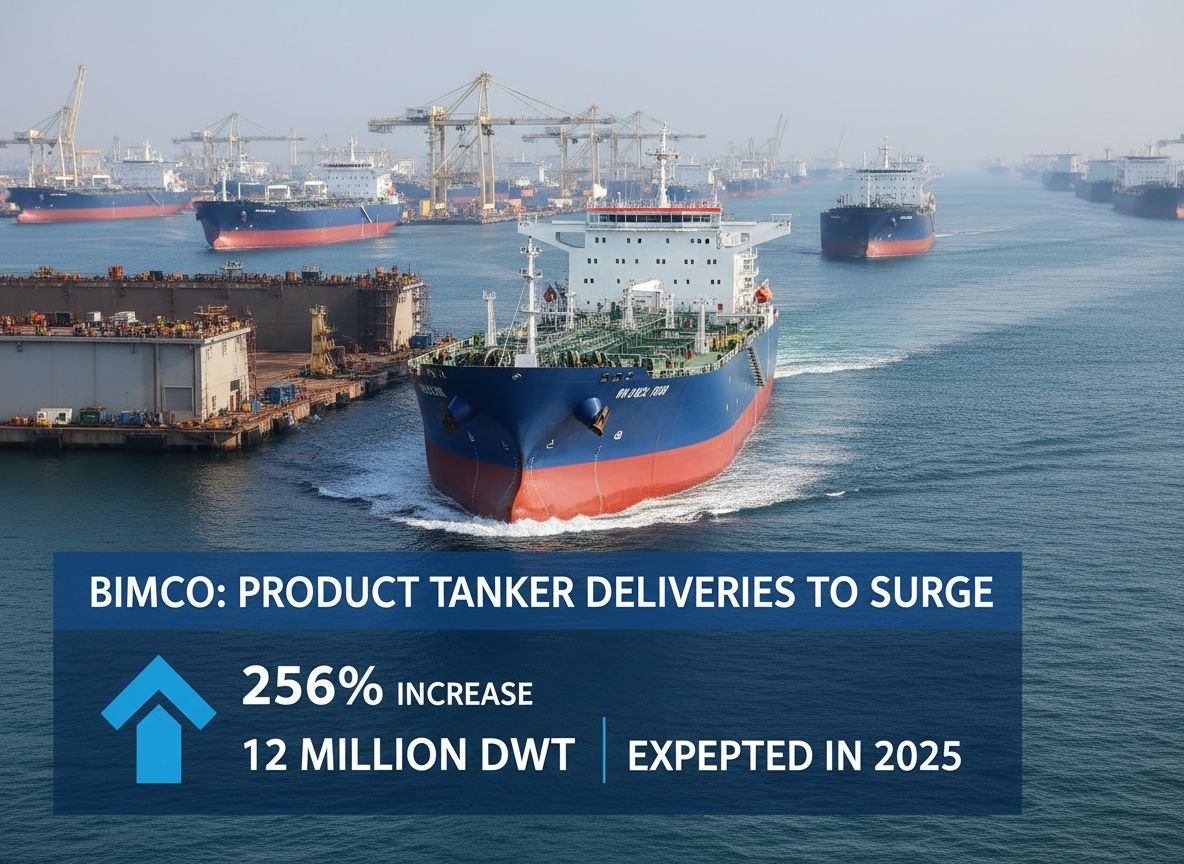
The global maritime sector is about to undergo a major change. BIMCO, a leading shipping association, predicts that new product tanker deliveries will soar by an extraordinary 256% in 2025, totalling 12 million deadweight tonnes (DWT). This surge will be the highest in 16 years and the second-highest ever recorded, marking the start of a new era for the product tanker market.
The Drivers Behind the Surge
The dramatic increase in deliveries is rooted in a wave of contracting activity during 2023 and 2024. Over these two years, shipowners placed orders for 551 new product tankers, totalling 38.7 million DWT. This figure far exceeds the previous decade’s annual average of 122 ships (7.3 million DWT).
As a result, the orderbook has ballooned from 10.6 million DWT at the start of 2023 to 41.2 million DWT by early 2025. The orderbook-to-fleet ratio has also jumped from 6% to 22%, reflecting the industry’s confidence in future demand and the need to modernise fleets.
Segment Breakdown: MR and LR2 Tankers Lead the Way
BIMCO’s analysis highlights that the MR (Medium Range) and LR2 (Long Range 2) segments are at the forefront of this expansion. Of the new orders, 278 are MR tankers, while LR2 tankers account for the largest capacity at 19.2 million DWT. In 2025, 98 MR tankers and 52 LR2 tankers are scheduled for delivery, representing 4.9 million and 6.0 million DWT, respectively.
Compared to the fleet size at the beginning of 2025, these deliveries will increase the deadweight capacity of the Handysize, MR, LR1, and LR2 fleets by 2%, 6%, 3%, and 12%, respectively.
Environmental and Operational Implications
Despite the surge in newbuilds, BIMCO raises concerns about the pace of fleet renewal and decarbonisation. Only 7% of the ships scheduled for delivery in 2025 are capable of using alternative fuels, with another 12% designed for future retrofitting. The remainder will rely on conventional fuels, highlighting the industry’s slow transition towards greener technologies.
Recycling activity has also lagged, with the average age of the product tanker fleet increasing by more than 2.5 years since 2020. Currently, 10% of the fleet’s capacity consists of ships older than 20 years. This overhang of older vessels, combined with slow recycling, could delay the sector’s decarbonisation efforts and prolong the operational life of less efficient ships.
Market Outlook: Opportunities and Challenges
While the surge in deliveries will expand fleet capacity by 5-6% in 2025, BIMCO cautions that demand growth may not keep pace. Slowing oil demand, ongoing geopolitical tensions—including Russian sanctions and disruptions in the Red Sea—and the slow pace of vessel recycling could create market imbalances.
BIMCO’s Chief Shipping Analyst, Niels Rasmussen, notes that the low recycling activity over the past five years has created an overhang of older ships. If recycling does not accelerate, the market could face oversupply, putting downward pressure on freight rates and challenging operators to maintain profitability.
Strategic Considerations for Maritime Executives
For maritime executives, the coming year presents both opportunities and risks:
- Fleet Renewal: The influx of modern, more efficient vessels offers a chance to upgrade fleets and improve operational efficiency.
- Environmental Compliance: With only a small share of new ships ready for alternative fuels, executives must plan for future retrofits and compliance with tightening environmental regulations.
- Market Volatility: The risk of oversupply and uncertain demand growth requires agile fleet management and strategic deployment to maintain competitiveness.
- Geopolitical Risks: Ongoing disruptions and sanctions may affect trade routes and vessel utilisation, demanding robust risk management strategies.
Conclusion
The 256% surge in new product tanker deliveries forecasted by BIMCO for 2025 is set to reshape the global maritime landscape. While this growth brings opportunities for renewal and expansion, it also introduces challenges related to environmental compliance, market balance, and operational strategy. Maritime executives must stay informed and proactive to navigate this dynamic environment successfully.