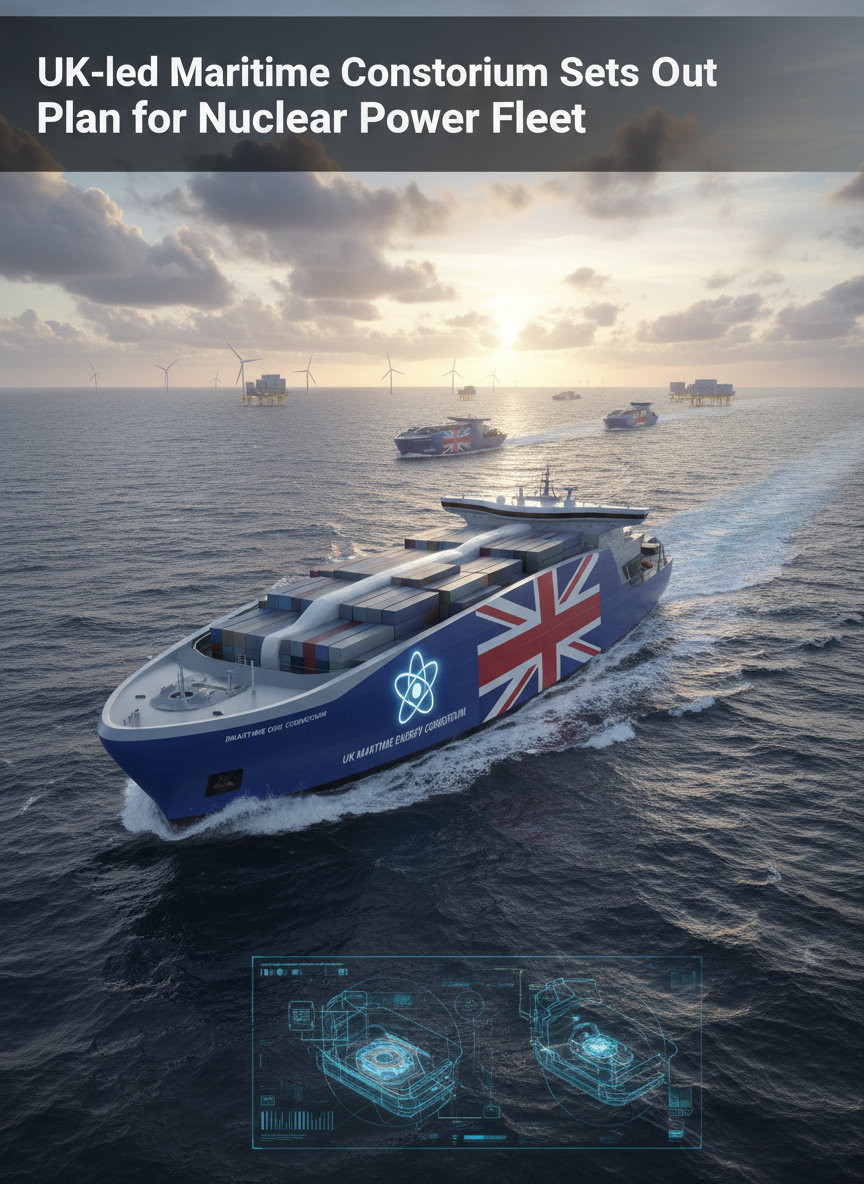
The UK has taken a bold step toward transforming the future of clean maritime transport with the launch of the Maritime Nuclear Consortium, a cross‑sector alliance designed to accelerate the safe, commercial adoption of nuclear-powered ships. Convened by Lloyd’s Register (LR), the consortium brings together world-leading expertise in nuclear engineering, ship design, regulation, insurance, and security—positioning the UK at the forefront of zero‑carbon shipping innovation.
🌍 A Major Move in the Race to Decarbonise Global Shipping
Shipping accounts for around 3% of global CO₂ emissions, and decarbonising the sector remains one of the toughest challenges in the energy transition. Nuclear propulsion—already proven in naval fleets—offers a transformative solution.
Advanced Modular Reactors (AMRs), the next generation of compact nuclear systems, can power vessels for years without refuelling. They produce zero carbon emissions, operate at full design speed without efficiency trade-offs, and incorporate rigorous safety and security features from the outset.
With more than 700 marine nuclear reactors already operating in navies worldwide, the technology is mature. The challenge now is adapting it for commercial use—and the UK intends to lead that transition.
⚓ Who’s in the Maritime Nuclear Consortium?
The consortium unites some of the UK’s most influential organisations across critical sectors:
| Organisation | Role |
|---|---|
| Lloyd’s Register | Lead, safety oversight, secretariat |
| Rolls-Royce | Reactor design and AMR expertise |
| Babcock International Group | Ship design, construction, and integration |
| Global Nuclear Security Partners (GNSP) | Security and safeguards |
| Stephenson Harwood | Legal and regulatory guidance |
| NorthStandard | Insurance and risk management |
This combination of engineering capability, regulatory credibility, and financial infrastructure gives the UK a unique platform to shape global standards for nuclear-powered shipping.
🇬🇧 Why the UK Is Positioned to Lead
The UK has a long history of maritime innovation—from shipbuilding to naval nuclear propulsion—and retains world-class engineering talent, trusted regulators, and deep capital markets. This ecosystem spans:
- Naval nuclear expertise built over decades
- Shipbuilding and marine engineering hubs across the UK
- London’s global financial and insurance markets
- Robust regulatory institutions respected worldwide
Together, these strengths create a complete value chain capable of supporting the design, regulation, financing, and insuring of nuclear-powered vessels.
But the opportunity is time-sensitive. Other nations are rapidly developing their own standards and technologies. Without coordinated action, the UK risks losing first-mover advantage, along with the associated jobs, investment, and supply chain leadership.
🚀 The Consortium’s First Programme: Setting Global Standards
The Maritime Nuclear Consortium will focus on five foundational workstreams:
- Achieving a Statement of Design Acceptability (SODA) for a generic, site-licensed AMR
- Developing a class certification framework that integrates nuclear and maritime regulation
- Defining a security and safeguards architecture aligned with international requirements
- Establishing insurability pathways for nuclear-powered commercial vessels
- Publishing guidance to accelerate safe adoption across industry and government
These steps aim to create a clear regulatory and commercial pathway for nuclear propulsion—something the global shipping industry currently lacks.
🗣️ Industry Leaders: Nuclear Shipping Is Ready
Nick Brown, CEO of Lloyd’s Register, emphasised the generational importance of the initiative, noting that nuclear power has been used safely in naval fleets for decades and now offers a credible route to zero‑carbon commercial shipping.
Jake Thompson, Director of Rolls-Royce AMRs, highlighted that nuclear is increasingly recognised as a key component of the energy transition, and that multi-sector collaboration is essential to shaping future international codes.
NorthStandard’s Mike Salthouse underscored the critical role of insurance in enabling confidence and adoption, stressing that safety, regulation, and human expertise must work hand in hand.
GNSP Senior Partner Nick Tomkinson reinforced that safety, security, and safeguards must be integrated from the start—an area where the consortium’s guidance will be vital.
Stephenson Harwood Partner Kirsti Massie noted that nuclear power could “turbo‑charge” the UK’s decarbonisation efforts, while Babcock’s Marine Engineering Director Maria Taboada framed the transition as a strategic move to secure long-term maritime leadership.
🌐 A Defining Moment for the Net-Zero Ocean Economy
As global shipping seeks scalable, zero-emission propulsion, nuclear power stands out as one of the few technologies capable of delivering long-range, high-speed, carbon-free operation. By shaping the rules and standards for emerging reactor designs, the UK aims to anchor a new global supply chain and create high-skilled jobs across engineering, shipbuilding, finance, and regulation.
The Maritime Nuclear Consortium marks a decisive step toward that future—one where the UK leads not only in decarbonising shipping, but in defining the global standards that will guide the next century of maritime innovation.
If you’d like, I can also create:
- a shorter press-release version
- a LinkedIn-optimised post
- a keyword list for SEO
- meta title + meta description
- a version tailored for industry, government, or investors
Just tell me what direction you want to take next.
