

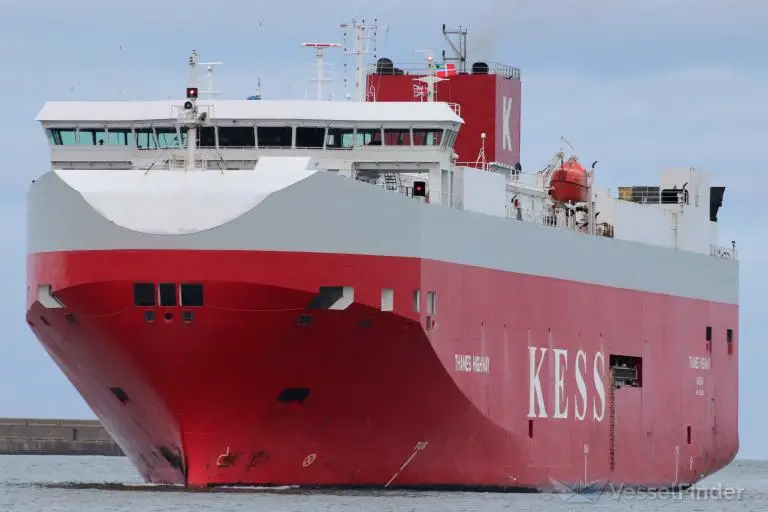
A car carrier fire (Thames Highway, Flag: Bahamas, Operator: “K” Line European Sea Highway Services (KESS), Year Built: 2005, Length: approx. 147.9–149 metres, Width: 26.4 metres) in the Wadden Sea off Germany on January 27, 2026, triggered a major emergency response and renewed concerns about fire safety aboard vehicle carriers. The incident occurred as the vessel was transiting the shallow coastal waters of the German North Sea, an area known for its ecological sensitivity and heavy maritime traffic.
Fire Breaks Out on January 27, 2026
The fire was first reported shortly after 03:40 local time on January 27, when the crew detected smoke rising from one of the lower vehicle decks. The vessel, which was en route to Bremerhaven, immediately sounded the alarm and activated its onboard firefighting systems. Despite the crew’s rapid response, the situation escalated quickly, prompting the captain to request external assistance.
Germany’s Maritime Rescue Coordination Centre (MRCC) in Bremen launched a coordinated emergency operation, dispatching firefighting tugs, rescue vessels, and a helicopter to assess the severity of the blaze. Navigational warnings were issued to nearby ships due to drifting smoke and reduced visibility.
Crew Response Prevents a Larger Disaster
The crew’s swift actions on January 27 were instrumental in preventing the car carrier fire from spreading across multiple decks. Using fixed CO₂ systems and portable firefighting equipment, they managed to isolate the affected area until professional firefighting teams could board the vessel.
Car carriers are particularly vulnerable to fire due to their open‑deck structure, high vehicle density, and the presence of flammable materials such as fuel, plastics, and increasingly, lithium‑ion batteries. Even a small ignition source can escalate rapidly. In this case, the crew’s training and quick decision‑making prevented a far more serious outcome.
Cause of the Fire Under Investigation
Authorities have not yet confirmed the cause of the January 27 car carrier fire, but investigators are examining several potential sources, including:
- Electrical faults in vehicles
- Lithium‑ion battery malfunctions
- Fuel leaks
- Short circuits in onboard systems
- Human error during loading or securing operations
With the growing number of electric vehicles transported by sea, fire risks have become a major concern. Lithium‑ion battery fires burn hotter, spread faster, and are significantly harder to extinguish. While it is not yet known whether EVs were involved in this incident, investigators will review the cargo manifest and vehicle condition.
Environmental Concerns in a Protected Region
The Wadden Sea is a UNESCO World Heritage Site, home to one of Europe’s most important coastal ecosystems. Any maritime incident in this region raises immediate environmental concerns. Fortunately, early assessments on January 28 indicated that the fire was contained without causing pollution or fuel leakage.
Authorities continue to monitor the area for delayed environmental effects.
Vessel Escorted to Safe Anchorage
After the fire was brought under control later on January 27, emergency tugs escorted the vessel to a designated safe anchorage near the German coast. Firefighters boarded the ship to extinguish remaining hotspots and assess structural damage. The vessel will undergo a full inspection before being allowed to continue its voyage.
No injuries were reported among the crew.
Growing Focus on Car Carrier Fire Safety
This incident adds to a rising number of fires aboard vehicle carriers in recent years, prompting calls for:
- Enhanced fire detection and suppression systems
- Stricter inspection of vehicles before loading
- Specialized training for lithium‑ion battery fires
- Updated international regulations for vehicle transport
As global vehicle shipments increase, so does the urgency of addressing these safety challenges.
Conclusion
The car carrier fire in the Wadden Sea on January 27, 2026, serves as a stark reminder of the risks associated with transporting thousands of vehicles at sea. Thanks to the quick actions of the crew and the coordinated response from German authorities, a major disaster was avoided. However, the incident highlights the need for continued improvements in fire prevention, detection, and emergency response across the maritime industry.
