

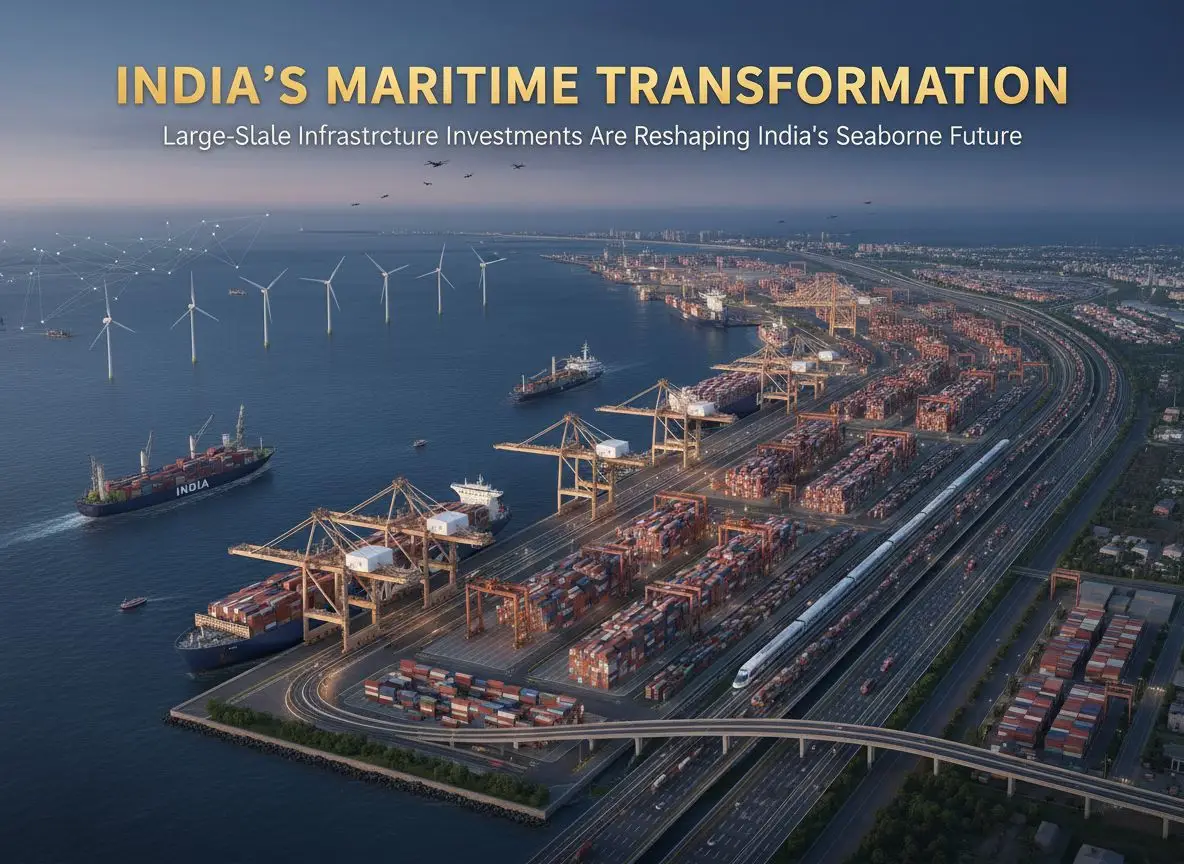
Please note: The featured image is a conceptual illustration
India is entering a pivotal phase in its economic and strategic evolution, driven by unprecedented infrastructure investments across the maritime sector. The Union Budget 2026 has reinforced the country’s commitment to modernising ports, strengthening coastal and inland waterway networks, scaling domestic shipbuilding, and reducing structural dependencies in global logistics. Together, these initiatives signal an ambitious transformation that stands to reshape India’s position in global trade.
At the centre of this transformation is a remarkable increase in financial commitment. The Ministry of Ports, Shipping and Waterways received an allocation of ₹5,164.8 crore, a significant 48% rise from the previous fiscal year, underscoring the government’s recognition of maritime transport as a central economic driver. Alongside this, the government earmarked ₹1,000 crore for the Maritime Development Fund (MDF), which is intended to provide long‑term, low‑cost financing for ports, shipbuilding yards, vessel construction, and other large‑scale projects critical to expanding maritime capabilities.
These large allocations reflect a strategic understanding: nearly 95% of India’s trade by volume and 70% by value moves through maritime routes, making ocean‑based logistics indispensable to national growth. Strengthening this backbone requires not only money but also policy innovation—and Budget 2026 provides both.
One of the most transformative initiatives is the operationalisation of 20 new National Waterways over the next five years, beginning with National Waterway‑5 in Odisha. This critical corridor will connect mineral hubs such as Talcher and Angul with key industrial centres and ports like Paradeep and Dhamra. These long‑term inland waterway investments are expected to increase cargo efficiency, reduce logistics costs, and promote sustainable transportation—key outcomes for a rapidly industrialising country.
Enhanced connectivity also takes shape through the creation of new Dedicated Freight Corridors, including the major east‑west link between Dankuni and Surat. Such corridors are projected to streamline cargo movement, reduce congestion around existing road and rail networks, and integrate inland production zones with key export gateways. These investments further demonstrate the expanding reach and scale of infrastructure investments in India aimed at structural economic modernisation. [moneycontrol.com]
Another vital dimension of India’s maritime overhaul is the push to operationalise a Coastal Cargo Promotion Scheme, which aims to increase the share of national freight for coastal and inland shipping from 6% to 12% by 2047. The scheme promotes a strategic modal shift away from heavily burdened road and rail networks toward more sustainable and cost‑effective maritime routes. The government is also establishing ship‑repair hubs at Varanasi and Patna to support this growing fleet, further decentralising maritime capabilities and stimulating inland economic zones.
In parallel, the budget introduces initiatives to reduce foreign dependence and strengthen industrial resilience. A landmark ₹10,000‑crore container manufacturing scheme seeks to develop a globally competitive domestic industry. India currently produces only 30,000 containers a year, compared with China’s 5 million. Creating a reliable, home‑grown supply is essential to protecting exporters from global supply-chain shocks, lowering freight costs, and supporting the new Bharat Container Shipping Line.
This surge in infrastructure investment in India aligns with broader national strategies, including the Maritime Amrit Kaal Vision and Atmanirbhar Bharat. The shipbuilding reforms introduced earlier—including financing support, credit‑risk coverage, and capacity‑building—continue to complement these forward‑looking policies. Together, they promote innovation, cluster development, and environmentally friendly marine technologies, essential for India’s long‑term vision of becoming a global maritime power.
Ultimately, India’s large‑scale maritime investments represent more than infrastructure upgrades—they signal a structural repositioning. In a world defined by reconfigured supply chains, geopolitical uncertainty, and increasing global competition, maritime strength enables economic resilience. With sustained funding, expanded waterways, modernised ports, and a revitalised shipbuilding ecosystem, India is charting a course toward enhanced self‑reliance, trade competitiveness, and strategic autonomy.
These advancements collectively signal a new era in which infrastructure investments in India are not only foundational to domestic growth but also instrumental in transforming the nation’s global maritime position for years to come.
