
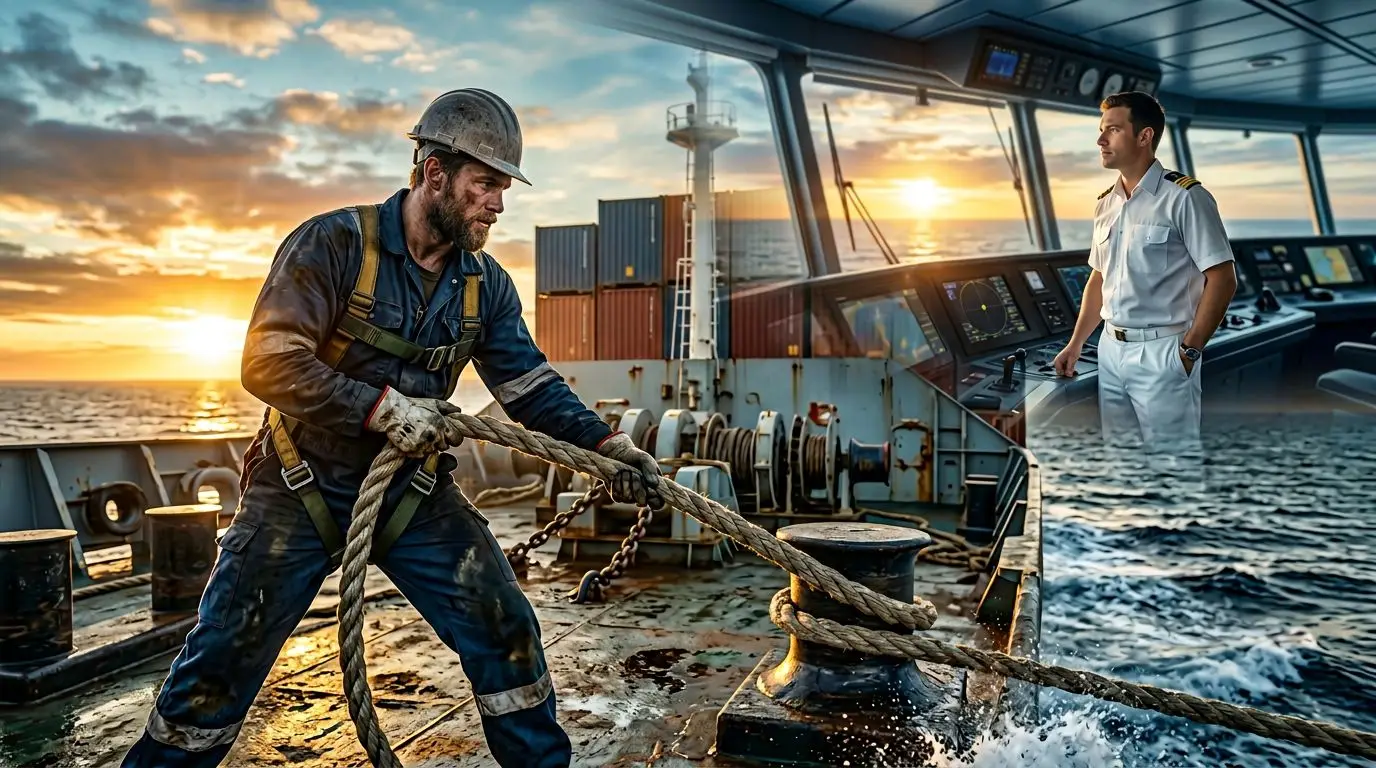
Advancing from Able Seaman to licensed officer is a significant and rewarding challenge. This transition involves a fundamental change in responsibility, mindset, and technical skills. Understanding this career path is essential for those seeking to move from manual tasks to navigation duties. Although the journey demands dedication, sea time, and rigorous study, it offers clear steps and substantial professional and financial growth.
For news related to seafarers, please follow the link.
The Foundation of Your Career: Understanding the Requirements
The transition starts with building a strong foundation as an Able Seaman (AB). Before applying for officer training, you must meet regulatory requirements set by the International Maritime Organisation (IMO) under the STCW Convention. Typically, this means completing 36 months of documented bridge watchkeeping duties, though approved fast-track programs may reduce this requirement.
At this stage, aim to go beyond basic deck duties. Actively seek to understand the reasons behind each operation. Observe how officers manage the bridge, communicate, and execute passage plans. This proactive mindset is essential for career advancement.
Bridging the Gap: Education and Certification
After meeting the sea time requirement, the next step is formal education, typically at a maritime academy or training centre, to obtain the Officer of the Watch (OOW) certification. This academically intensive phase covers subjects such as celestial and electronic navigation.
– Ship Stability and Construction
– Meteorology and Weather Reporting
– Maritime Law and Search and Rescue (SAR) operations.
You will also need to complete advanced STCW safety courses, such as Advanced Firefighting and Medical Care. The culmination of You must also complete advanced STCW safety courses, including Advanced Firefighting and Medical Care. Training concludes with the Certificate of Competency (CoC) oral examination, where your ability to make quick decisions under pressure is assessed. a Third Officer. This is where your real education as a leader begins. You are no longer following orders; you are responsible for the safety of the vessel, the cargo, and the crew during your watch.

The progression continues as follows:
– Third Officer: Focusing on safety equipment maintenance and bridge watches.
– Second Officer: Usually the designated navigation officer, responsible for passage planning and chart corrections.
– Chief Officer: The head of the deck department, managing cargo operations and ship stability.
– Master (Captain): The highest authority on board, responsible for the entire vessel. Each promotion requires additional sea time as an officer and further examinations. Advancing from Second Officer to Chief Officer, for example, requires “Management Level” certification, which focuses on advanced leadership and ship management.
Practical Tips for a Smooth Transition
Transitioning from rating to officer requires adapting your interactions with peers. To succeed, follow these steps: Maintain a detailed discharge book and ensure all sea time is accurately logged and signed by the Master.
– Find a Mentor: Seek guidance from current officers who have taken the same path. They can provide invaluable advice on exam preparation.
– Master the English Language: International maritime operations rely on “SeaSpeak.” Clear communication is a mandatory skill for any officer.
– Save Your Earnings: The transition period involves months of unpaid schooling and high examination fees. Financial planning is crucial.
Conclusion: A Future on the Bridge
The transition from Able Seaman to Officer is a long-term commitment that demands self-discipline and a willingness to embrace new challenges. The career path is clearly defined for those who aspire to lead. By combining practical experience with technical certification, you can achieve both professional pride and financial reward. Your journey begins with the decision to pursue your OOW license.
