
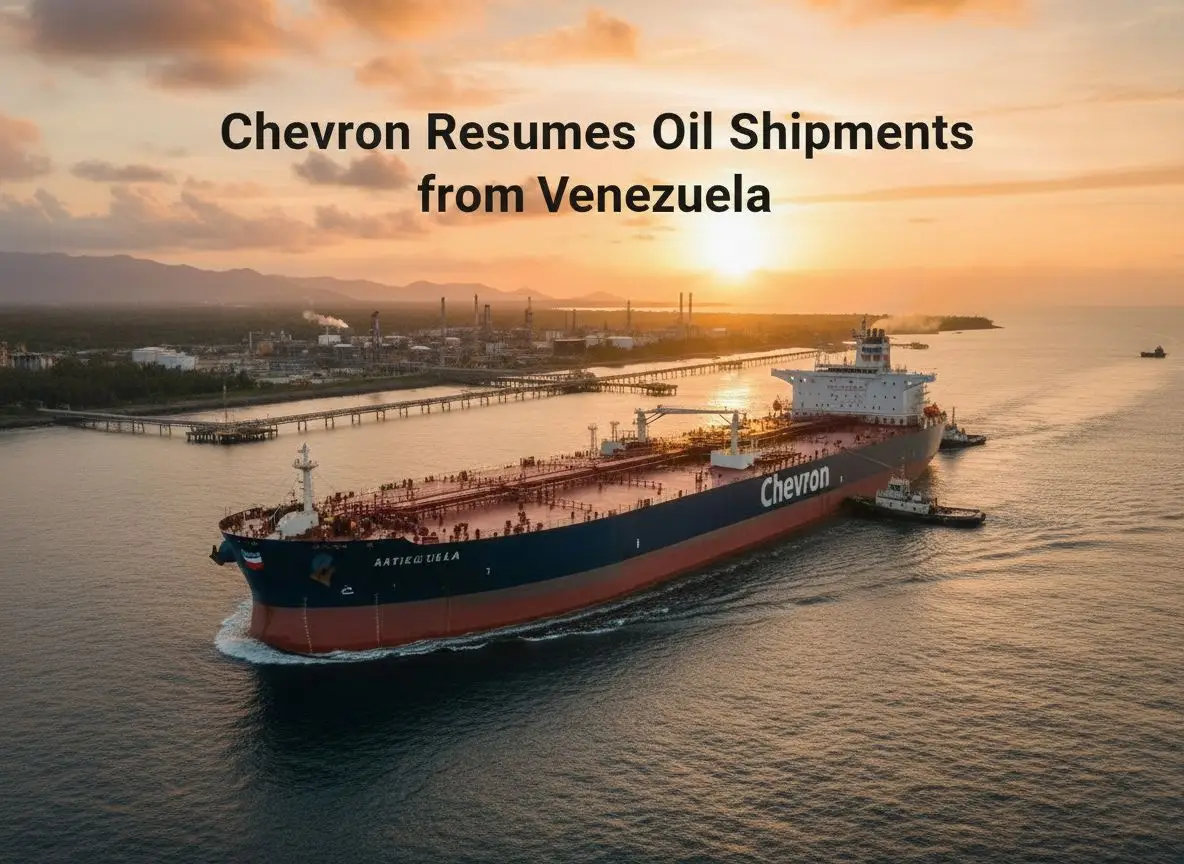
Venezuela’s oil exports have finally resumed through American channels after a lengthy hiatus. Chevron Corporation has successfully shipped its first cargo of Venezuelan crude to the United States, marking the end of a four-year ban that severely restricted the South American nation’s oil industry. This significant development comes after the U.S. Treasury Department granted Chevron a special license to restart limited operations in Venezuela, despite ongoing sanctions against the country’s energy sector.
After years of embargo, this initial shipment containing approximately 300,000 barrels of crude represents a critical turning point for Venezuela’s struggling economy. Previously, the country’s state oil company, PDVSA, was forced to rely on questionable shipping practices and unauthorised channels to export its petroleum products. However, this authorized resumption through Chevron’s joint ventures with PDVSA signals a potential shift in U.S.-Venezuela relations, though strict compliance requirements remain in place. Despite this progress, uncertainty remains amid ongoing political tensions, with Delcy Rodríguez recently sworn in as interim president and former U.S. President Trump warning of possible military action.
Chevron resumes oil exports after four-year U.S. ban
After a four-year hiatus, Chevron Corporation has officially restarted oil exports from Venezuela to the United States, marking a significant milestone in the relationship between the two countries. This development comes as the Biden administration reviews and eases certain restrictions in the petroleum sector that had been imposed in previous years [1].
Tanker departs with 300,000 barrels of crude
On Monday, January 5, 2026, an oil tanker chartered by Chevron departed from Venezuelan waters carrying approximately 300,000 barrels of heavy crude bound for the U.S. Gulf Coast [2]. This shipment represents the first cargo from the OPEC member nation to reach American shores through authorized channels since the beginning of the month. The vessel’s departure signals a resumption of normal trade relations, albeit under strictly controlled conditions.
The tanker’s movement is particularly significant given the current political climate. Despite the recent U.S. military strikes in Venezuela and the resulting political crisis, Chevron has managed to maintain its operational presence in the country [2]. This shipment demonstrates the company’s commitment to sustaining its Venezuelan investments even amid ongoing tensions.
Chevron restarts operations after holiday pause
Prior to this shipment, Chevron had not exported any Venezuelan oil cargoes since January 1st [2]. This four-day pause coincided with heightened political instability in the region. Additionally, the company has initiated efforts to normalize its operations by calling employees back to Venezuela who had been abroad during the holiday season [2].
According to sources familiar with the situation, approximately 20 staff members have been recalled to return to their posts now that international flights have resumed [3]. This move aligns with Chevron’s broader strategy to maintain business continuity in Venezuela despite the ongoing political turmoil.
Notably, as of Monday, Chevron’s output from its joint venture projects in Venezuela was reportedly around 240,000 barrels per day, operating near top capacity [2]. This production level is crucial for the company’s ability to recover pending debt in the country through continued oil exports.
Chevron remains in a unique position as the only U.S. oil major currently operating in Venezuela and the sole company authorized by Washington to export Venezuelan crude under the existing sanctions framework [4]. While the oil embargo announced by former President Trump technically remains in effect, Chevron’s special exemption allows it to continue these limited operations.
The continuity of Chevron’s activities stands in stark contrast to Venezuela’s state-run oil company PDVSA, which faces significant challenges due to the sanctions. Furthermore, the American oil giant’s ability to maintain normal operations amid Venezuela’s political crisis highlights the strategic importance the U.S. government places on maintaining some level of engagement with Venezuela’s energy sector.
The resumption of these oil shipments occurs at a critical time for Venezuela’s oil industry, which has suffered years of decline partly due to U.S. sanctions that have damaged its infrastructure and diminished its output capacity [5]. While this represents a positive development for Chevron, experts note that a return to full production capacity in Venezuela will likely take years of significant investment.
Why Chevron is exempt from U.S. sanctions
Unlike other American oil companies, Chevron maintains a unique position in Venezuela through a specific exemption that allows it to operate despite broad U.S. sanctions against the country’s energy sector.
Chevron’s special license from U.S. Treasury
The Office of Foreign Assets Control (OFAC) has granted Chevron Corporation a specialized license permitting limited operations in Venezuela’s oil sector. This authorization, known as Venezuela General License 41B, replaced previous iterations of the license and currently extends through May 27, 2025 [6].
The license comes with strict conditions that govern what Chevron can and cannot do in Venezuela. OFAC’s authorization allows Chevron to manage existing joint ventures with PDVSA, but explicitly prohibits:
- Paying taxes or royalties to the Venezuelan government
- Paying dividends to PDVSA or related entities
- Selling petroleum products for export to countries other than the United States
- Conducting transactions with Russian-controlled entities in Venezuela
- Engaging in other activities prohibited by Venezuela Sanctions Regulations [7]
Essentially, this arrangement creates a controlled channel for Venezuela oil exports while maintaining pressure on the Maduro regime. The license requires periodic renewal, giving Washington leverage to modify terms based on political developments.
Debt recovery and joint ventures with PDVSA
A key aspect of Chevron’s exemption involves debt recovery. For years, PDVSA failed to pay its share of operating costs in their joint ventures [8]. Consequently, Chevron’s current operations serve primarily to recover hundreds of millions in outstanding debt rather than generate new revenue for Venezuela.
Chevron’s joint ventures with PDVSA are responsible for approximately 23% of Venezuela’s total oil output [9]. These partnerships were established when Chevron chose a different path than competitors like ExxonMobil and ConocoPhillips, which exited Venezuela in 2007 amid nationalization disputes [10].
The current arrangement functions more as a debt settlement mechanism than a commercial operation. As one source explained: “In effect, Chevron is being repaid in oil, rather than paying Venezuela in cash. The Venezuelan government does not receive fresh revenue from these operations — no dividends, no budget income, no direct cash transfers” [8].
Chevron’s fourth-quarter 2025 exports from these ventures averaged approximately 140,000 barrels per day [9], making it a significant player even with the restrictions in place.
Company statement on compliance and safety
Throughout the recent political turmoil, Chevron has maintained a consistent public stance emphasizing compliance and safety concerns. Following the overthrow of President Maduro, the company released a statement: “Chevron remains focused on the safety and wellbeing of our employees, as well as the integrity of our assets” [11].
The company has repeatedly affirmed its commitment to operating “in full compliance with all relevant laws and regulations” [11][12]. This careful wording reflects the delicate balance Chevron must maintain between business interests and geopolitical considerations.
Unlike companies that would need to renegotiate entry terms, Chevron’s continuous presence gives it a strategic advantage. As one analyst noted, “Chevron can scale faster than any other Western operator because it never lost its foothold” [13]. Moreover, the company has taken a long-term view in Venezuela, similar to its approach in other politically complex regions like Kazakhstan [14].
How PDVSA struggles amid export blockade
State-owned oil company PDVSA faces severe operational challenges as U.S. sanctions and naval blockades push Venezuela’s petroleum sector to the brink. With exports nearly paralyzed and inventory management becoming increasingly difficult, the company is implementing emergency measures to prevent a complete shutdown.
Storage capacity maxed out
PDVSA’s storage infrastructure has reached critical levels, forcing the company to adopt unconventional solutions. After filling more than 45% of its 48-million-barrel onshore storage capacity, officials have begun loading tankers with crude and fuel oil to serve as floating storage [15]. This desperate measure became necessary two weeks ago as traditional storage options were exhausted.
Currently, more than 17 million barrels of oil remain stranded in ships waiting for permission to depart [15]. Some of this oil is being redirected to open-air waste pools as the company runs out of suitable containment options [15]. Storage at the José terminal, which handles the crucial extra-heavy crude from the Orinoco Belt, had fluctuated between 9-17 million barrels in recent months before climbing to 12.6 million barrels by mid-December [16].
Forced output cuts due to halted exports
Subsequently, PDVSA has started reducing crude production across its operations. This includes shutting down oilfields and disconnecting well clusters throughout the country’s oil-producing regions [15]. The company has even instructed its joint ventures, including those with China’s CNPC and Chevron, to cut production [17].
Specifically, PDVSA asked Petrolera Sinovensa, its joint venture with CNPC, to reduce output by disconnecting up to 10 well clusters [17]. If the blockade continues, Venezuelan officials expect national oil production to collapse from about 1.2 million barrels per day to less than 300,000 barrels later this year [18].
This dramatic decline would significantly impair the government’s ability to:
- Import essential goods
- Maintain basic services
- Support PDVSA’s workforce
Indeed, in a worst-case scenario, Venezuela’s oil production would be limited only to fields operated by Chevron [18]. This would force PDVSA to furlough tens of thousands of workers and slash employee benefits [18].
PDVSA’s reliance on shadow shipping
Meanwhile, PDVSA has increasingly turned to a “shadow fleet” of tankers operating outside traditional shipping regulations to bypass sanctions. These vessels often disguise their locations or switch off transmission signals to evade detection [18].
The U.S. Treasury Department recently sanctioned four companies and identified four associated oil tankers as blocked property for operating in Venezuela’s oil sector [19]. These vessels were part of the shadow fleet serving Venezuela and providing financial resources to the regime [19].
At least 16 sanctioned oil tankers have attempted to breach the blockade since last week by employing various evasion tactics [18]. If successful, these shadow shipments could provide PDVSA temporary relief while it adjusts to the new reality [18].
Nevertheless, this strategy carries substantial risks. Violations of U.S. sanctions may result in severe civil or criminal penalties for both U.S. and foreign persons involved in these transactions [19].
Sanctioned tankers defy embargo in ‘dark mode’
Approximately a dozen oil tankers have evaded the U.S. naval blockade of Venezuela’s energy sector by operating in what industry experts call “dark mode.” These vessels, mostly laden with Venezuelan crude and fuel oil, have slipped out of the country’s waters in recent days [20], seemingly coordinating their movements to overwhelm surveillance efforts.
What is dark mode shipping?
“Dark mode” refers to the practice of vessels deliberately turning off their Automatic Identification System (AIS) transponders to avoid detection by monitoring systems [2]. This tactic makes it extraordinarily difficult for external observers—including U.S. authorities—to track their movements across international waters. The shadow fleet employs several additional deception strategies:
- Broadcasting false identities (known as “spoofing”)
- Painting crude Russian flags or fake vessel names on their hulls
- Misrepresenting their geographical positions
- Using names of decommissioned vessels [3]
TankerTrackers.com identified at least 16 oil tankers that apparently attempted to break the blockade over a two-day period [3]. Four vessels were observed using fake ship names and misrepresenting their positions, a deceptive tactic known as “spoofing” [3], altogether creating a coordinated effort to bypass American naval forces.
Routes used to bypass U.S. surveillance
At least four of the oil carriers were spotted leaving through a route north of Margarita Island, near Venezuela’s maritime border, after brief stops just offshore [2]. Satellite data confirmed their movement approximately 30 miles from shore, heading eastward [3]. In an apparent coordination effort, at least three ships sailed in proximity as they departed Venezuelan waters in the same direction [3].
One tanker, formerly known as Bella 1, changed its name to Marinera, registered in Russia, and its crew even painted a crude Russian flag on the side, presumably to prevent possible U.S. seizure near the British Isles [21]. Flight records revealed U.S. P-8 surveillance aircraft closely monitored this vessel as it crossed the Atlantic [21].
Uncertainty over final destinations
Currently, the ultimate destinations of these vessels remain unknown [20]. When originally loaded in December, most were reportedly bound for Asia [20]. The total volume being transported is significant—estimated at 12 million barrels of Venezuelan heavy crude and fuel oil [20].
One sanctioned vessel, the Vesna (using the fake name Priya), was spotted hundreds of miles from Venezuela, heading northeast in the Atlantic Ocean, roughly 25 miles west of Grenada [3]. Of the 16 vessels that attempted to leave, 12 are not broadcasting any signals, making their current positions unknown [4].
Throughout this crisis, China has remained Venezuela’s largest oil customer [22], suggesting many tankers may ultimately head there, though through extremely circuitous routes designed to obscure their origins and ownership.
What this means for Venezuela’s oil future
The political instability in Venezuela creates significant uncertainty for the country’s oil industry, despite Chevron’s resumed operations. The nation’s petroleum sector stands at a critical crossroads as new leadership assumes power amid ongoing tensions with the United States.
Delcy Rodríguez sworn in as interim president
Currently, Delcy Rodríguez has assumed the role of interim president following recent political upheaval. Her administration faces immediate challenges in managing Venezuela’s primary economic resource amidst international pressure. Ultimately, her leadership approach toward the energy sector will determine whether the country can capitalize on Chevron’s renewed presence.
Chevron’s role in stabilizing oil revenue
In light of Venezuela’s economic crisis, Chevron’s operations represent a rare source of stability. The American company’s continued presence provides technical expertise that PDVSA desperately needs to maintain production levels. Additionally, as one of the few legitimate channels for Venezuelan crude to reach international markets, Chevron’s activities help prevent further economic deterioration.
Trump’s warning of further military action
Even more concerning for Venezuela’s oil future is former President Trump’s recent threat of expanded military intervention. Such action could potentially disrupt the fragile progress made through Chevron’s operations. At this point, any escalation of conflict would likely reverse gains in export capacity, further complicating Venezuela’s attempts to revitalize its struggling oil industry.
Conclusion
Chevron’s resumed oil shipments from Venezuela mark a significant turning point in US-Venezuela relations, albeit under strictly controlled conditions. This development represents more than just a commercial transaction; it signifies a limited economic lifeline for Venezuela’s devastated oil sector. Nevertheless, the country’s broader petroleum industry continues to face substantial challenges, with PDVSA struggling to manage storage capacity and forced to cut production significantly.
The contrast between Chevron’s operations and PDVSA’s dire situation highlights the complex reality of Venezuela’s oil industry. While Chevron maintains a carefully regulated presence through its special Treasury license, the majority of Venezuela’s energy sector remains crippled by sanctions. Additionally, the shadow fleet of tankers operating in “dark mode” demonstrates the desperate measures taken to circumvent these restrictions, though such actions carry significant legal risks.
Political uncertainty further compounds these challenges. Delcy Rodríguez’s interim presidency arrives at a critical juncture when stable leadership is essential for economic recovery. Meanwhile, threats of expanded military intervention from former President Trump cast a long shadow over any potential progress. These factors together create an unpredictable environment for Venezuela’s most vital economic resource.
The future of Venezuela’s oil industry thus remains precarious. Though Chevron’s presence provides a degree of stability and technical expertise, this single company cannot single-handedly revitalize the country’s petroleum sector. Ultimately, Venezuela’s oil future depends on finding a delicate balance between international relations, internal politics, and economic necessities. The resumption of limited oil exports through Chevron represents just the first step in what will likely be a long and complicated journey toward recovery for Venezuela’s once-powerful oil industry.
References
[1] – https://en.wikipedia.org/wiki/United_States_sanctions_during_the_Venezuelan_crisis
[2] – https://www.firstpost.com/world/in-dark-mode-venezuelan-oil-tankers-allegedly-broke-us-blockade-sailed-secretly-before-maduros-arrest-13965747.html
[3] – https://www.nytimes.com/2026/01/05/world/americas/oil-tankers-venezuela-blockade.html
[4] – https://www.dailymail.co.uk/news/article-15437825/Flotilla-oil-tankers-break-Trumps-blockade-Venezuela-escape-dark-mode.html
[5] – https://www.nbcnews.com/business/energy/energy-chevron-venezuela-oil-rcna252311
[6] – https://ofac.treasury.gov/recent-actions/20250324
[7] – https://www.federalregister.gov/documents/2025/07/23/2025-13846/publication-of-venezuela-sanctions-regulations-web-general-licenses-41a-5r-and-41b
[8] – https://www.euronews.com/business/2025/12/29/explainer-why-chevron-still-operates-in-venezuela-despite-us-sanctions
[9] – https://www.cnbc.com/2026/01/05/maduro-overthrow-could-pave-the-way-for-us-oil-companies-to-recover-venezuela-assets.html
[10] – https://www.ainvest.com/news/chevron-strategic-edge-venezuela-oil-revival-implications-energy-sector-2601
[11] – https://www.politico.com/news/2026/01/03/trump-venezuela-oil-us-companies-return-00709782
[12] – https://www.houstonpublicmedia.org/articles/news/local/2026/01/03/539818/venezuela-houston-oil-and-gas-chevron-citgo-nungaray-trump/
[13] – https://www.forbes.com/sites/rrapier/2026/01/05/why-sanctions-not-reserves-will-decide-venezuelas-oil-future/
[14] – https://www.nytimes.com/2026/01/05/business/energy-environment/venezuela-chevron-trump-oil.html
[15] – https://www.reuters.com/business/energy/venezuelas-pdvsa-asks-some-joint-ventures-cut-back-oil-output-sources-say-2026-01-04/
[16] – https://www.marineinsight.com/shipping-news/venezuela-uses-tankers-for-oil-storage-as-u-s-sanctions-disrupt-shipments/
[17] – https://oilprice.com/Latest-Energy-News/World-News/US-Oil-Blockade-Forces-Venezuelas-PDVSA-to-Slash-Production.html
[18] – https://www.nytimes.com/2026/01/06/world/americas/venezuela-us-blockade-economy-oil.html
[19] – https://home.treasury.gov/news/press-releases/sb0348
[20] – https://www.reuters.com/world/americas/about-dozen-loaded-oil-tankers-left-venezuela-dark-mode-tankertrackerscom-says-2026-01-05/
[21] – https://www.theguardian.com/world/2026/jan/05/us-planes-monitor-tanker-ireland-clampdown-venezuelan-oil
[22] – https://www.atlanticcouncil.org/dispatches/what-trumps-venezuela-oil-blockade-means-for-maduro-and-the-world/
