

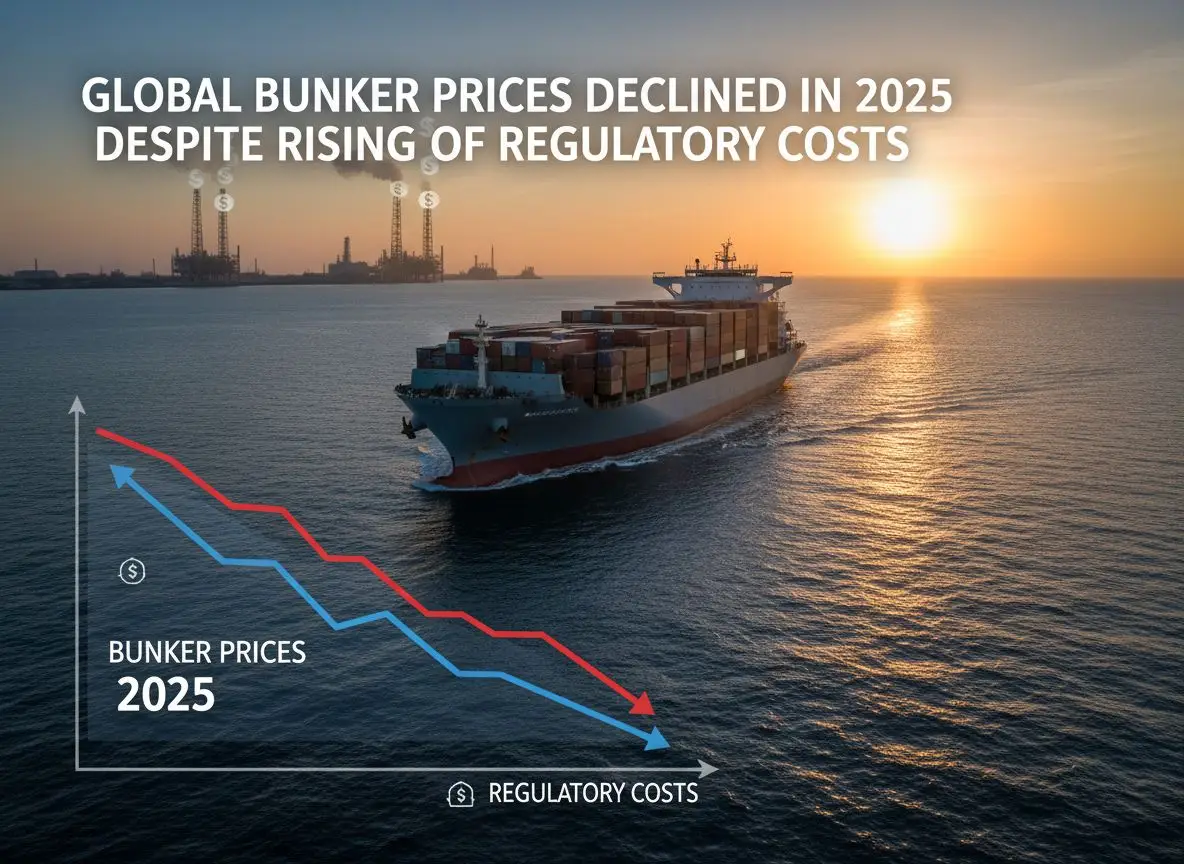
The year 2025 marked a significant shift in global bunker prices, with fuel costs falling sharply across major marine energy markets even as regulatory compliance expenses increased. Data from Ship & Bunker shows that volatility in crude markets, geopolitical disruptions, and tightening environmental rules shaped a complex operating landscape for shipowners and operators.
VLSFO, HSFO, and MGO Prices Saw Double‑Digit Declines
Across the 20 leading bunkering hubs, the G20-VLSFO index closed 2025 at $463.50/mt, representing a 20.4% year‑on‑year decline. The average VLSFO price for the year settled at $535/mt, its lowest annual level since 2020 and down 14.4% from 2024.
Key price movements included:
- VLSFO peaked at $621/mt in January and dropped to $456/mt by December.
- HSFO ranged from $533/mt at its January high to $382/mt in December, ending the year at $391/mt—a 22.7% decline from 2024.
- MGO remained the most volatile, reaching $822/mt in November and bottoming at $693/mt in May. The G20-MGO index averaged $754/mt, down 7.1% year on year.
The scrubber spread—a key metric influencing fuel choice for scrubber‑equipped tonnage—narrowed significantly. The average spread fell to $74/mt, a 32.7% reduction from 2024, with a high of $101.50/mt in January and a low of $52/mt in October.
Geopolitical Events Drove Market Volatility
The bunker market in 2025 was heavily influenced by global political and economic developments:
- Trade tensions and tariff concerns triggered a sharp price correction in April.
- Industrial strikes in June caused a temporary spike in bunker prices before the market normalized.
- Attacks on oil infrastructure supported middle distillate values, pushing MGO higher in October and November.
- Expectations of weaker crude prices in 2026 exerted downward pressure toward year‑end.
- Rising crude inventories in China provided some counterbalance to bearish sentiment.
These factors collectively contributed to one of the steepest annual declines in bunker prices since the widespread adoption of VLSFO in 2020.
Regulatory Costs Increased Despite Falling Fuel Prices
While fuel prices eased, ship operators faced higher compliance costs due to new and expanded environmental regulations.
FuelEU Maritime and EU ETS Tightening
2025 marked the first year of FuelEU Maritime implementation alongside a stricter EU Emissions Trading System (EU ETS) for shipping. Under the updated rules:
- Companies were required to surrender EU Allowances (EUAs) covering 70% of emissions from intra‑EU voyages, up from 40% in 2024.
- The average EUA price rose to $84/mtCO₂e, compared with $72 the previous year.
As a result, EU‑ETS compliance costs for VLSFO on intra‑EU voyages surged to $185 per tonne, more than double the 2024 level of $91.
This $94 increase in emissions‑related costs effectively outweighed the $91/mt reduction in VLSFO bunker prices, meaning many operators saw higher overall voyage expenses despite cheaper fuel.
What the 2025 Trends Mean for Shipowners
For maritime professionals, the 2025 market underscored several strategic considerations:
- Fuel choice optimization became more complex as the scrubber spread narrowed.
- Voyage planning within the EU required closer monitoring of EUA price movements.
- Long‑term hedging strategies gained importance amid geopolitical volatility.
- Operational efficiency and emissions reduction remained critical to offset rising regulatory costs.
Outlook for 2026
With expectations of softer crude prices and continued regulatory tightening, the bunker market in 2026 is likely to remain challenging. Operators may benefit from lower base fuel costs, but compliance‑driven expenses will continue to shape total voyage economics.
