
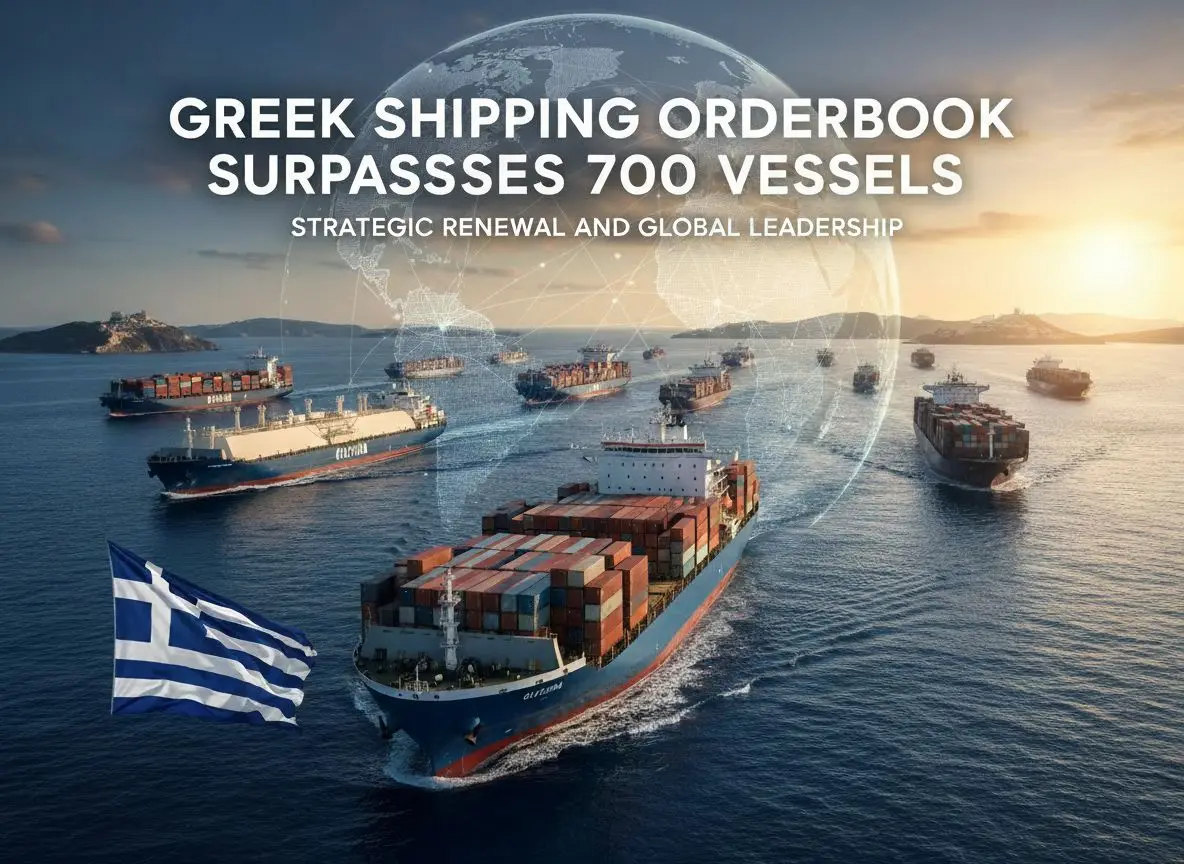
Greek shipowners have built 644 ships during the recent period, which has strengthened their greek shipping industry position globally. Market conditions remain challenging, yet Greek shipowners continue to increase their investments in tankers. They now hold 295 orders, which represent about 24% of the global orderbook. This growth shows Greece’s continuing dominance in international maritime commerce.
Greek fleet reaches 700 vessels amid global expansion
Greek shipowners reached a major milestone when their orderbook grew to 693 vessels in November 2025, up from 651 in October 2025. The growth shows no signs of slowing down. The Greek orderbook will pass 700 ships for the first time in years and reach 727 vessels under construction.
Greek shipping companies have expanded their presence in many vessel types. They now control 302 tankers under construction, which makes up 24% of the global tanker orderbook. Their bulk carrier orders stand at 162 ships or 12% of global orders. Most of these orders – about 62% – are in the panamax, kamsarmax, and postpanamax categories.
Greek influence in the global orderbook has climbed to 15.6% from 15.07% last month. The containership sector has also grown rapidly, with 126 vessels on order, representing 11% of the global total.
Greek shipowners have also made smart moves in specialised markets. They hold 14% of all LNG carrier orders and control 15% of the LPG carrier segment with 46 vessels. Greek interests now control 17.8% of all new ships being built worldwide. This historic fleet expansion proves their growing influence in global shipping.
Greek shipowners diversify across vessel types
Diversification is the lifeblood strategy of the Greek shipping industry, driven by substantial investments across multiple vessel categories. Greek shipowners have ordered 156 dry bulk carriers that represent 11.5% of the global orderbook. Their fleet primarily consists of Kamsarmax and Panamax types, which make up 62% of their new orders in this sector.
Greek shipping interests have built a powerful presence in gas transportation over the years. Their fleet has 55 LNG vessels under construction, which represents 17% of the global orderbook. These orders mainly focus on large vessels ranging between 141,000-200,000 cubic meters. Greek owners’ LPG segment controls 44 vessels under construction, accounting for 14% of global orders. They dominate the Very Large Gas Carriers (48%) and Medium Gas Carriers (20%) segments.
Recent data shows Greek shipowners’ unprecedented $18 billion investment in newbuild gas vessels since 2021. They invested $13.8 billion in 59 LNG vessels and allocated approximately $4 billion toward 41 LPG vessels. Their investments in other sectors reached $12.2 billion for 167 tankers, $4.1 billion for 109 bulkers, and $3.1 billion for 39 containerships.
The Greek shipping industry statistics demonstrate Greek shipowners’ control of 17.8% of global ship construction, which underscores how big the Greek shipping industry is in terms of worldwide maritime influence.
How Greece maintains global shipping dominance
The Greek shipping industry leads the global maritime sector through key advantages and steady reinvestment. Greek shipowners now control an impressive 21% of the world’s merchant fleet with 5,520 vessels, making Greece the world’s leading maritime power. Their dominance spans multiple segments: Greeks operate 31.27% of the global oil tanker fleet, 25.32% of bulk carriers, and 22.65% of liquefied natural gas carriers.
The sector’s economic strength goes beyond mere fleet size. Global revenue reaches approximately $40 billion annually, with $14 billion flowing into the domestic economy and creating over 150,000 jobs. Greek shipping ensures energy, food, and supply chain security for EU member states and the international community.
Greek shipowners’ fleets average 9.54 years, compared with the global average of 9.87 years. This younger fleet showcases its commitment to renewal and technological advancement. Greek shipowners have built the world’s largest fleet of alternative-fuel-capable vessels and lead in SOx scrubber-fitted vessels.
Conclusion
Greek shipping’s remarkable growth proves Greece’s lasting maritime heritage. Greek shipowners have established a strong presence across major vessel segments and made an unprecedented mark on global shipping. Their innovative approach to fleet diversification has delivered strong results, particularly in the profitable gas carrier market, where significant investments demonstrate their business acumen.
Without doubt, this growth means more than just numbers. The fleet’s younger-than-average age shows Greek shipowners’ steadfast dedication to modernisation and efficiency. They have invested heavily in alternative-fuel capabilities and emissions-reduction technology to meet evolving environmental standards.
Greek shipping leads the industry for several reasons. Their unmatched skill in operating vessels of all types enables them to adapt to market changes. They make vital economic contributions both globally and domestically. Their joint industry work toward decarbonization shows leadership that goes beyond fleet size alone.
Reaching 700 vessels means much more than a milestone. It shows how Greece has grown into a maritime powerhouse that combines traditional shipping knowledge with modern business methods. This achievement also highlights Greek shipping’s role in supporting global trade, energy transport, and supply chain security.
The future looks bright for Greek shipping despite industry challenges. Smart investments in various vessel types, especially in specialised segments, reveal a clear path toward sustainable growth. The Greek maritime sector remains vital not just for Greece but for worldwide commerce.