

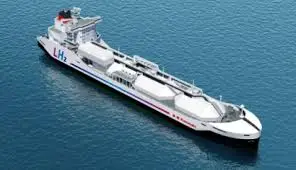
Kawasaki Heavy Industries (KHI) has secured a newbuild order for one 40,000 cubic metre liquid hydrogen carrier, marking another significant milestone in the development of hydrogen shipping infrastructure and reinforcing Japan’s leadership in next‑generation maritime energy solutions.
The vessel will be among the largest purpose‑built liquid hydrogen carriers ordered to date and is designed to support the emerging global hydrogen supply chain, which is increasingly seen as central to long‑term decarbonisation strategies in both the energy and maritime sectors.
Expanding the Global Liquid Hydrogen Fleet
The new order builds on Kawasaki Heavy Industries’ pioneering role in hydrogen transportation, following its earlier development of smaller‑scale liquid hydrogen vessels. At 40,000 m³, the new carrier represents a step change in scale, moving liquid hydrogen shipping closer to commercial viability for long‑distance, high‑volume transport.
Liquid hydrogen must be kept at extremely low temperatures of approximately ‑253°C, which presents unique technical challenges for containment, insulation, and boil‑off management. Kawasaki has been at the forefront of addressing these challenges, leveraging decades of experience in cryogenic engineering, LNG containment systems and advanced materials technology.
Industry analysts say the vessel’s size suggests confidence from project stakeholders in future hydrogen trade flows, particularly between exporting regions with abundant renewable energy and importing markets seeking to decarbonise power generation, heavy industry and transport.
Strategic Importance for the Energy Transition
The order comes as governments and industrial groups across Asia, Europe and the Middle East accelerate investments in hydrogen as a clean energy carrier. Japan, in particular, has positioned hydrogen as a cornerstone of its national energy transition strategy, supporting both domestic consumption and international supply chains.
Liquid hydrogen shipping is expected to complement other hydrogen transport methods, such as ammonia and liquid organic hydrogen carriers (LOHCs). While ammonia has gained early momentum due to easier handling, liquid hydrogen offers advantages in purity and direct usability, especially for fuel‑cell applications and power generation, provided technical and cost barriers can be overcome.
The new carrier will demonstrate that large‑scale maritime transport of liquid hydrogen is feasible, safe, and commercially scalable.
Technology and Design Focus
Although detailed specifications of the vessel have not yet been disclosed, the carrier is expected to incorporate:
- Advanced vacuum‑insulated cargo tanks designed specifically for liquid hydrogen
- Highly efficient boil‑off gas management systems
- Enhanced safety systems tailored to hydrogen’s physical properties
- Energy‑efficient hull and propulsion designs aligned with low‑emission objectives
Kawasaki Heavy Industries has previously highlighted safety, redundancy and operational reliability as core principles in its hydrogen vessel designs, given hydrogen’s low ignition energy and high diffusivity.
Implications for Shipbuilding and Maritime Markets
From a shipbuilding perspective, the order underscores growing demand for high‑complexity, technologically advanced vessels, a segment where Japanese yards and engineering groups continue to command a competitive edge.
Unlike conventional LNG carriers, liquid hydrogen carriers require bespoke engineering solutions, creating higher barriers to entry and potentially attractive margins for experienced builders. The project also highlights the increasing collaboration among shipbuilders, energy companies, governments, and classification societies in developing new vessel types.
For the wider maritime industry, the order signals that hydrogen shipping is transitioning from demonstration projects to early commercialisation, with implications for ports, bunkering infrastructure, crew training and regulatory frameworks.
Looking Ahead
While the global hydrogen economy is still in its early stages, orders such as this one suggest growing confidence in long‑term demand. As export projects mature and importing nations lock in supply agreements, shipping capacity will become a critical enabler of hydrogen trade.
Kawasaki Heavy Industries’ latest order positions the company to remain a key player in hydrogen maritime logistics, as shipowners and energy majors seek reliable transport solutions for future fuels.
The main features of the new vessel are as follows:
1) Equipped with cargo tanks for liquefied hydrogen with a total capacity of around 40,000 m3. Uses a
high-performance insulation system to reduce the generation of boil-off gas (BOG) caused by natural
heat ingress from the outside, enabling large-scale transportation of cryogenic liquefied hydrogen.
2) The electric propulsion system features a hydrogen/oil-based dual-fuel generator engine*4 in addition
to a conventional oil-based generator engine. Furthermore, the installation of a hydrogen gas supply
system with a compressor and a heat exchanger enables BOG generated from the liquefied hydrogen
cargo tanks to be used as a propellant, reducing CO₂ emissions during liquid hydrogen transport.
3) Equipped with a cargo handling system capable of loading and unloading large volumes of liquefied
hydrogen. Double-wall vacuum jacketed piping keeps the material at an extremely low temperature
for efficient and safe transfer between the onshore facility and the liquefied hydrogen tanks on the
vessel.
4) With a shape and draft that consider the low density of liquefied hydrogen, the vessel requires less
power and has a high propulsion efficiency.
5) The hydrogen fuel system, fuel supply system, and cargo handling system for liquefied hydrogen and
hydrogen gas are risk assessed, and suitable safety measures taken to ensure that the liquefied
hydrogen poses no risk to the crew, environment, or structural integrity and soundness of the vessel.