
Tragedy in the Pacific: Investigation into the Mariana Vessel Capsizing
The maritime community is mourning the devastating capsizing of the Mariana vessel near the Northern Mariana Islands.
The 450-dwt platform supply vessel, built in 1981, was caught in the ferocious path of Typhoon Sinlaku, a Category 5 storm that brought sustained winds of 150 mph to the region. While the U.S. Coast Guard has confirmed the recovery of one deceased crew member, five others remain missing, sparking a massive multinational search effort and raising serious questions about offshore vessel safety during extreme weather events.
The Severity of Typhoon Sinlaku Maritime Impact
The tragedy began on April 15, 2026, when the Mariana reported a disabled starboard engine while navigating approximately 125 nautical miles northwest of Saipan. This mechanical failure occurred at the worst possible time, as Typhoon Sinlaku was rapidly intensifying and bearing down on the archipelago. The Typhoon Sinlaku maritime impact was profound, creating 20-foot swells and 150-mph winds that crippled search efforts for nearly 48 hours.
When a vessel loses propulsion in such extreme conditions, it can no longer steer into the waves, making it highly susceptible to rolling and eventual overturning.

Source: Social Media
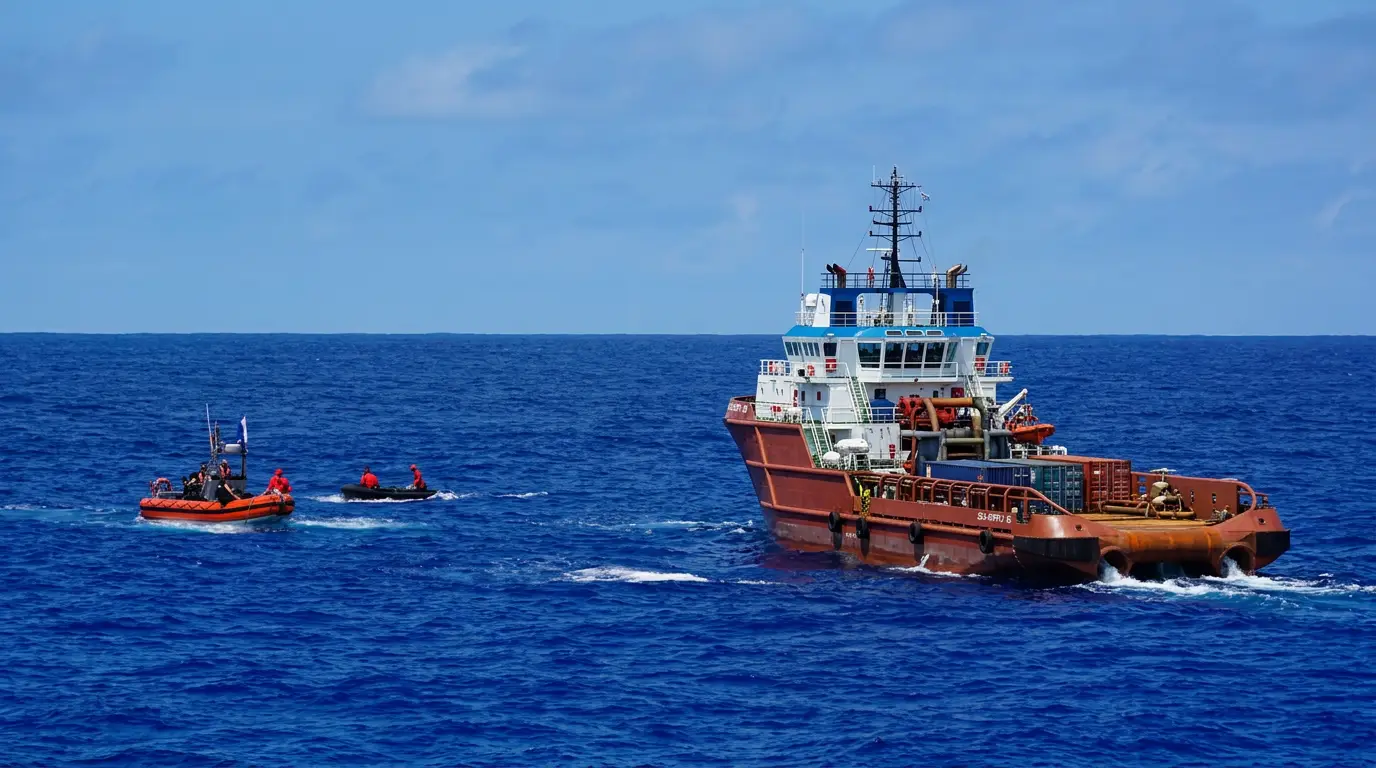
The Mariana, a veteran offshore supply ship, was particularly vulnerable. By the time the weather cleared enough for a Coast Guard HC-130 Hercules aircraft to reach the area, the vessel had drifted significantly and was spotted upside down, approximately 34 nautical miles northeast of Pagan Island.
US Coast Guard Search and Rescue Saipan Efforts
The US Coast Guard search-and-rescue operations in Saipan quickly evolved into a complex, multinational mission. Coordinating through the Joint Rescue Coordination Centre Honolulu, the response included the USCG cutter Frederick Hatch, U.S. Navy Boeing P-8A Poseidon aircraft, and specialised dive teams from the Japan Coast Guard.
Rescue teams have utilised advanced technology and high-risk manoeuvres to locate the missing crew, including deploying U.S. Air Force 31st Rescue Squadron parajumpers to rendezvous with cutters at sea.
– Utilising underwater remotely operated vehicles (ROVs) to penetrate the hull of the capsized ship.
– Conducting aerial sweeps covering over 127,000 square nautical miles—an area roughly the size of California.
– Investigating debris fields, which included a partially submerged and inflated 12-person life raft found 95 miles from the wreck.Despite these exhaustive efforts, the maritime crew disappearance typhoon remains a grim reality for the families of the five missing mariners. The discovery of one body inside the hull on April 20 suggests that at least some of the crew may have been trapped when the vessel suddenly overturned.
Analysing Platform Supply Vessel Safety and Standards
The loss of the Mariana highlights the inherent risks of maritime careers or the challenges that seafarers face daily. Industry experts are now looking closely at platform supply vessel safety, especially for older hulls like the Mariana, which was 45 years old at the time of the incident. Under International Maritime Organisation (IMO) standards, vessels must maintain strict stability criteria, but mechanical failure in a Category 5 storm can override even the best safety protocols.
Experts suggest several factors likely contributed to the Northern Mariana Islands shipwreck:
– Engine Failure: The loss of the starboard engine removed the vessel’s primary defence against “broaching,” where a ship is pushed broadside to the waves.
– Cargo Stability: In supply vessels, shifting deck cargo can rapidly alter the center of gravity, leading to a “dynamic capsizing” event.
– Age and Maintenance: While the Mariana was U.S.-registered and subject to Coast Guard inspections, older vessels often have less redundant power systems compared to modern diesel-electric designs.The Importance of Enhanced Safety Protocols
This tragic shipwreck in the Northern Mariana Islands serves as a reminder that the ocean remains an unpredictable, high-stakes environment. For those pursuing a career path in https://maritime-hub.com/seafarers-and-life-at-sea-challenges-and-opportunities/, understanding the rigorous demands of emergency response and vessel stability is life-saving knowledge.
The investigation into the Mariana vessel capsizing will likely result in new recommendations for heavy weather avoidance and mandatory engine redundancy for offshore vessels operating in typhoon-prone corridors. As climate change increases the frequency and intensity of early-season storms like Sinlaku, the industry must adapt its safety margins to protect the lives of those who power global trade.
A Community Waiting for Answers
As the search for the five missing mariners continues, the focus remains on the bravery of the rescuers and the resilience of the maritime community in Guam and the CNMI. While the transition from a rescue mission to a recovery operation seems increasingly likely, the lessons learned from the Mariana vessel capsizing will be vital in preventing future tragedies. Currently, the maritime community comes together to support the families of the Mariana crew, holding onto hope for a miracle in the Pacific Ocean.
