

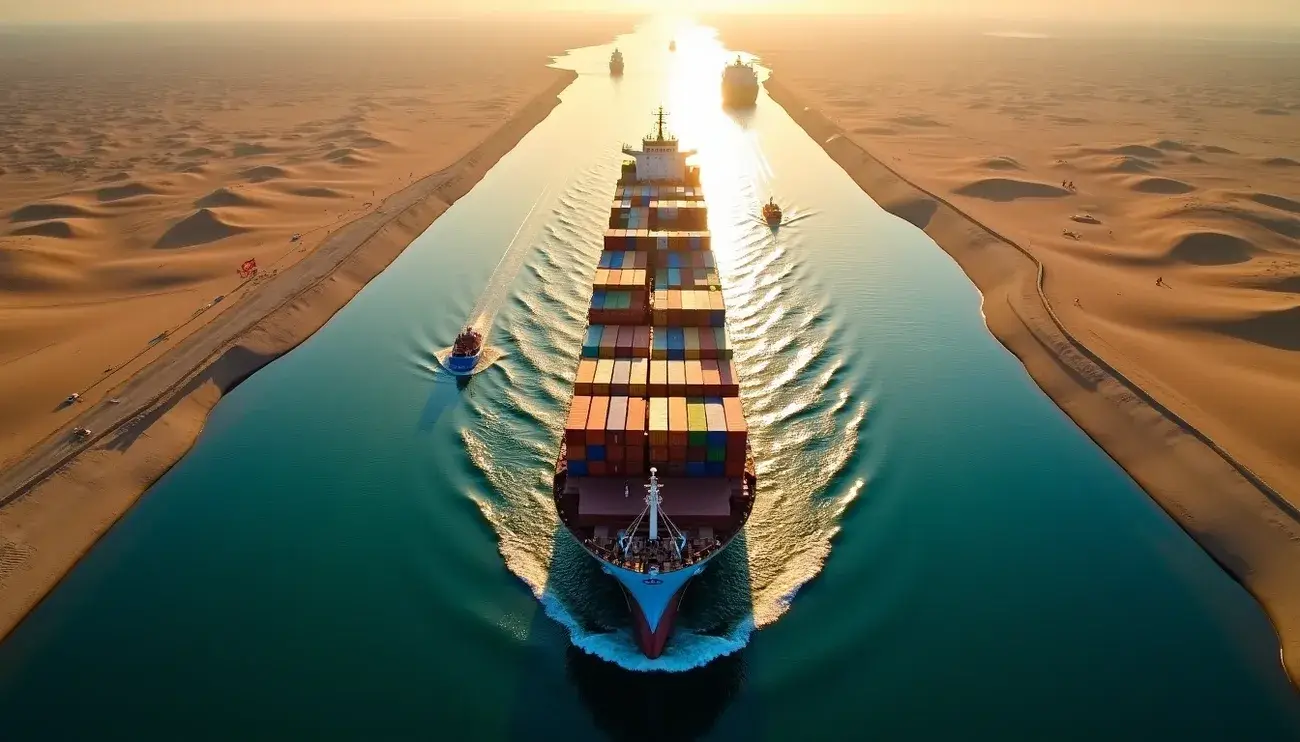
Suez Canal operations have resumed with major shipping carriers cautiously restarting transits after months of disruption due to regional conflicts. The strategic waterway, which handles approximately 12% of global trade, is witnessing a gradual return of commercial vessels as shipping lines test the waters with limited voyages. Maersk, CMA CGM, and MSC have all announced plans to resume selected services through the canal, signaling a potential turning point for global maritime routes.
Despite the reopening, many carriers continue to approach Suez Canal transits with significant caution. The return comes after nearly three months of rerouting vessels around Africa’s Cape of Good Hope, adding weeks to transit times and billions in additional costs to the shipping industry. However, maritime security experts warn that a complete normalization of traffic through the Suez Canal could take months, with many shipping companies implementing case-by-case risk assessments before committing their vessels to the shorter route. The resumption represents a delicate balancing act between operational efficiency and security considerations in one of the world’s most critical maritime chokepoints.
Maersk resumes Red Sea transits after successful trials
Danish shipping giant Maersk has begun a structured reintroduction of vessels through the Suez Canal, marking a significant shift after diverting ships for nearly two years. The company’s MECL service, connecting India and the Middle East with the U.S. East Coast, will be the first to formally return to the trans-Suez route, signaling increased confidence in regional stability.
First vessel departs from Salalah on January 26
The Cornelia Maersk voyage 603W will depart Salalah, Oman, on January 26, 2026, officially implementing the structural return to the trans-Suez route for all Maersk MECL services [1]. This voyage represents the first in a planned series of regular transits through the previously avoided waterway. The Maersk Detroit voyage 602E, which departed North Charleston on January 10, will be the first eastbound sailing utilizing the trans-Suez route, with all subsequent sailings following this routing [2].
Maersk officials note that the trans-Suez route is substantially more efficient, offering transit times approximately one week faster than the Cape of Good Hope alternative [3]. This improved efficiency benefits customers with significantly reduced shipping times while restoring the service pattern originally designed for optimal operations.
Maersk emphasizes safety and gradual return
Throughout its announcements, Maersk has consistently emphasized that safety remains the primary consideration in its return strategy. The company stated, “The safety of crew, assets, and customers’ cargo remains the highest priority” [2]. Additionally, Maersk has developed comprehensive contingency plans should security conditions deteriorate, including provisions to revert individual MECL sailings or the entire service back to the Cape of Good Hope route if necessary [1].
The shipping line will continue monitoring the security situation in the Middle East region closely, and any alterations to the MECL service will depend on ongoing stability in the Red Sea area and the absence of escalation in regional conflicts [2]. This cautious approach reflects Maersk’s reputation as among the most risk-averse major carriers regarding Red Sea operations [4].
Previous test voyages in December and January
Maersk’s decision follows successful test voyages conducted in recent weeks. The Singapore-flagged vessel Maersk Sebarok successfully transited the Bab el-Mandeb Strait and Red Sea on December 18-19, 2025, marking the company’s first containership to return to the route in nearly two years [5][3].
Following this initial test, the U.S.-flagged vessel Maersk Denver completed the company’s second Red Sea transit on January 11-12, 2026, while operating on voyage 552W of Maersk’s MECL service [5][6]. During both transits, Maersk implemented necessary safety measures to protect crew, vessels, and cargo [6].
The gradual restoration of Suez Canal transits follows what Maersk describes as “continued stabilization of conditions in and around the Red Sea” [1]. Since first diverting sailings to the Cape of Good Hope, Maersk has maintained its intention to resume trans-Suez routing when conditions allowed [2]. The structural change of the MECL service represents a significant milestone in the company’s phased resumption strategy.
Nonetheless, Maersk maintains its cautious stance, emphasizing its “stepwise approach towards gradually resuming navigation along the East-West corridor via the Suez Canal and the Red Sea” [6]. The company’s measured response indicates its commitment to balancing operational efficiency with careful risk management as stability returns to this vital maritime corridor.
CMA CGM and MSC cautiously reintroduce Suez routes
French carrier CMA CGM leads major shipping lines in restoring Suez Canal routes, implementing a structured return while MSC follows with cautious optimism. The gradual resumption marks a significant development in resolving the nearly two-year maritime crisis that forced vessels to divert around Africa.
CMA CGM deploys ultra-large vessels on INDAMEX service
CMA CGM has announced the formal return of its INDAMEX service through the Suez Canal, becoming the first major carrier to structurally restore a complete east-west service loop. The service, which connects India, Pakistan, and the U.S. East Coast, will resume transit through the Suez on both fronthaul and backhaul legs beginning January 15, 2026 [7]. The CMA CGM VERDI will pioneer this route change, departing from Karachi to New York, with four additional vessels (APL OREGON, CMA CGM PASSION, APL LE HAVRE, and CMA CGM MAUPASSANT) following on eastbound transits [8].
According to shipping analysts, this strategic shift reduces the full loop transit time by two weeks, bringing it down to 77 days compared to the Cape of Good Hope alternative [8]. The INDAMEX service operates with 8,000 TEU vessels, including three dedicated CMA CGM ships [9].
Furthermore, CMA CGM demonstrated its growing confidence in Suez Canal safety by sending the 23,000-TEU CMA CGM Jacques Saade through the route in late December—the largest vessel to use the canal in two years [2]. This ultra-large containership transit signaled a potential turning point for carrier strategies regarding the vital trade corridor.
MSC and APL test limited transits through Suez
Mediterranean Shipping Company (MSC), alongside CMA CGM and its subsidiary APL, has cautiously reintroduced Suez Canal transits. In the second week of January 2026, these carriers collectively sent five containerships of 8,000 TEU or larger through the canal, up from just two such vessels the previous week [10]. This represents a notable increase, although traffic remains substantially below pre-crisis levels of approximately 55 northbound and 25 southbound transits weekly [11].
The current approach for MSC appears more measured than CMA CGM’s structured service reintroduction. Rather than committing entire service loops, MSC continues evaluating routes on a voyage-by-voyage basis, reflecting the industry’s broader caution about regional stability.
Shipping consultancy Drewry notes that smaller, niche carriers continue sending relatively smaller ships through the Suez Canal [11]. In contrast, major carriers like MSC are testing with larger vessels but have yet to announce permanent routing changes similar to CMA CGM’s INDAMEX service adjustment.
Controlled, case-by-case decisions by carriers
Ocean carriers remain methodical in their approach to Suez Canal returns, carefully balancing operational efficiency against security concerns. Although CMA CGM has moved faster than competitors, the industry as a whole continues to make decisions based on multiple critical factors:
- Insurance availability and pricing remains paramount, with ZIM explicitly stating it awaits insurance approval before considering a return [8]
- Early mover actions are closely monitored by competitors evaluating their own strategies
- Potential impacts on freight rates if diversions end abruptly must be considered
Above all, security assessments focus on three key elements: the Houthis’ ability, opportunity, and intent to attack ships [8]. While carriers acknowledge the capability exists, they require assurance regarding intent, especially as increased ship traffic through the region would create more opportunities for potential incidents.
Consequently, carriers are implementing a gradual return strategy, which Drewry suggests may help minimize vessel bunching and prevent severe port congestion in Europe [11]. The measured approach reflects the delicate balance between commercial interests and operational risks as the industry navigates the complex return to one of global shipping’s most crucial waterways.
Hapag-Lloyd and others delay return amid security concerns
Unlike its competitors, German container line Hapag-Lloyd maintains its decision to avoid the Suez Canal route, citing ongoing security concerns even as other major carriers resume transits. The world’s fifth-largest container company represents a significant faction of shipping lines that remain unconvinced about the stability of the Red Sea region.
Hapag-Lloyd CEO confirms no immediate plans
Hapag-Lloyd CEO Rolf Habben Jansen has explicitly stated there is no specific timeline for when the shipping industry will resume sailing through the Suez Canal. “No date is set (for a resumption), and once it comes it will be gradual,” Habben Jansen noted during an online call with customers. The company continues to monitor the situation closely, acknowledging that Maersk’s recent decision “changed the situation” without prompting immediate policy adjustments.
Nevertheless, Hapag-Lloyd isn’t unprepared for an eventual return. A company spokesperson confirmed, “A plan is already in place for a possible return,” indicating the carrier has developed an action plan “on the shelf” ready for implementation when conditions improve. Currently, the company maintains that “the safety of our crews and vessels remains our highest priority,” which primarily drives their continued diversion strategy.
Norwegian car carriers still assessing risks
Similarly, Norwegian vehicle carrier Wallenius Wilhelmsen continues to evaluate regional stability before committing to a return. The car shipping group “is still assessing the situation and will not resume sailing until certain conditions are met,” according to a company spokesperson. Wallenius Wilhelmsen was among the first companies to publicly announce its decision to reroute all ships previously planned for Red Sea transit via the Cape of Good Hope.
This cautious approach extends to other Scandinavian operators. Fifth-largest operator Höegh Autoliners confirmed it would not make transits through the Red Sea “for the time being” after the Norwegian Maritime Authority advised avoiding the area. Likewise, vehicle carrier tonnage provider Gram Car Carriers has restricted its vessels from passing through the Red Sea due to elevated risk levels.
Transition period expected to last 60–90 days
Whenever Hapag-Lloyd ultimately decides to resume Suez Canal transits, Habben Jansen emphasized there would be a transition period of 60 to 90 days to adjust current logistics and avoid sudden port congestion. This methodical approach aims to manage what he describes as “huge” risks of significant congestion, particularly in Mediterranean and North European ports.
The CEO outlined specific operational challenges that concern the carrier:
- Ships arriving in Europe in bunches, causing large amounts of cargo to flow into ports simultaneously
- Challenges for shippers in moving freight out of ports when they suddenly receive multiple times their normal inventory
- Maintaining schedule reliability during the transition period
Maritime analysts point out that rushing back before networks and ports are ready could trigger fresh disruption rather than restoring stability. Certainly, even with the canal reopening, residual war-risk premiums and contingency measures may keep operating costs elevated beyond pre-crisis levels for months to come.
Canal traffic increases but full recovery remains distant
Recent data shows a gradual improvement in Suez Canal traffic as shipping lines cautiously return to the vital waterway. Overall shipping numbers remain substantially below historical averages, yet early 2026 has brought notable increases in transit volumes after years of disruption.
Drewry reports the highest weekly transits in over a month
The number of containerships sailing via the Suez Canal increased to 26 in the week ending January 11, 2026 – the highest weekly total in five weeks, according to Drewry Shipping Consultants’ newly launched Red Sea Diversion Tracker [12]. This marks a significant jump from just 10 transits the previous week, though analysts attribute the earlier low figure primarily to the traditional post-Christmas shipping lull [12]. The apparent increased popularity coincides with major carriers testing larger vessels through the route, as CMA CGM/APL and MSC sent five containerships exceeding 8,000 TEU capacity via Suez in week 2, up from only two such vessels the week before [12].
Cape of Good Hope route still dominates
Even as Suez transits increase, the longer route around Africa remains the predominant choice for global shipping. Indeed, voyages via the Cape of Good Hope simultaneously jumped to 175 in the same week, compared to 72 in the previous week [12]. Some reports indicate even higher figures, with up to 203 vessels taking the Cape route [2]. Currently, Suez Canal traffic hovers far below pre-crisis norms of approximately 55 weekly northbound and 25 weekly southbound transits [12]. BIMCO’s Chief Shipping Analyst noted that traffic in early 2026 remains 60% below corresponding figures from 2023, before diversions began [13].
Suez Canal Authority hopes for normalization by 2026
The Suez Canal Authority reports encouraging signs amid the recovery process. October 2025 saw 229 vessels resume transits, recording the highest monthly rate since the regional crisis began [4]. From July through October 2025, 4,405 vessels with 185 million tons total tonnage crossed the canal [4]. SCA Chairman Admiral Rabiee expressed optimism about the gradual return of ultra-large container vessels during late 2025, notably including the 23,000-TEU CMA CGM Jacques Saade in November [14]. Looking ahead, the Authority expects traffic to improve more substantially in the second half of 2026, when several major shipping lines anticipate restoring operations to normal levels [15].
Freight rates, capacity, and port congestion face volatility
The resumption of Suez Canal routes is poised to trigger major market disruptions across the shipping industry, affecting freight rates, vessel deployment, and port operations worldwide.
Return of capacity may disrupt rates
As carriers shift back to shorter Suez routings, approximately 6-8% of global container shipping capacity—equivalent to 2.1 million TEU—will effectively return to the market [16]. This sudden capacity surge explains why Maersk’s share price dropped over 5% following their Suez return announcement [17]. Shipping analysts at SEB warn that “rates will deteriorate from the effective release of supply having a significant impact on supply/demand” [16]. Moreover, experts suggest the transition from Cape to Suez could push the market from tightness into “massive oversupply,” as it coincides with delivery of new megaships between 2024-2028 [1].
Potential for blank sailings and slow steaming
To counterbalance this capacity flood, carriers will likely deploy several tactical measures. Shipping analysts anticipate increased blank sailings to manage the transition period [3]. Additionally, slow steaming could absorb some excess capacity, while carriers are expected to accelerate scrapping of older vessels after five years of minimal fleet reduction [18]. As one industry expert noted, “carriers have become adept at managing effective supply” and will protect revenue “whether by slow steaming, idling or blank sailings” [19].
European ports may face short-term congestion
Perhaps most immediately concerning, European ports face potential gridlock as vessels converge from both routing options. Ships arriving 7-10 days earlier via Suez will reach terminals simultaneously with those that departed weeks earlier via the Cape [20]. This convergence could increase port arrivals by 10%-39%, creating two to three weeks of “massive volume spikes” [1]. Even with carriers attempting to stagger arrivals, analysts predict temporary but severe port congestion throughout Q1 and potentially Q2 2026 [3].
Conclusion
The reopening of the Suez Canal marks a pivotal moment for global shipping after months of disruption. Major carriers have adopted notably different approaches to resuming transits through this strategic waterway. Maersk, CMA CGM, and MSC lead the cautious return, while Hapag-Lloyd and several other shipping lines continue routing vessels around Africa’s Cape of Good Hope. This divided response highlights the delicate balance between operational efficiency and security considerations that shipping companies must navigate.
Nevertheless, transit numbers show positive momentum, with weekly Suez passages reaching their highest levels in over a month. Despite this progress, traffic remains significantly below pre-crisis norms – approximately 60% lower than corresponding figures from 2023. Meanwhile, the Cape route still dominates global shipping flows, underscoring the gradual nature of this maritime transition.
The shift back to shorter Suez routings will undoubtedly reshape market dynamics throughout 2026. First, the effective return of 6-8% of global container shipping capacity threatens to push freight rates downward. Second, carriers must carefully manage this transition to prevent severe port congestion, particularly at European terminals where vessels from both routes could converge simultaneously. Last, shipping companies face challenging decisions regarding blank sailings, slow steaming, and fleet management as they adapt to changing conditions.
Though challenges persist, the Suez Canal Authority projects increased normalization by late 2026. The gradual resumption of ultra-large container vessel transits signals growing confidence in regional stability. Accordingly, the maritime industry stands at a crossroads – balancing the operational advantages of shorter Suez routes against lingering security concerns while managing the complex logistical ripple effects that this transition creates across global supply chain.
