

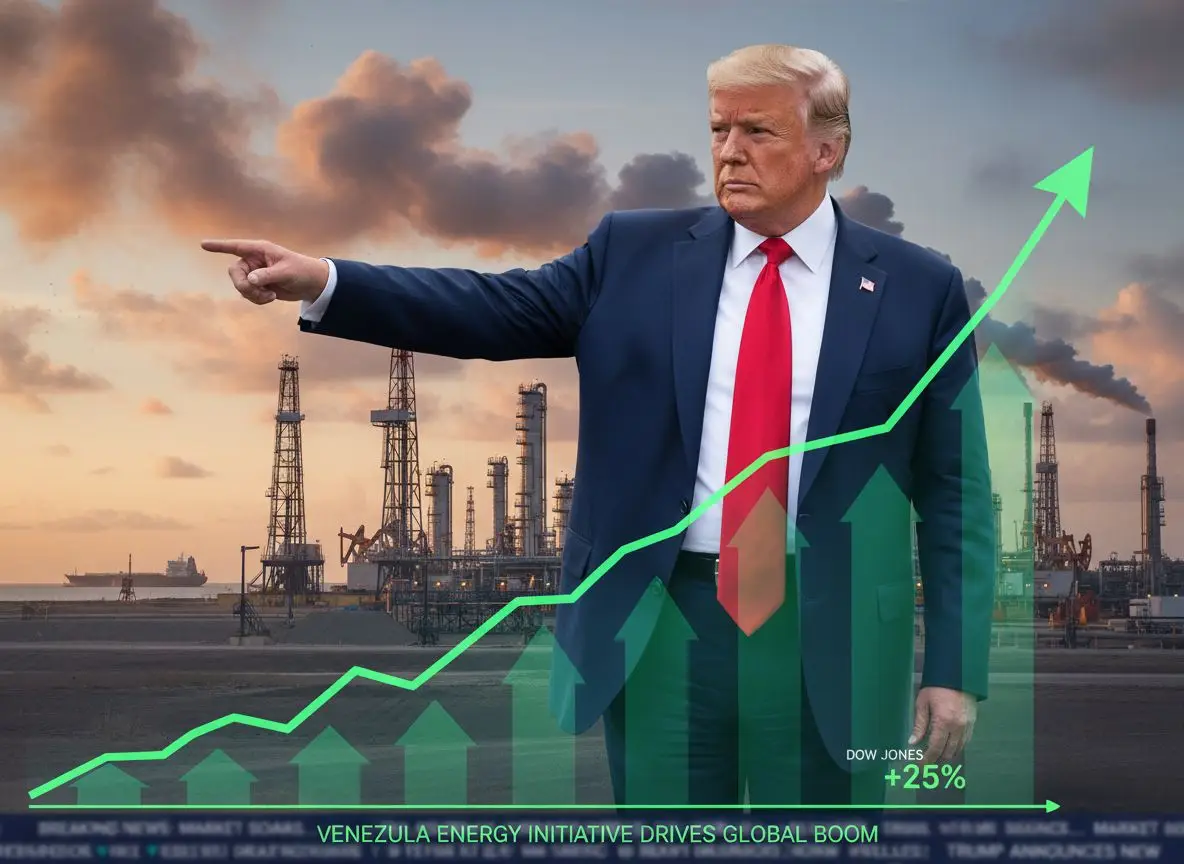

Venezuela’s stock market responded dramatically to former President Donald Trump’s recent assertions of control over the nation’s oil resources. Trump’s claims triggered unprecedented trading volumes as investors scrambled to position themselves around potential shifts in global energy markets.
The country possesses the world’s largest proven oil reserves, totalling approximately 303 billion barrels according to the U.S. Energy Information Administration. These reserves account for roughly 17% of all global oil reserves. Venezuela currently produces only about 1 million barrels of oil per day, representing merely 0.8% of global crude production.
Venezuela was once among the world’s largest oil producers and remains a founding member of OPEC. The country was producing more than 3 million barrels daily decades ago, but output has declined significantly over time. Venezuela now contributes only about 1% of global oil production.
The decline stems from multiple factors, including international sanctions, economic crisis, and a severe lack of investment in maintenance. According to Venezuela’s state-owned oil company PDVSA, its pipelines have not been updated in 50 years. Returning to peak production levels would require approximately $58 billion in infrastructure updates.
Venezuela also faces substantial financial obligations. ExxonMobil and ConocoPhillips were awarded over $11 billion collectively in international arbitration after leaving the country in 2007.
Trump Announces U.S. Control Over Venezuela’s Oil Sector
Former President Donald Trump claimed that the United States had taken control of Venezuela’s oil sector during a campaign rally in Pennsylvania. His declaration sent immediate shockwaves through global markets.
“We have secured the oil fields and now control Venezuela’s oil,” Trump told supporters at the rally. He offered no specific details about how such control had been established.
The announcement occurred amid ongoing tensions between Washington and Caracas. Market analysts noted that the reaction highlights the significant impact geopolitical statements can have on emerging markets, particularly those dependent on natural resource exports.
The U.S. State Department remained silent on Trump’s claims, neither confirming nor denying their accuracy. Venezuelan officials rejected the assertion, calling it “an outrageous violation of sovereignty” and “completely false.”
Oil industry experts point out that any actual U.S. control over Venezuelan oil would represent a dramatic shift in international relations. Many analysts remain sceptical about the practical implementation of such control, given the complex political and operational challenges involved in Venezuela’s oil sector.
Venezuela’s Oil Reserves Offer Opportunity and Challenge
The petroleum reserves beneath Venezuela present significant opportunities alongside substantial operational challenges for potential developers. These resources require extensive capital investment before production can approach historical levels, according to industry analysts.
Foreign companies considering Venezuela face obstacles beyond financial requirements. Political instability creates operational risks, while international sanctions complicate financial transactions. Companies must also address complex legal questions regarding ownership rights and contract enforcement.
The stock market response to Trump’s claims underscores the economic significance these reserves hold for Venezuela’s future. Should U.S.-based companies gain access to these resources, they would potentially secure strategic advantages in global energy markets for decades.
Successful development requires technical expertise that has largely departed Venezuela during its economic crisis. Many skilled petroleum engineers and technicians have left the country, creating knowledge gaps that present additional hurdles to sector revitalisation.
“The sheer scale of these reserves ensures they remain an attractive prospect,” one industry analyst noted, despite the operational challenges involved.
U.S. Oil Companies Weigh Return Amid Legal and Market Risks
Major U.S. oil companies remain cautious about re-entering Venezuela’s market despite Trump’s claims of control over the nation’s oil sector. Chevron stands as the only American major operating in the country, exporting approximately 150,000 barrels per day of crude to the U.S. Gulf Coast. The company has maintained operations in Venezuela for over a century, yet has responded to recent developments with measured statements about employee safety and asset integrity.
ConocoPhillips faces substantial legal complications, owing more than $10 billion following Venezuela’s 2007 nationalisation under Hugo Chávez. An international tribunal ordered Venezuela to pay ConocoPhillips $8.7 billion plus interest for unlawful expropriation in 2019.
Market conditions present additional challenges. Global oil supplies are projected to exceed demand by 3.8 million barrels daily in 2026, marking a record surplus. Oil prices have slumped to around $60 per barrel.
Production increases would occur gradually under any scenario. Venezuela’s output could increase by only 200,000 barrels per day within the first year after regime change. Industry experts estimate reaching 2 million barrels per day would take a decade and require approximately $100 billion in investments.
Companies require political stability and legal certainty before committing billions. “No one’s going to start investing where there’s no legal contract or viable permission to operate,” one analyst noted.
Conclusion
The alleged U.S. control over Venezuela’s oil reserves remains unsubstantiated despite Trump’s assertions. Venezuela possesses the world’s largest proven reserves, though production has declined from historic peaks to current levels below 1 million barrels daily. Market participants responded dramatically to Trump’s statements, according to trading data showing unprecedented volatility.
Substantial obstacles confront any entity seeking to revitalise Venezuela’s oil sector. Critical infrastructure requires extensive updates after decades of underinvestment. Estimates suggest at least $58 billion would be needed for essential upgrades.
Unresolved financial obligations to companies like ExxonMobil and ConocoPhillips further complicate matters. ConocoPhillips alone is owed more than $10 billion following Venezuela’s 2007 nationalization under Hugo Chávez.
Chevron remains the sole American oil major operating in Venezuela, exporting approximately 150,000 barrels daily to U.S. refineries. Other companies approach with caution, recognising that production increases would occur gradually even under optimal conditions while requiring enormous capital investment.
Industry experts estimate reaching 2 million barrels per day would take a decade and require approximately $100 billion in investments. “No one’s going to start investing where there’s no legal contract or viable permission to operate,” one analyst noted.
The fate of Venezuela’s petroleum resources carries significant implications for global energy markets. Successful development depends on financial resources, technical expertise, political stability, and legal certainty before Venezuela’s vast oil potential can be realised.
