

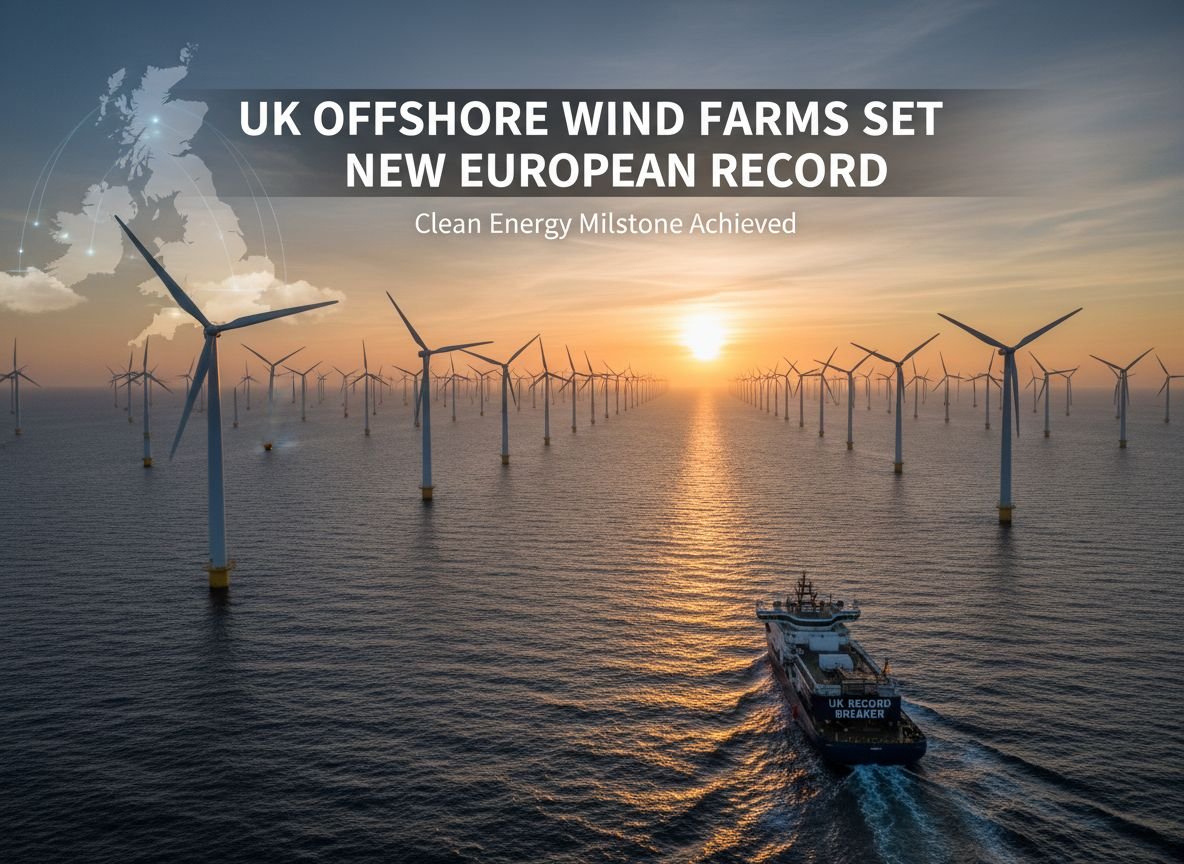

The UK government has awarded contracts for 8.4 gigawatts (GW) of offshore wind capacity across 12 projects, marking the largest offshore wind procurement in both British and European history. Energy Secretary Ed Miliband described the result as a “monumental step” toward reducing the country’s reliance on volatile fossil fuels.
The awarded projects will generate enough electricity to power more than 12 million homes and attract over £22 billion in private-sector investment, according to official reports. Government analysis indicates the new capacity will save billpayers nearly £1.7 billion annually compared to gas-fired generation.
The auction outcome advances the UK’s target of at least 43 GW of offshore wind power by 2030. Current installed capacity stands at 16.6 GW, with an additional 11.7 GW under construction.
Price competitiveness drives record allocation
Strike prices for the awarded capacity averaged approximately £91 per megawatt-hour, roughly 40% below the cost of new gas generation at £147/MWh. The offshore wind contracts also demonstrated clear economic advantages over nuclear power, which costs £124/MWh.
“This achievement puts the UK firmly on track to deliver its mission for clean power by 2030,” according to government statements, emphasising the goal of “taking back control of our energy sovereignty” rather than depending on markets controlled by “petrostates and dictators”.
The allocation spans projects across England, Scotland and Wales. Dogger Bank South off Yorkshire and Norfolk Vanguard off East Anglia represent two of the world’s largest proposed offshore wind developments. Scotland’s Berwick Bank in the North Sea marks the first new Scottish project to secure contracts since 2022. Wales benefits from Awel y Môr, the country’s first successful project in more than a decade.
German utility RWE secured the largest share, winning contracts for almost 7 GW of capacity across Norfolk Vanguard East, Norfolk Vanguard West, two Dogger Bank South projects and Awel y Môr. SSE obtained a 1.4 GW contract for Phase B of its Berwick Bank development.
Government projections indicate the investments will support approximately 7,000 skilled jobs, particularly benefiting coastal communities where economic opportunities remain limited. The auction included 8.245 GW of fixed-foundation projects alongside 192.5 MW from two floating wind developments.
Previous Auction Failures Highlight Current Success
The current auction results mark a dramatic reversal from recent setbacks that threatened the UK’s offshore wind ambitions.
AR5 collapse undermined confidence
Allocation Round 5 (AR5) delivered what ScottishPower CEO Keith Anderson described as a “catastrophic outcome” when not a single offshore wind project submitted a bid. The unprecedented result represented a “multi-billion pound lost opportunity” for the sector.
The AR5 failure followed disappointing results from AR4, where only two offshore wind projects proceeded to construction. Industry analysts pointed to the administrative strike price of £44 per megawatt-hour, which remained static despite rising inflation and capital costs.
The setbacks raised serious questions about the government’s target of 50GW of offshore wind by 2030. With only 14GW installed at the time of AR5’s collapse, the goal of more than tripling capacity appeared increasingly distant.
Policy reforms restored sector confidence
Government reforms addressed weaknesses in the auction process. Strike prices were adjusted upward to approximately £91 per megawatt-hour on average for AR7. The auction budget for fixed-bottom offshore wind doubled from £900 million to nearly £1.8 billion. Rules were modified to prioritize project deliverability over lowest costs alone.
Officials emphasized that offshore wind remained 40% cheaper than new gas power at £147/MWh despite higher strike prices. Aurora Energy Research analysis indicated the increased prices still delivered “a net benefit to bills over the next decade”.
The government justified these changes as necessary for energy security and reducing dependence on “petrostates”. One official described the approach as addressing “the fiasco of the previous government’s failed Auction Round 5”.
The sector’s response to AR7’s success – with one industry leader declaring “We’re back, baby!” – demonstrates the importance of this turnaround for maintaining momentum toward clean power objectives.
Contract Winners and Project Details
German energy company RWE emerged as the primary winner, securing contracts for 6.9GW of capacity. The company’s portfolio includes Norfolk Vanguard East and West (3.1GW combined), two Dogger Bank South projects (3GW), and Awel y Môr in the Irish Sea (0.8GW). RWE has established partnerships with KKR for a 50% stake in the Norfolk projects and with Masdar, which holds 49% of Dogger Bank South.
SSE secured a contract for 1.4GW from Phase B of its Berwick Bank Wind Farm project in Scotland at a strike price of £89.49/MWh. Located in the outer Firth of Forth about 38km east of the Scottish Borders, the project represents the only successful fixed-bottom offshore wind development in Scotland during this auction round. SSE Chief Executive Martin Pibworth said that if built to full capacity across three phases, Berwick Bank would “rank among the largest offshore wind projects globally”.
Floating wind gains foothold
Two floating wind projects secured contracts at £216.49/MWh. The 100MW Erebus project in the Celtic Sea represents Wales’ first floating offshore wind farm. Blue Gem Wind, a joint venture between TotalEnergies and Simply Blue Energy, expects Erebus to power 90,000 homes.
The 92.5MW Pentland project in Scotland, developed by Copenhagen Infrastructure Partners, recently secured investment from Great British Energy. These floating projects demonstrate the UK’s commitment to emerging offshore wind technologies beyond traditional fixed-foundation installations.
The projects are distributed across England, Scotland and Wales, with Dogger Bank South off Yorkshire and Norfolk Vanguard off East Anglia representing two of the world’s largest offshore wind developments.
Economic Impact Extends Beyond Contract Awards
The 8.4GW procurement positions the UK ahead of European competitors in offshore wind deployment. The projects will increase total UK offshore wind capacity by approximately 50% once operational, according to government analysis.
Investment drives coastal employment
The anticipated £22 billion private investment will support around 7,000 skilled jobs, particularly benefiting coastal communities where economic opportunities remain limited. Supply chain impacts are expected to extend across hundreds of British companies participating in wind farm construction and operation.
Strike prices undercut conventional generation
The auction secured capacity at an average strike price of £91 per megawatt-hour, demonstrating offshore wind’s cost competitiveness against gas (£147/MWh) and nuclear power (£124/MWh). Industry analysts note this represents a 40% discount compared to new gas-fired generation costs.
The government estimates these strike prices will deliver net savings to billpayers over the project lifetime, despite higher upfront support compared to previous auction rounds. Aurora Energy Research analysis indicates the contracts represent “a net benefit to bills over the next decade.”
Capacity allocation spans multiple technologies
Fixed-foundation projects account for 8.245GW of the awarded capacity, while floating wind technologies secured 192.5MW across two pioneering developments. The inclusion of floating projects signals the UK’s commitment to next-generation offshore wind applications in deeper waters.
The auction results mark a recovery for the UK offshore wind sector after the failure of Allocation Round 5, when no projects submitted bids. Government reforms to strike prices and auction rules appear to have restored industry confidence.
The 12 successful projects span England, Scotland and Wales, with German utility RWE securing the largest allocation at nearly 7GW of capacity. The awards include both fixed-foundation developments and floating wind technologies.
At an average strike price of £91/MWh, the contracted projects cost significantly less than gas generation at £147/MWh and nuclear power at £124/MWh, according to government analysis. The price difference positions offshore wind as the most cost-effective option for new electricity generation.
The procurement puts the UK ahead of European competitors in offshore wind deployment and advances the government’s goal of clean power by 2030. The sector now moves from auction success to the challenge of delivering projects on schedule.
