

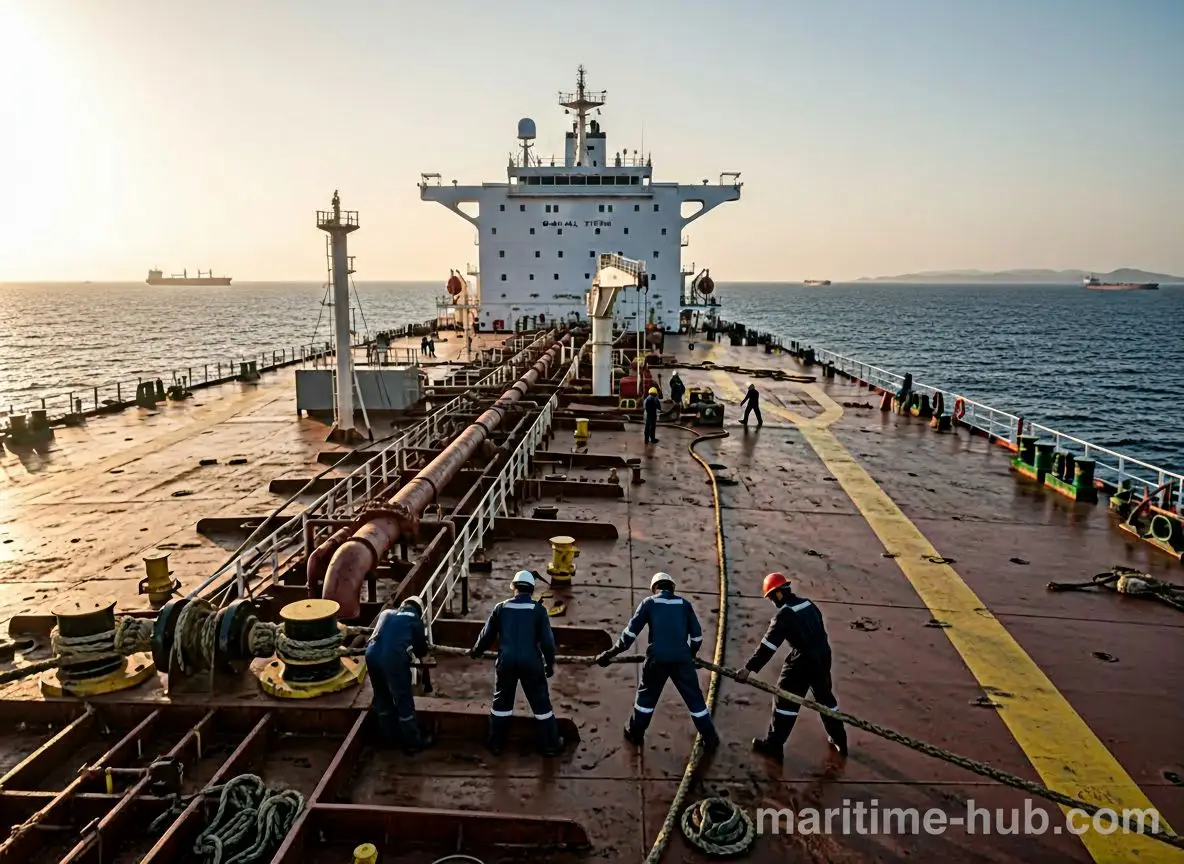
“At Maritime-Hub, we consider our seafarers the cornerstone of the maritime industry; training, personal development, and well-being must be our top priorities. We introduce a weekly digest news section with all the small but important developments in the maritime world for our seafarers.“
Read more news about seafarers on our site.
1. IMO Launches “Year of Implementation” Focused on Seafarer Safety & Training
The International Maritime Organization has kicked off a major initiative at the STCW Regional Forum in Manila to strengthen seafarer rights, training, and safety amid rapid shifts toward decarbonization and digitalization.
The initiative emphasizes updated training for emerging alternative fuels like ammonia, hydrogen, and methanol, and calls for harmonized global standards to ensure no seafarer is left behind in the energy transition.
The following executive summary provides a high-level overview of the December 2025 Current Awareness Bulletin published by the International Maritime Organization (IMO) Maritime Knowledge Centre.+2
The “Year of Implementation”
The maritime industry entered 2026 under a new “Powering Maritime Excellence” theme, with IMO Secretary-General Arsenio Dominguez designating it the “year of implementation”. As of January 1, 2026, several critical international shipping rules have officially come into force:
- Human Element: New mandatory STCW Code requirements focus on basic training to prevent and respond to violence, bullying, and sexual harassment at sea.
- Safety & Operations: New SOLAS regulations now govern the safety of onboard lifting appliances and anchor handling winches. Additionally, new containerships and bulk carriers (3,000+ GT) must be equipped with electronic inclinometers.
- Environmental Protection: A global ban on fire-extinguishing media containing perfluorooctane sulfonic acid (PFOS) is now in effect for new and existing ships.
- Navigation & Reporting: Mandatory reporting of lost containers has been introduced through amendments to the MARPOL and SOLAS Conventions.
2. Filipino Seafarers at Risk on Russian Vessels
Philippine officials are raising alarm over more than 24 Filipino seafarers serving aboard Russian ships near the Russia–Ukraine conflict zone. The Philippine Senate is pressing the DFA and the Migrant Workers Department to verify employment conditions and ensure the safety of migrant workers, especially those hired directly. A prominent example of individual risk is the case of Raymon Santos Gumangan, a Filipino national currently held as a prisoner of war (POW) in Ukraine.
- Humanitarian Concerns: As of February 2026, Philippine officials are seeking humanitarian access and communication with Gumangan and his family in Pangasinan.
- Recruitment Deception: Gumangan originally secured a job through an online portal as a “logistics truck driver” in Russia.
- Military Involvement: Upon arrival, he found himself serving under Russian military operations and was subsequently captured by Ukrainian forces in September 2025.
While many Filipinos serve on foreign-flagged vessels, they remain targets of Russian military activity in the Black Sea:
- Missile Attack on Kmax Ruler: In late 2023, four Filipino seafarers—including the captain, an electrician, and a deck cadet—were injured when a Russian missile struck their Liberian-flagged ship while it was docked at a Ukrainian port.
- Casualties on MV Eternity: In July 2025, three Filipino seafarers were killed during an attack on the MV Eternity, which was carrying 22 crew members, including one Russian national.
3. New Seafarers’ Welfare Centre Opens in Manila
A one‑stop Seafarers’ Welfare Centre has opened in Parañaque City, offering streamlined access to government services—including SSS, Pag‑IBIG, PhilHealth, legal aid, medical care, training facilities, and wellness support.
It also includes designated services for women seafarers, mental‑health amenities, and crew‑change support.
4. Australia–Philippines Agreement to Protect Seafarer Rights
Australia and the Philippines have agreed on mutual recognition of seafarer certifications, easing administrative barriers and improving cooperation on seafarer welfare and training.
Australia also endorsed the Manila Declaration on Seafarers’ Human Rights, Safety, and Well‑being, reinforcing long‑term maritime collaboration.
5. Significant Economic Contribution of Filipino Seafarers
A new economic study shows that the Philippine seafaring workforce generated ₱1.06 trillion in total economic impact (around 4% of GDP), supporting nearly 400,000 jobs and providing ₱150 billion in household income.
The report highlights risks from “ambulance chasing” practices that could drive foreign employers away if unaddressed.
6. Strengthening Seafarer Contracts & Benefits (Philippines)
The Department of Migrant Workers is finalising a new standard employment contract for seafarers, covering:
- Expanded illness and disability compensation
- Crisis‑preparedness measures amid Red Sea and Middle East security risks
- Updated rules for safer overseas deployment
This follows multiple high‑risk incidents affecting Filipino crews in 2025.
7. Malaysia Endorses Simulator‑Based Training Standards
The Malaysian Marine Department is officially backing modern simulator‑based training to ensure seafarers meet evolving STCW standards and remain competent in high‑risk, technical shipping environments.
The initiative aims to improve training quality and expand advanced engineering and navigation simulation programs.
8. Rising Cases of Seafarer Abandonment (Global)
According to ITF data, over 6,000 seafarers were abandoned in 2025—one of the worst years on record—with Indian crew among the most affected.
The ITF continues to push for stronger protections against abandonment, unsafe working conditions, and exploitation.
9. Seafarer Happiness Index: Modest Recovery but Deep Problems Remain
The latest Seafarer Happiness Index (Q4 2025) shows a slight improvement but persistent challenges in:
- Workload & fatigue
- Training quality
- Wages & welfare facilities
- Food quality and crew interaction
Digital connectivity was the only area showing clear improvement.
