

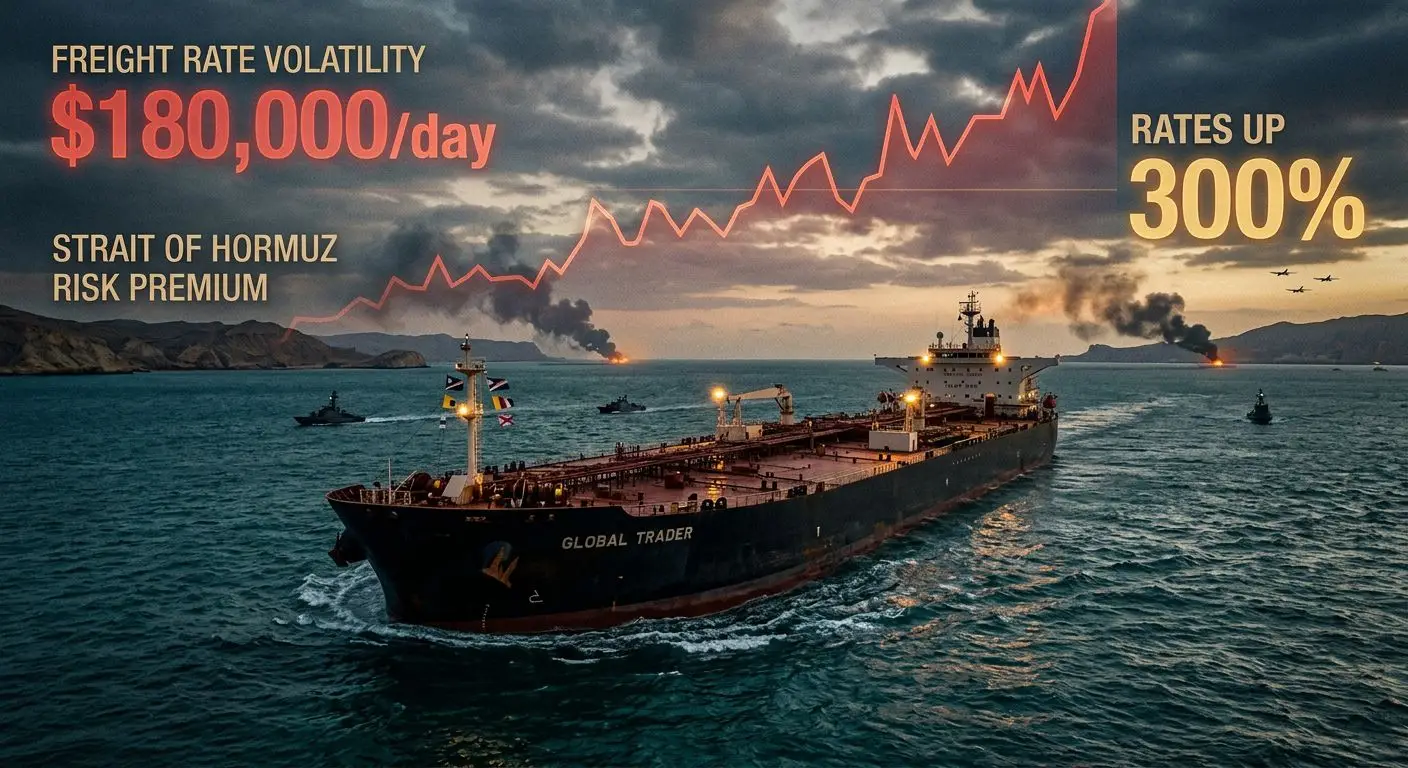
The global tanker market has entered one of its most volatile periods in history as VLCC (Very Large Crude Carrier) freight rates surge to unprecedented highs following the escalation of the US–Iran conflict. With the Strait of Hormuz effectively compromised and insurers withdrawing war‑risk coverage, shipping economics have shifted dramatically—sending day rates into record‑breaking territory.
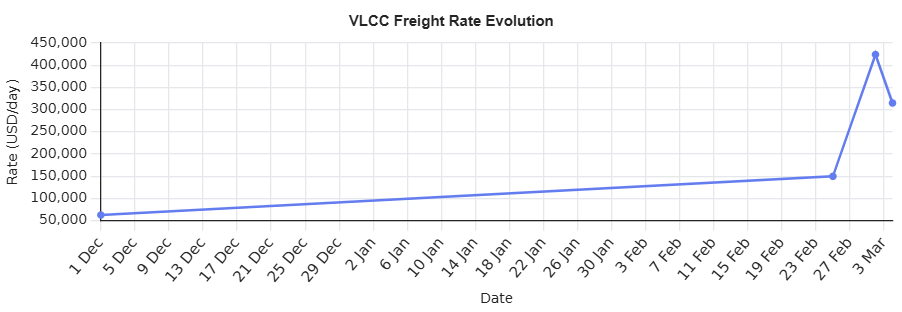
This article provides a data‑driven summary, the latest spot market highs, and a visual chart tracking VLCC rate evolution leading up to the current crisis.
Latest VLCC Freight Rates (as of March 2026)
Thanks to real‑time market intelligence, here are the verified maximum VLCC spot rates following the conflict:
📌 All‑Time Record High: $424,000/day
According to Clarksons, VLCC spot rates from the Middle East Gulf to China surged above $400,000/day, with a peak of $424,000/day, shattering all historical records.
📌 Benchmark Indicator Confirms: $423,736/day (WS 410.44)
Rate indicators for MEG → China routes recorded a TCE of $423,736/day, more than double the February figures.
📌 Insurer Withdrawal Pushes Rates Higher
War‑risk insurance cancellation forced many ships to abandon Hormuz transits, tightening vessel supply and driving rates up sharply.
📌 Early Spike Before Full Escalation: $315,000/day
Just before the major escalation, rates had already surged to $315,000/day due to restricted traffic in the Strait of Hormuz.
📌 Pre-Conflict Levels: $150,000–200,000/day
Throughout late February, spot rates were already breaching the $150,000–200,000/day threshold amid tightening supply and increased geopolitical uncertainty.
VLCC Freight Rate Evolution Chart (2025–2026)
Below is a visualisation summarising the dramatic freight rate escalation from late 2025 through March 2026, created using verified data points from market sources.
VLCC Rate Evolution (Chart)
🌍 Why Rates Are Exploding: Key Drivers
1. Strait of Hormuz Disruption
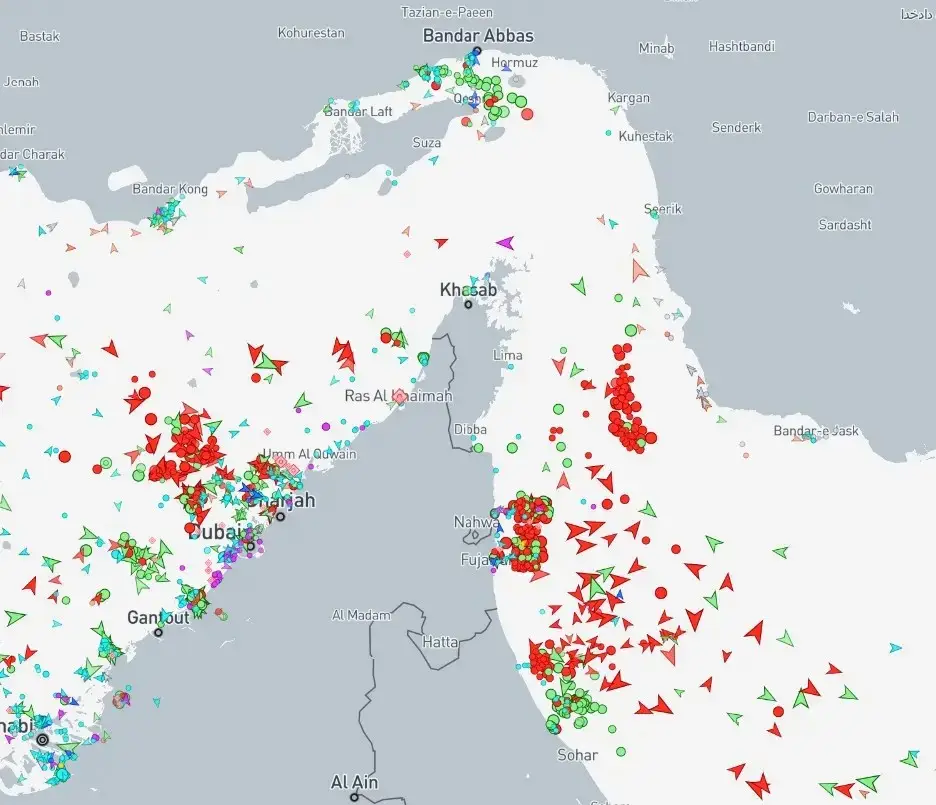
With Iran threatening to close the Strait of Hormuz and insurers dropping coverage, tanker traffic through the world’s most vital oil chokepoint has collapsed.
2. War-Risk Insurance Crisis
The War‑Risk Insurance Crisis refers to the sudden, sweeping withdrawal and extreme repricing of war‑risk insurance coverage for vessels operating in the Persian Gulf, Strait of Hormuz, and surrounding conflict zones following the escalation of the US–Iran and Israel–Iran conflict in early 2026.
This crisis fundamentally reshaped maritime operations because ships cannot legally or safely transit high‑risk zones without war‑risk cover. When insurers cancelled these policies almost simultaneously, the global shipping system was thrown into disarray.
Insurers such as Gard, Skuld, NorthStandard, and others suspended war‑risk coverage—effectively removing fleet capacity overnight.
3. Panic Chartering & Tonnage Scarcity
Oil traders rushed to secure tonnage ahead of potential embargoes, driving day rates into extreme ranges.
4. Longer Tonne-Mile Demand
Refiners diverted purchases to alternative suppliers (US Gulf, Brazil, West Africa), dramatically extending voyage duration and tightening capacity.
The Big Picture: What It Means for Global Oil Markets
- Freight costs for crude oil have never been higher, adding enormous premiums to global energy prices.
- Asian refiners face sharp increases in landed crude costs due to longer-haul routes.
- European natural gas and oil prices are rising rapidly as LNG flows and oil shipments reroute away from the Gulf.
- The tanker market may face volatility for months, with some analysts projecting prices could approach $800,000/day if a full blockade occurs.
Conclusion
The escalation of the US–Iran conflict has pushed VLCC freight rates into uncharted territory, reshaping global oil logistics and imposing major cost burdens on refiners, traders, and shipowners. With geopolitical risks intensifying and supply routes shifting, the tanker market is expected to remain volatile—depending heavily on developments in the Gulf.