

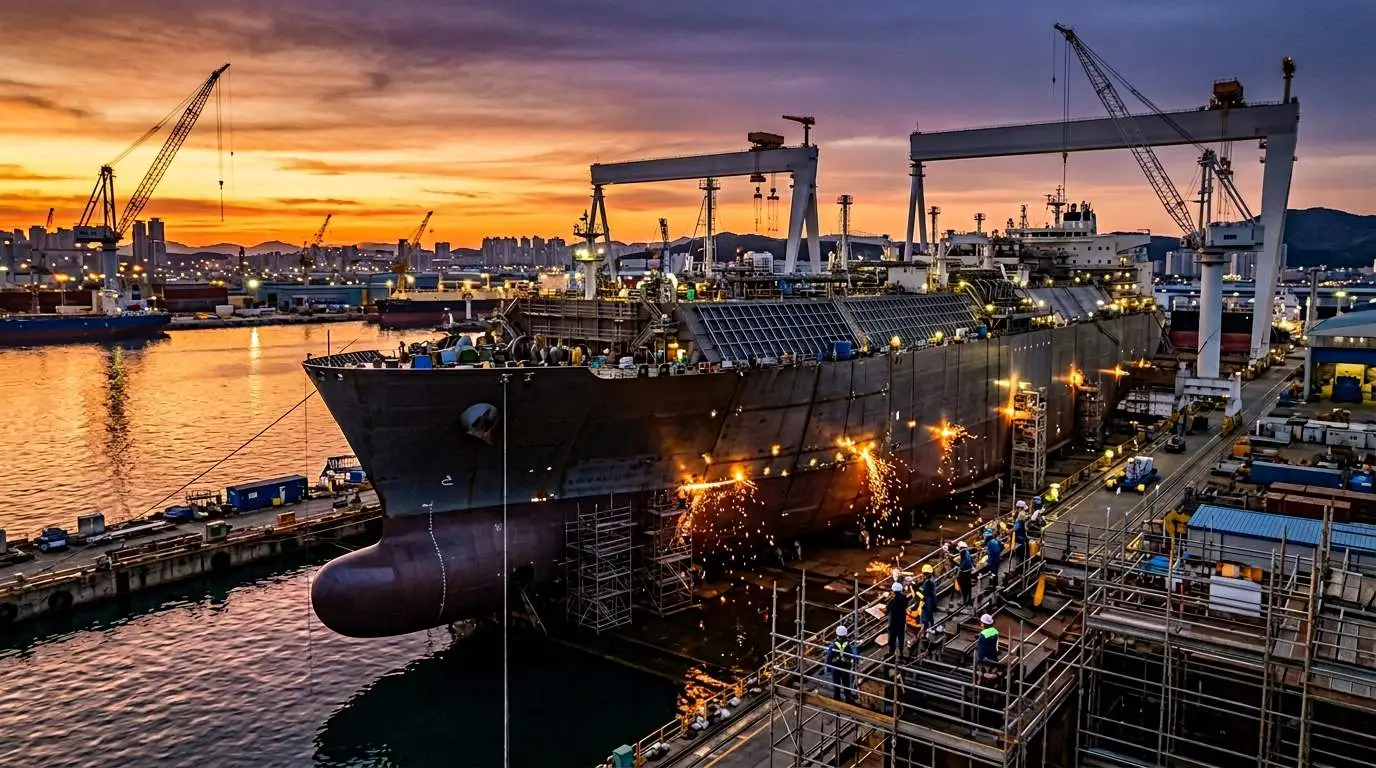
South Korean Shipbuilding Dominance: A Deep Dive into the 2026 Surge in South Korea LNG Carrier Orders
The global maritime landscape is witnessing a significant shift as South Korean shipbuilders reclaim their dominance in the high-stakes energy transportation sector. Within the first quarter of 2026, a remarkable surge in South Korea LNG Carrier Orders has underscored the nation’s position as the world’s premier destination for sophisticated vessel construction. As global energy security remains a top priority and the transition toward cleaner fuels accelerates, Korean shipyards have successfully leveraged their technical prowess to secure multi-billion dollar contracts from major energy exporters and international shipping conglomerates.
The Big Three Drive Strategic Market Growth
The success of the Korean shipbuilding sector is anchored by three industrial giants: HD Hyundai Heavy Industries, Samsung Heavy Industries, and Hanwha Ocean. These shipyards, often referred to as the “Big Three,” have pivoted from a volume-based competition model to a strategy of “selective order taking.” This approach focuses on high-value-added vessels that require advanced engineering, rather than low-margin bulk carriers where competition with other regional yards, e.g., China Shipbuilders, is fierce.
In early 2026 alone, HD Hyundai Heavy Industries secured a landmark $1.02 billion contract to build four ultra-large LNG carriers for a joint venture involving NYK and Ocean Yield, destined for service with U.S. exporter Cheniere. Similarly, Samsung Heavy Industries has maintained a blistering pace, securing orders for multiple vessels, including a $514 million duo for an Oceania-based owner. This consistent performance has allowed South Korean yards to maintain a 22% global market share, even as worldwide vessel orders experienced a temporary downturn.
The Shift Toward High-Value-Added Vessels and Innovation
What sets these current South Korea LNG Carrier Orders apart is the increasing complexity of the ship specifications. The industry is no longer just building tankers; it is building mobile pieces of high-tech infrastructure. The demand for high-value-added vessels is driven by the need for greater efficiency and reliability in the transport of liquefied natural gas, which must be kept at -162 degrees Celsius throughout transoceanic voyages.
To maintain this edge, shipbuilders are integrating revolutionary designs. For example, Samsung Heavy Industries is collaborating with the Korean Register to develop a 174,000cbm LNG carrier featuring only three cargo tanks instead of the traditional four. This design change lightens the hull and improves fuel efficiency while significantly reducing the natural “boil-off” rate of the gas. Such innovations are critical for shipowners who must balance massive capital expenditures with long-term operational profitability and stringent safety standards set by the International Maritime Organization (IMO).
Decarbonization and Eco-Friendly Ship Technology
The modern maritime era is defined by the quest for net-zero emissions, and South Korean yards are leading the charge in eco-friendly ship technology. New orders increasingly specify dual-fuel engines and propulsion systems capable of running on methanol or ammonia, effectively future-proofing the global fleet against evolving environmental mandates.
Hanwha Ocean has been particularly vocal about its push into green shipping solutions, integrating onboard carbon capture and storage (OCCS) technology and rotor sails into its latest designs. This commitment to sustainability is not just about environmental stewardship; it is a core business requirement. As the European Union expands its Emissions Trading System (EU ETS) to cover 100% of maritime emissions for intra-European voyages, the “green premium” of a Korean-built ship becomes a financial necessity for global carriers. – Advanced Cryogenic Containment: Integration of GTT Mark III membrane technology for superior thermal insulation.
– Digital Twin Integration: Utilising real-time data analytics for predictive maintenance and vessel performance monitoring.
– Strategic Alliances: Collaborative frameworks with U.S. and European energy firms to ensure vessels meet specific regional regulatory hurdles.Future Outlook: Careers and Global Supply Chain Resilience
The backlog of orders extending into 2029 ensures that South Korean shipyards will operate at full capacity for years to come. This industrial boom is creating a ripple effect across the global economy, from professional engineering roles to the technical teams required for vessel delivery and operation. However, the rapid evolution of technology also presents seafarers and life at sea challenges and opportunities, as the next generation of maritime professionals must be trained to operate increasingly automated and environmentally complex systems.
As South Korea targets even more ambitious order intakes for the remainder of 2026, the focus remains on quality over quantity. By dominating the LNG carrier market, firms like HD Hyundai, Samsung, and Hanwha are not just building ships; they are securing the infrastructure of the global energy transition.
Korean Shipbuilding comeback
The recent wave of South Korea LNG Carrier Orders signals a robust vote of confidence in the nation’s industrial capability. By focusing on high-value-added vessels and pioneering eco-friendly ship technology, South Korean shipbuilders have insulated themselves from the volatility of the broader shipping market. As the world continues to rely on LNG as a bridge fuel toward a renewable future, the docks of Geoje and Ulsan will remain the beating heart of global maritime trade, delivering the efficiency and innovation required for a modern, sustainable fleet.
