
Newport Docks Ship Fire: Lessons in Scrap Metal Cargo Safety and Emergency Response
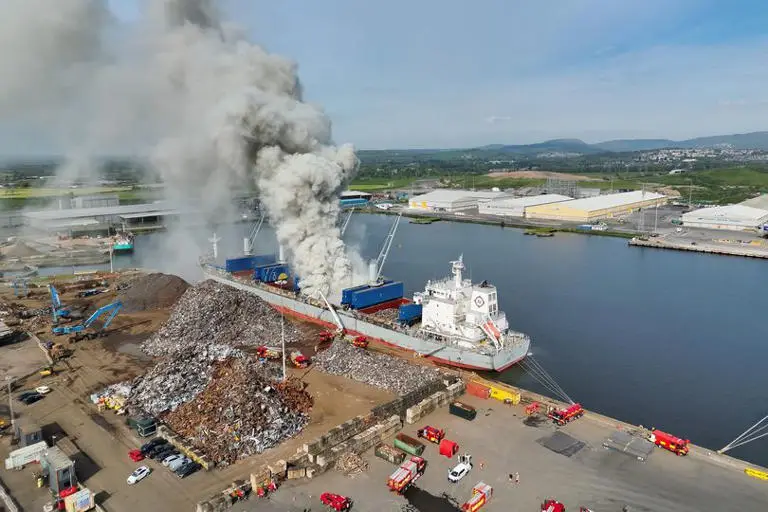
The maritime community was recently alerted to a significant incident when a Newport Docks ship fire broke out aboard the bulk carrier Nord Houston.
On April 26, 2026, emergency services were summoned to the Welsh port at approximately 05:38 BST to combat a blaze involving roughly 1,000 tonnes of scrap metal. While the South Wales Fire and Rescue Service (SWFRS) successfully contained the fire without any reported injuries or immediate public risk, the event serves as a stark reminder of the complexities involved in transporting metal recyclables.
Understanding Bulk Carrier Fire Hazards in Scrap Metal
Scrap metal is often perceived as a low-risk, non-combustible cargo. However, the reality of bulk carrier fire hazards is much more nuanced. While the metal itself may not ignite easily, the impurities mixed within the cargo often act as the catalyst for disaster. In the case of Nord Houston, the vessel was berthed and undergoing routine operations when the fire broke out, a common occurrence for this cargo type.
The primary drivers of fire in scrap metal include:
– Contaminants: Lithium-ion batteries, oily rags, and plastics frequently find their way into scrap piles. When damaged or crushed during loading, batteries can enter thermal runaway, providing the initial ignition source.
– Exothermic Reactions: Finely divided ferrous metals, such as borings and turnings, can oxidise rapidly when exposed to moisture. This rusting process generates significant heat that, if trapped in a deep cargo hold, can reach temperatures sufficient to ignite nearby materials.
– Mechanical Friction: The use of heavy machinery like bulldozers to trim and compact scrap in the hold can create friction or damage pressurised cylinders hidden within the waste.
Navigating IMSBC Code Regulations for Recyclables
To manage these risks, the shipping industry relies on the International Maritime Solid Bulk Cargoes (IMSBC) Code. Under the current IMSBC Code regulations, scrap metal is generally categorised into two groups. Standard “Scrap Metal” is listed as a Group C cargo, meaning it is neither liable to liquefy nor possesses significant chemical hazards. However, if the cargo contains “swarf” or fine metal turnings, it must be declared as a Group B cargo due to its liability to self-heat and ignite spontaneously.
A persistent challenge for the industry is the misdeclaration of cargo. Many incidents occur when materials declared as non-hazardous Group C actually contain significant amounts of hazardous contaminants. Regulatory bodies are currently evaluating whether to broaden Group B definitions to better account for the prevalence of electronics and batteries in modern recycling streams. For those pursuing modern maritime careers or challenges, understanding these shifting regulatory landscapes is essential for ensuring vessel safety.
Port Fire Safety Protocols and Newport Docks Ship Fire Response
The resolution of the Nord Houston incident highlighted the importance of robust port fire safety protocols. The response was a massive, multi-agency effort involving five pumping appliances, two hydraulic aerial platforms, and specialist units. Because firefighting on a vessel is vastly different from shore-based operations, the use of fire service boats and drone units was critical for situational awareness and cooling the ship’s hull from the exterior.
One of the most complex aspects of maritime emergency response is water management. While “copious amounts” of water are often needed to extinguish deep-seated scrap fires, excessive water can compromise a vessel’s stability and lead to capsizing. Furthermore, runoff from scrap fires is often contaminated with heavy metals and other pollutants, necessitating close coordination with environmental agencies such as Natural Resources Wales to prevent ecological damage to the port basin.
The Role of Proactive Maritime Emergency Response
The Newport Docks ship fire was eventually brought under control, but the recovery process continues long after the flames are out. Firefighters remained on-site for over 24 hours to monitor for re-ignition, a common risk in scrap fires, where hotspots can remain buried deep within the pile. The shipowner and Associated British Ports (ABP) must now execute a careful cargo discharge plan, with fire crews standing by to monitor for further flare-ups as the burned material is removed.
Control and Screening
The Newport Docks ship fire underscores the vital necessity of strict cargo screening and adherence to international safety standards. As the volume of global metal recycling continues to grow, the industry must adapt its scrap-metal cargo safety practices to account for modern contaminants such as lithium-ion batteries.
By combining rigorous IMSBC Code compliance with well-rehearsed port fire safety protocols, the maritime sector can better protect its assets, its environment, and most importantly, the lives of the seafarers who keep global trade moving.
