
The Greek Merchant Fleet in 2026: Navigating Geopolitics and the Green Transition
The Greek shipping industry 2026 remains the undisputed titan of the high seas, controlling over 20% of the global merchant fleet and roughly 60% of the European Union’s deadweight tonnage. However, this dominance is being tested by a dual-front challenge: a fragmented geopolitical landscape that has weaponized traditional trade routes and a rigid European regulatory framework.
As Athens prepares for the biennial industry summit at Posidonia 2026, the conversation has moved past theoretical targets. For Greek owners, the focus is now on the granular, day-to-day management of carbon costs and the physical security of their vessels in volatile corridors.
Regulatory Mechanics and the Commercial Framework
The primary driver of structural change this year is the full-scale implementation of the EU’s environmental directives. Greek shipowners are currently navigating a complex “compliance sandwich” consisting of the International Maritime Organization’s (IMO) global standards and the European Union’s more aggressive regional mandates. Specifically, EU ETS maritime compliance has entered its final phase-in period, requiring companies to surrender allowances for 100% of their verified emissions from intra-EU voyages and 50% of their verified emissions from international voyages that start or end at an EU port.
This financial burden is coupled with the FuelEU Maritime regulations, which impose increasingly stringent limits on the greenhouse gas intensity of the energy used on board. Unlike the ETS, which is a carbon tax, FuelEU is a technical mandate that penalises the use of high-carbon fuels.
The Union of Greek Shipowners’ annual report highlights that these overlapping regulations pose a significant administrative and financial burden for the thousands of small- to medium-sized family offices that characterise the Greek maritime cluster. To maintain their competitive edge, these owners are aggressively investing in “eco-ships” and retrofitting existing tankers and bulkers with energy-saving devices, making Greek fleet decarbonization the central investment theme of the decade.

Operational Impact on the Greek Shipping Industry 2026
Operationally, the blend of regulation and regional conflict has fundamentally altered how a Greek-managed vessel moves from Point A to Point B.
The continued instability in the Red Sea and the resulting rerouting around the Cape of Good Hope have increased fuel consumption and, consequently, carbon exposure under the ETS. Shipowners must now factor the cost of carbon allowances directly into their charter party agreements, often leading to complex legal negotiations with charterers over who bears the financial risk of emissions during delays or deviations.
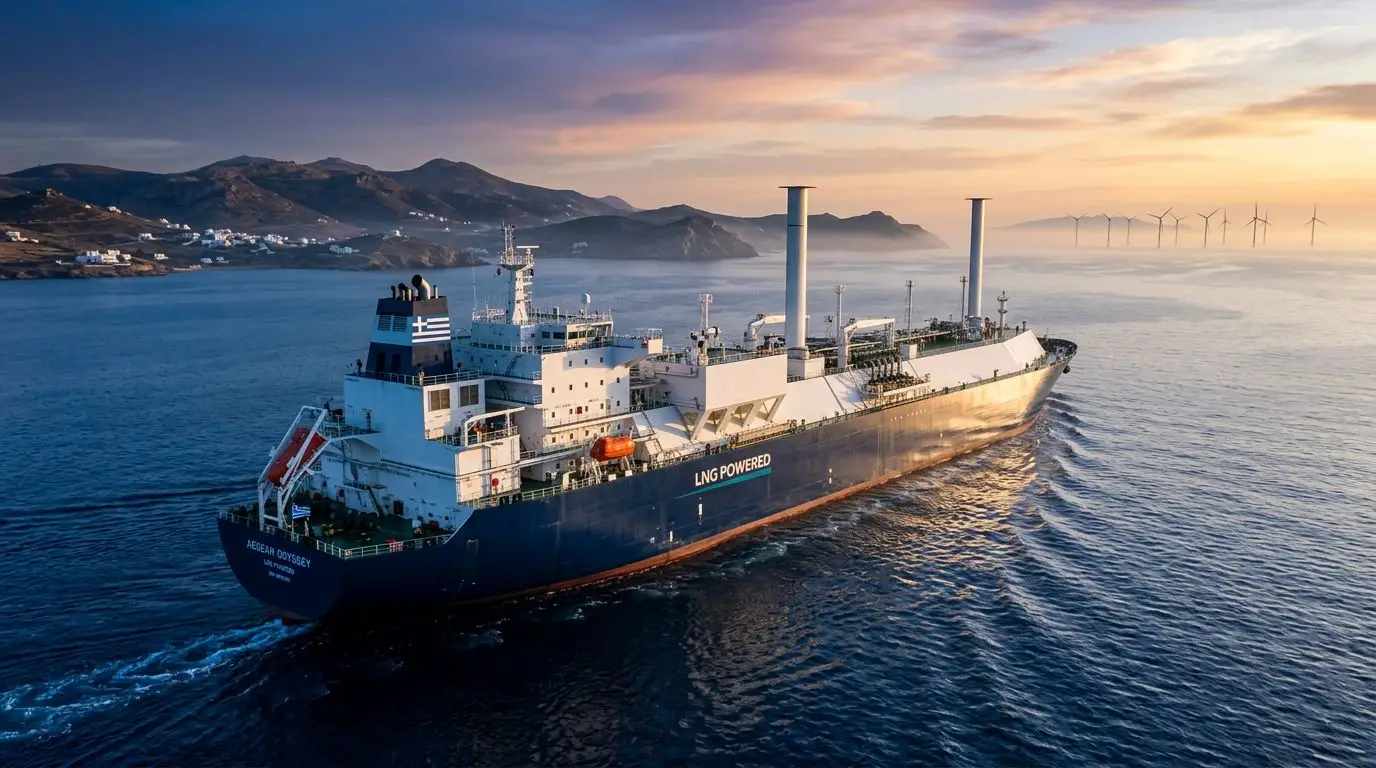
Technical compliance adjustments are also reshaping the engine room. The Greek fleet, known for its versatility in the “cross-trading” market, is seeing a surge in the adoption of dual-fuel technologies. However, the operational reality at sea is often hampered by the lack of global infrastructure for green fuels.
– Fuel Management: Chief engineers are now managing “digital bunkers,” tracking precise fuel quality and carbon intensity to avoid heavy FuelEU fines.
– Commercial Routing: Logistics desks are prioritising routes that minimise ETS exposure, sometimes at the expense of traditional efficiency.
– Financial Risk: Smaller owners are facing higher insurance premiums as insurers demand detailed decarbonization roadmaps before renewing hull and machinery policies.
– Crew Training: Seafarers are being retrained to handle new, volatile fuel types like ammonia and methanol, adding a layer of safety management to daily workflows.Future Outlook and Commercial Risks
Looking ahead to the remainder of 2026, the industry must monitor the widening gap between the availability of green technology and regulatory deadlines. A significant bottleneck is the “wait-and-see” approach currently affecting shipyard slots. With newbuild costs at historic highs, many Greek owners are opting for life-extension projects on 10- to 15-year-old vessels, which may struggle to meet the tightening emissions trajectory of the late 2020s.
Furthermore, the commercial risk of a “two-tier” market is becoming a reality. Large energy majors and commodity traders are increasingly willing to pay a premium for high-efficiency, low-emission Greek tonnage, while older, less-efficient vessels are being pushed into less-regulated, “dark fleet”- adjacent trades or lower-margin routes. The upcoming months will be a period of consolidation, where the ability to manage data and regulatory reporting will be as critical to a shipping company’s survival as the ability to navigate a storm.
The backboke of global trade
The Greek merchant fleet remains the backbone of global trade, but its continued leadership in 2026 depends on its ability to turn regulatory pressure into a technical advantage. While the financial burden of the EU’s green mandates is substantial, the Greek maritime cluster’s historic resilience suggests it will adapt. As the world watches the debates at Posidonia 2026, the message from Athens is clear: the industry is ready to decarbonize, but the transition must be supported by global fuel availability and a level playing field that does not penalize the very shipowners who move the world’s essential goods.
Data & Sources
– Union of Greek Shipowners (UGS)
– International Maritime Organization (IMO)
– European Maritime Safety Agency (EMSA)