


952
A Global Leader
Singapore has a long history in shipbuilding and maritime work. Today, it is regarded as a global centre for ship repair, shipbuilding, and marine engineering due to its advanced technology, efficient operations, and skilled workforce. Its location, strong infrastructure, and focus on innovation and sustainability help keep Singapore at the forefront of the international maritime industry.
1. Production and Output
Singapore’s shipbuilding and shipyard work is part of a larger maritime sector that also covers ship repair, offshore engineering, port operations, and marine services. Here is an overview of its output and scale:
- Container and vessel traffic
In 2024, Singapore handled over 41 million TEUs in container throughput and saw more than 3 billion gross tonnes of vessel arrivals. (Loi, 2025) This shows constant demand for ship repair, maintenance, and port-related marine services. - Shipbuilding output
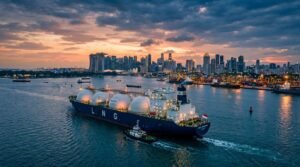
In 2024, Singapore produced about 160,000 gross tonnes of shipbuilding output. (Economic Survey of Singapore 2024, n.d.) This highlights its focus on building specialised, high-value vessels such as LNG carriers, offshore support vessels, and Floating Production Storage and Offloading units (FPSOs), rather than mass-producing ships. These advanced vessels require precision engineering and are in strong demand across global energy and offshore industries. - Bunkering activity
Singapore remains the world’s largest bunkering port, selling over 54 million tonnes of marine fuel in 2024. (Neo & Lim, 2025) This provides a broad range of shipyard, maintenance, and offshore engineering work related to vessel turnaround and services. It operates as a high‑productivity maritime hub, where shipyards operate alongside port and marine services within an integrated production environment.
2. Income and Economic Contribution
The maritime sector, which includes shipbuilding, ship repair, and offshore engineering, plays a major role in Singapore’s economy:
- Contribution to GDP
The maritime industry makes up about 7% of Singapore’s GDP, or roughly SGD 47 billion, making it one of the country’s key industrial and service sectors. (Economic Survey of Singapore 2024, n.d.) Offshore engineering value‑add
Marine and offshore engineering alone adds about SGD 3.6 billion in value, illustrating the importance of shipyards and offshore work to the economy. (Industry, n.d.) - Industry business spending
In 2024, major maritime companies in Singapore generated over SGD 5.2 billion in revenue, reflecting strong performance across shipyards, port operators, and marine service providers. (Singapore Achieved Record Growth in 2024, 2025)
These figures show that Singapore’s shipyard industry relies on major investment and focuses on complex engineering, conversions, and specialised offshore projects, rather than low-margin bulk construction.
3. Labour and Workforce
Singapore’s maritime and shipyard sector engages a large and diverse workforce, covering engineering, production, operations, and professional services:
- Sector employment
About 170,000 people work in Singapore’s maritime sector, including shipyards, port operations, offshore engineering, marine services, and related jobs. (Industry, n.d.) - Manufacturing linkage
Manufacturing in Singapore employs around 494,000 people nationwide. (Labour Market in 4Q 2024, 2025) Marine and offshore engineering is a specialised part of this group, supported by construction and service workers connected to shipyard operations. This reflects the broader labour context in which the shipyard industry operates, relying on both specialised and supporting roles to maintain high productivity and efficiency.
In 2025, Singapore’s total workforce reached about 4.12 million. (Labour Force in Singapore 2025, n.d.) This tight labour market points to the need for productivity, automation, and skills upgrades in shipyards. - Workforce development
Government programs focus on developing skills and creating more high-value jobs in marine and offshore engineering, especially in digitalisation, advanced manufacturing, and green technologies.
Overall, Singapore’s shipyard industry is moving toward more high-skilled roles, such as naval architecture, systems integration, digital engineering, and sustainability. For students interested in these careers, building a strong foundation in STEM (science, technology, engineering, mathematics) subjects is key. Participating in relevant courses, internships, and industry attachment programs can help develop practical experience. Taking part in maritime skills competitions or joining student chapters of professional associations also provides valuable networking and learning opportunities that can lead to future roles in this evolving sector.
Why Singapore Is Considered the World’s Leading Maritime Hub
4. Consistent Global Rankings
Singapore has been ranked the world’s top maritime centre for 12 consecutive years in the Xinhua‑Baltic International Shipping Centre Development Index (ISCDI), which benchmarks 43 global maritime cities.
The index evaluates:
- Port activity and throughput
- Quality of marine infrastructure
- Depth of maritime services (finance, law, insurance, broking)
- Overall business and regulatory environment
Singapore’s consistent top ranking shows its strong, long-term leadership in the maritime sector, not just short-term success.
In parallel, the DNV–Menon Economics “Leading Maritime Cities of the World” report consistently places Singapore first globally, leading in three of five core pillars:
- Shipping
- Ports and Logistics
- Attractiveness and Competitiveness
5. Key Location on the World’s Busiest Shipping Route
Singapore is located at the southern entrance of the Strait of Malacca, one of the world’s most critical maritime chokepoints.
- Approximately one‑quarter of global maritime trade passes through this corridor.
- Singapore sits directly on the main East–West trade lane, connecting Asia, Europe, the Middle East, and Africa.
This location gives Singapore a natural advantage as a transhipment hub, allowing cargo to be moved efficiently between mainline and feeder ships.
6. World’s Busiest Transhipment and Container Hub
Singapore’s port is known for its large scale and reliable operations:
- 41.12 million TEUs handled in 2024 (record high)
- Over 3 billion GT of vessel arrivals annually
- Approximately 130,000 vessel calls per year
- Connectivity to 600+ ports in over 120 countries
With more than 90% of Singapore’s container traffic transhipping, it is the world’s largest transhipment hub, rather than just a national gateway port, and the biggest Bunkering Port.
Singapore is the largest marine fuel bunkering port globally, a major indicator of maritime hub status:
- 54.92 million tonnes of bunker fuel sold in 2024
- Accounts for roughly a quarter of worldwide bunker demand
- First country to mandate digital bunker delivery notes, improving transparency and operational proficiency
This strengthens Singapore’s position as the main refuelling and turnaround point for global shipping.
8. Integrated Maritime Services Ecosystem
While some ports only handle cargo, Singapore provides a full range of maritime services, all in one place,
- Ship finance, insurance, and arbitration
- Ship management, crewing, and classification
- Maritime technology and digital solutions
Singapore hosts more than 200 international shipping groups and thousands of maritime service providers, creating a strong ecosystem that few other cities can match.
9. Pro‑Business Governance and Regulatory Credibility
Singapore’s success in maritime activities is closely tied to its stable government and reliable regulations:
- Open legal system and strong contract enforcement
- Globally respected maritime arbitration framework
- Active leadership role in the International Maritime Organisation (IMO)
- Long‑term policy continuity rather than short‑term intervention
These attributes consistently score highly in international maritime competitiveness rankings.
Singapore is known as a champion in transforming the maritime industry:
- National digital port platforms
- Mandatory digital bunkering documentation
- Test‑bedding for autonomous and smart vessels
- Early embracing of alternative marine fuels (LNG, methanol, ammonia)
Both the ISCD Index and the DNV–Menon report highlight Singapore’s leadership in digitalisation and green initiatives, showing it is ready for the future. Singapore’s shipyards are competitive and technologically advanced. They offer ship repair, maintenance, conversion, and newbuilding services to meet a wide variety of needs. Known for high-quality workmanship and strong safety standards, Singapore’s shipyards have earned the trust of global clients. Even with strong regional competition and shifting demand trends, the industry continues to show resilience. This resilience is built on ongoing innovation, government support, and continuous improvements in skills and infrastructure.
Key Shipyards in Singapore
- Sembcorp Marine (Seatrium)
A leading global marine and offshore engineering group offering integrated solutions in ship repair, shipbuilding, conversion, rig building, and offshore engineering, with a strong concentration on innovation. - Jurong Shipyard
Specialises in ship repair, maintenance, and conversion, with extensive experience handling a wide range of vessels and offshore structures. - Singapore Technologies Marine (ST Marine)
A leading provider of naval and commercial shipbuilding, repair, and conversion services, recognised for quality and technological innovation. - Jurong Port
A multipurpose port providing ship repair facilities, marine services, and logistics solutions, supporting Singapore’s maritime ecosystem. - ASL Shipyard
Specialises in offshore support vessels, tugs, and barges, known for efficient processes and timely delivery. - PPL Shipyard
A leading rig builder specialising in the design, construction, and repair of offshore drilling rigs. - Benoi Shipyard
Provides ship repair, maintenance, and engineering services with a strong record of high‑quality delivery. - Jurong SML
Offers specialised marine engineering services, including ship repair, maintenance, and conversion, with strong project management capabilities. - Jelutong Shipyard
An established facility providing cost‑effective ship repair and maintenance for various vessel types.
Government Involvement
The Singapore government plays a central role in supporting and regulating the shipbuilding and shipyard industry through:
- Regulatory framework
Enforcement of safety, quality, and environmental standards to maintain Singapore’s standing as a responsible maritime hub. - Financial support
Grants and incentives to promote innovation, research and development, and workforce training. - Infrastructure development
Continuous investment in port and shipyard infrastructure for enhancing capacity and output. - Industry promotion
Support through international partnerships, trade missions, and participation in global maritime events. - Digitalisation initiatives
Encouragement of smart technologies and digital transformation across shipyards and maritime operations.
Government involvement and support are key to keeping the industry sustainable and competitive in the long run. The outlook for Singapore’s shipbuilding and shipyard industry is positive, despite worldwide uncertainties:
- Continued concentration on innovation and automation
- Accelerated embrace of green and low-emission technologies
- Diversification into offshore renewables, FPSOs (Floating Production, Storage and Offloading vessels), and specialised vessels. FPSOs are ships used by the offshore oil and gas industry to process and store oil and gas, highlighting Singapore’s expertise in advanced marine engineering and its ability to meet evolving industry needs.
- Ongoing workforce upskilling
- Sustained government support and public–private collaboration
Overall, Singapore’s shipbuilding and shipyard industry is positioned for prolonged growth, driven by innovation, sustainability, diversification, and strong institutional support.
References
Loi, E. (January 15, 2025). Singapore’s port sets new records for vessel arrivals, shipping containers handled in 2024. The Straits Times. https://www.straitstimes.com/singapore/transport/singapores-port-sets-new-records-for-vessel-arrivals-shipping-containers-handled-in-2024/
(n.d.). Economic Survey of Singapore 2024. https://www.mti.gov.sg/-/media/MTI/Resources/Economic-Survey-of-Singapore/2024/Economic-Survey-of-Singapore-2024/SA_AES2024.pdf
Neo, R. W. & Lim, N. (January 15, 2025). Singapore bunker sales hit 54.92 million mt record in 2024 amid Red Sea reroutes. S&P Global. https://www.spglobal.com/commodity-insights/en/news-research/latest-news/refined-products/011525-singapore-bunker-sales-hit-5492-million-mt-record-in-2024-amid-red-sea-reroutes
(n.d.). Economic Survey of Singapore 2024. https://www.mti.gov.sg/Resources/Economic-Survey-of-Singapore/2024/Economic-Survey-of-Singapore-2024
Industry, M. o. (n.d.). Economic Survey of Singapore 2024. https://www.mti.gov.sg/Resources/Economic-Survey-of-Singapore/2024/Economic-Survey-of-Singapore-2024
Industry, M. o. (n.d.). Economic Survey of Singapore 2024. https://www.mti.gov.sg/resources/economic-survey-of-singapore/economic-survey-of-singapore-and-feature-articles/economic-survey-of-singapore-2024/
(March 19, 2025). Labour Market in 4Q 2024. Ministry of Manpower. https://www.mom.gov.sg/newsroom/press-releases/2025/0319/labour-market-in-4q-2024
(January 15, 2025). Singapore Achieved Record Growth in 2024. Maritime Professional. https://www.maritimeprofessional.com/news/singapore-achieved-record-growth-2024-401128
(n.d.). Labour Force in Singapore 2025. https://stats.mom.gov.sg/Pages/Labour-Force-In-Singapore-2025.aspx
