

Introduction
China’s container trade is making headlines in 2025 as two of its largest ports—Shanghai and Ningbo-Zhoushan—set a new combined record, handling over 90 million TEU (twenty-foot equivalent units) in just eleven months. This achievement not only highlights China’s dominance in global logistics but also showcases the country’s commitment to innovation and operational excellence.
Shanghai Port: Leading the World
Shanghai Port continues to hold its position as the world’s busiest container port, surpassing the 50 million TEU mark for the second consecutive year. This milestone was reached even earlier than in 2024, thanks to the port’s focus on automation and digital transformation. Key innovations include:
- Remote-controlled cranes
- Unmanned yard vehicles
- AI-driven planning tools
- Digital twins for real-time management
These advancements have enabled Shanghai to maintain its top global ranking for 16 years, supporting efficient and resilient supply chains.
Ningbo-Zhoushan Port: Rapid Growth and First-Time Achievement
Ningbo-Zhoushan Port celebrated a major milestone on December 2, 2025, by handling its 40 millionth TEU—a first in its history. The port’s growth trajectory is impressive, with throughput rising from 10 to 20 million TEU in seven years, and then to 30 million TEU in just six more years. This rapid expansion underscores Ningbo-Zhoushan’s rising importance in global trade.
Chinese Ports: Global Leaders
- Shanghai Port: The world’s busiest container port, handling over 50 million TEUs in 2025. Shanghai has held the top global ranking for 16 years, with monthly averages above 4 million TEUs and peaks over 5 million TEUs.
- Ningbo-Zhoushan Port: Surpassed 40 million TEUs for the first time in 2025. Its rapid growth is unmatched, with throughput rising from 30 to 40 million TEUs in just four years.
Other top Chinese ports include Shenzhen (27–30 million TEUs), Qingdao (25–27 million TEUs), and Guangzhou (22–23 million TEUs).
European Ports: Strong but Smaller Scale
- Rotterdam (Netherlands): Europe’s largest port, handling about 14–15 million TEUs annually. Rotterdam is known for its efficiency and sustainability, but its volume is less than a third of Shanghai’s.
- Hamburg (Germany): Around 8–9 million TEUs per year, with recent growth driven by new alliances and investments.
- Antwerp-Bruges (Belgium): Similar scale to Hamburg, typically 12–13 million TEUs.
- Other EU leaders: Valencia, Algeciras, and Barcelona (Spain), Gioia Tauro (Italy), and Piraeus (Greece) range from 4–6 million TEUs each.
American Ports: Competitive but Behind Asia
- Los Angeles (USA): The busiest US port, handled about 8.7 million TEUs in 2025. Monthly peaks are just over 1 million TEUs.
- Long Beach (USA): Close to Los Angeles, with 8–9 million TEUs annually.
- New York/New Jersey (USA): About 4.5 million TEUs in the first half of 2025, likely reaching 9 million TEUs for the year.
- Savannah and Houston (USA): Each handles 2–3 million TEUs per year.
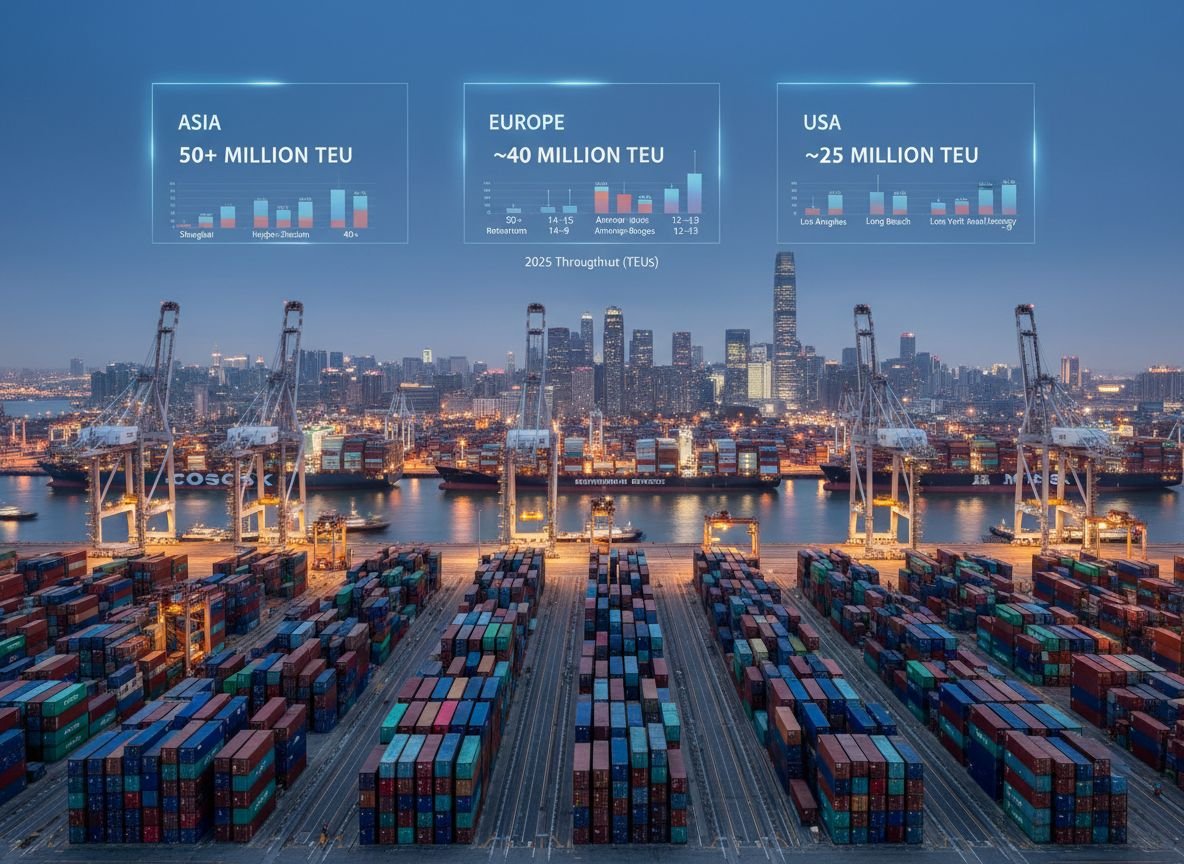
Comparative Table (2025 Estimates)
| Port | Region | 2025 Throughput (TEUs) |
|---|---|---|
| Shanghai | China | 50+ million |
| Ningbo-Zhoushan | China | 40+ million |
| Rotterdam | Europe | 14–15 million |
| Hamburg | Europe | 8–9 million |
| Antwerp-Bruges | Europe | 12–13 million |
| Los Angeles | USA | 8.7 million |
| Long Beach | USA | 8–9 million |
| New York/New Jersey | USA | ~9 million |
- Scale: Shanghai and Ningbo-Zhoushan each handle more containers than any single European or American port—often by a factor of 3–5.
- Growth: Chinese ports are growing faster, driven by automation, digitalization, and strong export demand.
- Network: Chinese ports have extensive global connectivity, with hundreds of shipping routes and deep-water berths.
- Europe and America: While efficient and technologically advanced, their volumes are much lower, and growth is slower.
Factors Driving the Surge
Several factors have contributed to this record-setting performance:
- Trade Policy Dynamics: A temporary truce in trade tensions with the US led exporters to rush shipments ahead of potential new tariffs, resulting in record weekly throughput.
- Technological Innovation: Both ports have invested heavily in automation and digitalization, improving efficiency and reducing human intervention.
- Strategic Location: East China’s ports are central to global container trade, making them critical nodes in international supply chains.
Implications for Global Trade
The combined throughput of over 90 million TEU from Shanghai and Ningbo-Zhoushan highlights China’s pivotal role in global logistics. These developments have significant implications for:
- Capacity planning
- Network utilization
- Supply chain resilience
As China continues to innovate and expand its port operations, the country is set to reinforce its position as a global logistics powerhouse.
Conclusion
The surge in China’s container trade and the record-setting performance of Shanghai and Ningbo-Zhoushan ports reflect the nation’s commitment to technological advancement and operational excellence. With over 90 million TEU handled in 2025, China is not just breaking records—it’s setting new standards for the global shipping industry.
