

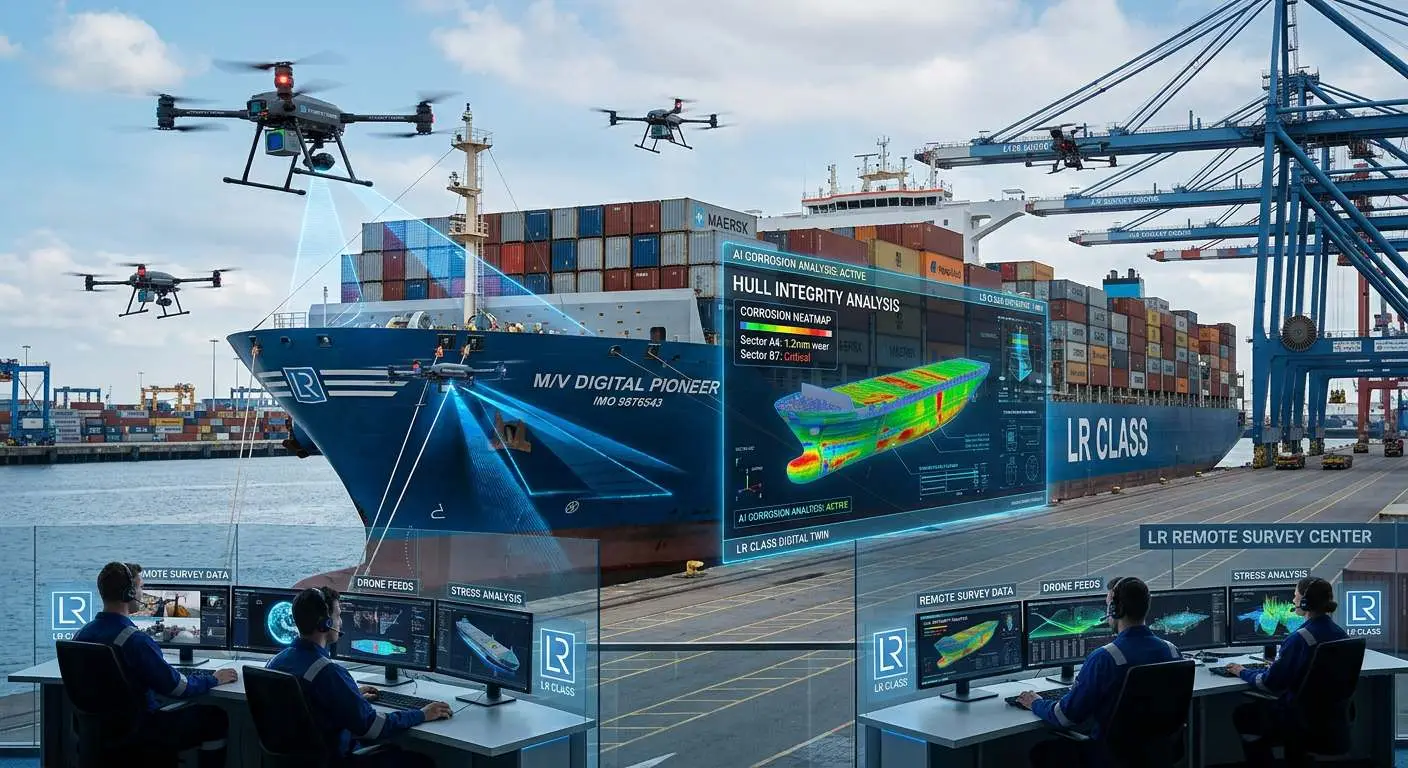
A Technical Deep‑Dive into the Future of Maritime Surveying
Digitalisation, remote inspection, robotics, AI-driven assessment, and data integration are transforming shipping. Classification societies, traditionally reliant on expert surveyors onboard, now face profound changes to their operating model.
In recent years, the central question has shifted from “Should classification societies adopt digital tools?” to the far more ambitious:
“Can classification societies fully replace onboard surveyors with remote, data‑driven systems?”
The answer today is complex: digital surveying is expanding rapidly and already replacing some physical tasks — but complete replacement of onboard surveyors is not yet feasible. Instead, the industry is entering a hybrid era, blending physical expertise with sophisticated remote technologies.
This article breaks down the current state of digital surveying, regulatory constraints, emerging technologies, and the realistic future of class operations.
1. Remote Surveying Has Already Become a Core Part of Class Operations
Remote surveys are no longer a theoretical innovation. They have evolved into mainstream operational tools for classification societies, particularly following the global disruption caused by COVID‑19.
Bureau Veritas: Remote Surveys as a Long‑Term Transformation
According to Bureau Veritas, remote surveys have undergone a major transformation since the early 2000s, accelerating sharply during the pandemic when onboard access became restricted. Remote survey processes now rely on:
- Digital documentation submissions
- Photo and video evidence
- Real‑time video assessments
- Remote collaboration with crew members and ship staff
This shift has produced substantial benefits for both class and shipowners:
- Reduced safety risks, as surveyors avoid hazardous conditions onboard
- Lower emissions and travel costs, improving sustainability
- Increased flexibility, enabling time‑efficient and responsive survey scheduling
Bureau Veritas also emphasises that remote surveys now represent an opportunity to improve survey processes, not just replace physical attendance. Remote techniques are being refined, standardised, and expanded into new survey types.
2. Lloyd’s Register: One‑Third of All Surveys Completed Remotely
Lloyd’s Register provides some of the strongest evidence of remote surveying’s maturity.
The organisation reports that 1 in 3 of its 30,000+ annual surveys are now conducted without physical attendance.
This is powered by the LR Remote application, a platform enabling:
- Live video streaming
- Image upload and documentation sharing
- Low‑bandwidth communication suitable for offshore and poor‑coverage environments
- Real‑time guidance from Remote Survey Leads
These developments demonstrate clearly that remote data‑collection methods are already embedded in class operations globally. The barrier is no longer technological — but regulatory and procedural.
3. AI, Robotics, and Autonomous Systems Are Reducing Human Presence Onboard
Beyond remote supervision, the industry is investing in a new generation of data‑centric, AI‑enhanced inspection tools. These innovations increasingly allow structural and safety assessments to be performed without a surveyor physically present, using:
AI‑Driven Image and Video Analysis
Artificial intelligence can rapidly identify:
- Corrosion patterns
- Coating breakdown
- Deformation
- Fatigue cracks
- Anomalies in structural components
Could the above apply during Special Surveys on examination of Water ballast tanks, Cargo Holds or Cargo oil tanks? Yes, for sure, the examination of hull structure can be AI-driven and based on risk-based statistical models.
Drone‑Based Structural Surveys
Unmanned aerial vehicles are now deployed inside cargo holds, tanks, and enclosed spaces to capture visual data without human entry.
Underwater Remote Operated Vehicles (ROVs)
ROVs reduce the need for diver‑assisted underwater inspections, increasing safety and reducing costs.
Predictive Analytics for Survey Planning
Digital twins and continuous monitoring systems allow the class to shift from period-based surveys to condition-based and even predictive regimes.
Remote Inspection Technologies (RIT)
Academic literature highlights the adoption of:
- Crawlers
- Submersible drones
- Autonomous inspection robots
These technologies reduce the need for human presence in:
- Enclosed spaces
- Hazardous atmospheres
- High‑risk structures
- Deep‑draft areas and underwater zones
While promising, RITs introduce complex liability issues concerning data ownership, accuracy, human vs automated interpretation, and legal validation.
4. Regulatory Frameworks Still Require Human Surveyors for Many Tasks
Despite these advances, the regulatory environment remains rooted in long‑established safety frameworks. IACS Procedural Requirements (PRs) still mandate:
- Clear qualification rules for “exclusive surveyors”
- Defined responsibilities and accountability structures
- Audit trails of professional judgement
- Physical attendance for many statutory and enhanced surveys
In addition, many regulations explicitly require:
- Human verification of system functionality
- Hands‑on testing of safety‑critical equipment
- Witnessing performance or load tests
- Measurement of physical tolerances and clearances
These requirements reflect the reality that some aspects of maritime safety cannot yet be delegated to remote systems without compromising integrity or compliance.
What Can Be Replaced Today — and What Cannot?
⭐ Yes — Certain Survey Types Can Be Done Remotely
Remote and digital surveys can already replace physical attendance for:
- Documentation reviews
- Some annual or interim surveys
- Post-repair follow‑up inspections
- Damage verification where clear evidence exists
- Surveys that rely on visual confirmation only
- Non‑critical equipment verification
- In-Water-Surveys
- ISM/ISPS and MLC audits (currently not allowed)
The gains in flexibility, safety, and cost are substantial.
Partially — Structural and Safety‑Critical Surveys
Even when AI, drones, and sensors are used for data collection, a human surveyor must review and validate the information. Regulatory gaps, data integrity concerns, and the lack of standardised digital frameworks mean that full autonomy is not yet acceptable.
Examples include:
- Corrosion evaluation
- Structural coating and crack analysis
- Tank and hold inspections
- Hull surveys
Drones can capture the images, but surveyors still make the decisions.
❌ Not Yet — Surveys Requiring Physical Testing or Witnessing
Some tasks cannot be conducted remotely under current rules, including:
- Load tests and weight trials
- Fire system tests and foam demonstrations
- Lifeboat launch tests
- In-water surveys with insufficient visibility
- Safety equipment testing requires physical activation.
- Mandatory statutory surveys requiring human verification
These remain core physical-attendance activities.
The Future: A Hybrid, Data‑Driven Surveying Regime
The maritime industry is moving toward a hybrid model that merges physical surveyor expertise with increasingly powerful remote technologies.
What the future of classification surveying will include:
1. Data‑centric digital twins
Real‑time structural models linked to onboard sensors will enable class societies to continuously monitor vessel condition.
2. Predictive maintenance and automated alerts
AI will identify anomalies and forecast structural fatigue long before physical symptoms appear.
3. Robotics in enclosed-space inspections
Drones, crawlers, ROVs, and autonomous systems will minimise or eliminate confined‑space entry.
4. AI‑assisted defect identification
Computer vision will analyse corrosion, coating breakdown, and structural irregularities.
5. Remote‑First survey planning
Surveyors will increasingly act as data analysts, not just onsite inspectors.
6. Cloud‑integrated survey platforms
Encrypted data pipelines and tamper‑proof digital evidence will support compliance and traceability.
This path leads toward a future where onboard attendance is drastically reduced — but still required for critical tasks.
Conclusion: Will Data‑Driven Systems Replace Onboard Surveyors?
Yes — partially.
Remote surveying and digital inspections are already replacing large portions of the traditional survey workflow.
But not entirely.
Regulatory, safety, liability, and physical-testing requirements make full replacement impossible under current frameworks.
What’s realistic?
A progressive shift toward:
- Hybrid surveys
- AI‑supported decision making
- Increased use of drones, ROVs, and sensors
- Reduced physical attendance
- Higher-quality, data-driven assessments
What’s not realistic — yet?
A fully autonomous, surveyor‑free regime.
Classification societies are evolving rapidly, but regulatory evolution and industry‑wide standardisation must catch up before onboard surveyors can be fully replaced.
For now, and for the foreseeable future, the future of classification is hybrid — not fully remote or fully human, but an optimised combination of both.