

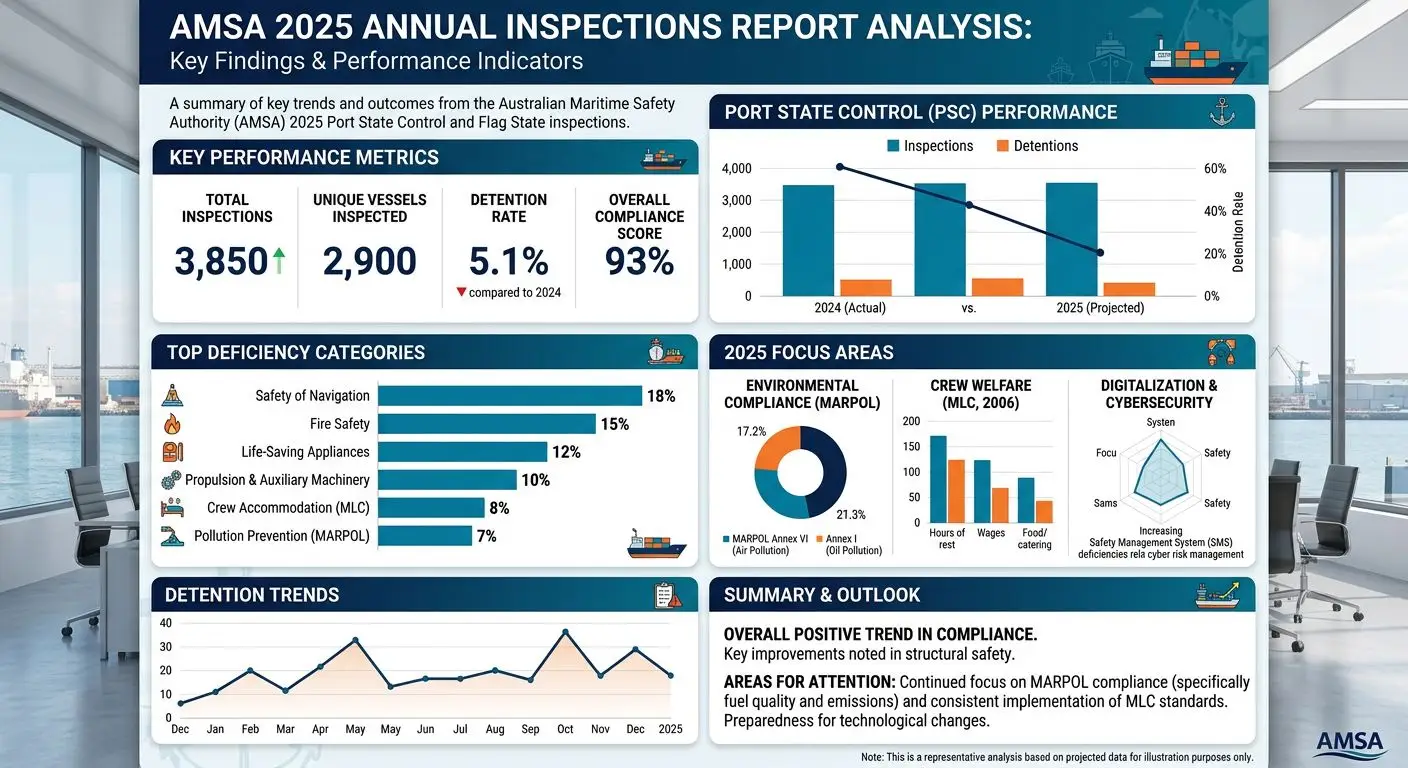
The Australian Maritime Safety Authority (AMSA) has released its 2025 Annual Inspections Report, providing a rigorous, data-driven analysis of maritime safety, seafarer welfare, and environmental protection within Australian waters. As a statutory authority, AMSA enforces both national and international maritime laws to ensure that trade remains safe and compliant.
In 2025, AMSA’s oversight covered three primary regimes: Port State Control (PSC) for foreign ships, Flag State Control (FSC) for Australian-registered vessels, and the Domestic Commercial Vessel (DCV) fleet.
1. Port State Control (PSC): Global Fleet Performance
PSC is Australia’s primary mechanism for ensuring that foreign-flagged ships visiting its ports comply with international conventions regarding safety, pollution prevention, and living conditions.
Inspection Volume and Strategy
AMSA conducted 2,768 initial PSC inspections in 2025, marking a significant 22.26% increase from 2024. This increase was a deliberate move to focus resources on higher-risk vessels through a dynamic targeting algorithm.
- Eligible ships: Out of 5,976 eligible foreign ships, 42% were inspected.
- Arrivals: Total arrivals remained steady at 28,639, involving 6,153 individual ships.
Compliance Outcomes
- Detention Rate: The PSC detention rate improved, falling to 4.8% from 5.9% in 2024. This is lower than the 10-year rolling average of 5.7%.
- Deficiency Rate: The rate of deficiencies per inspection rose slightly to 2.73, driven by the increased focus on high-risk vessels, which typically present more complex issues.
- Ship Types: Bulk carriers were the most frequently inspected (1,604 inspections), accounting for 51.8% of arrivals. However, the poorest performing ship types by detention rate were General cargo/multi-purpose ships (7.0%) and Container ships (5.9%).
The ISM Bottleneck
The International Safety Management (ISM) Code remains the most critical area of concern.
- ISM Detentions: Accounted for 26.7% of all PSC detentions.
- Root Causes: Failures are often linked to a poor maintenance culture and reactive management, in which issues are fixed only after an inspector identifies them.
2. Domestic Commercial Vessels (DCV): National Compliance
The DCV fleet includes fishing vessels, passenger ferries, and workboats regulated under the National Law Act 2012.
Operational Monitoring
AMSA conducted 2,481 initial DCV inspections, a 9.05% increase from 2024. Notably, 122 of these included operational monitoring, in which inspectors observed live emergency drills to verify the effectiveness of the Safety Management System (SMS).
Key Compliance Findings
- Detention Rate: Increased to 4.07% from 3.34% in 2024. This rise is attributed to smarter, risk-based targeting that focuses on high-risk vessels.
- Deficiency Trends: While the total number of deficiencies fell slightly, detainable deficiencies surged by 41.4%, rising from 140 to 198.
- Top Deficiency Categories:
- Life-Saving Appliances (LSA): 22.2% of all deficiencies.
- Safety Management Systems (SMS): 20.1%.
- Fire Safety: 14.3%.
3. Flag State Control (FSC): Australian Vessels
AMSA acts as the flag State authority for Regulated Australian Vessels (RAVs), ensuring they meet standards both at home and abroad.
National Performance
AMSA conducted 80 initial FSC inspections in 2025.
- Detention Rate: Remained relatively low at 3.75%, down from 4.35% in 2024.
- Deficiency Rate: Increased significantly to 5.44 per inspection, as AMSA focused on inspecting higher-risk Australian ships.
- Primary Deficiencies: Structural and equipment issues (2.84 rate) and operational failures (1.3 rate) were the main challenges.
International Performance
Australian ships were inspected twice by foreign port State authorities in 2025, resulting in one detention. This represents a slight decline in international performance compared to 2024, when no Australian ships were detained overseas.
4. Recognised Organisations (ROs) and Class Societies
ROs are authorized to conduct surveys and issue statutory certificates on behalf of AMSA. Their performance is a key indicator of the health of the certification industry.
Top Performing ROs (PSC)
In the PSC sector, AMSA tracks RO responsibility for detainable deficiencies.
- American Bureau of Shipping (ABS): Managed 413 inspections with a 4.6% detention rate; only 1 detainable deficiency was attributed to the RO (4.5% share).
- China Classification Society (CCS): Performed strongly with 156 inspections and a 4.5% detention rate, with zero detainable deficiencies attributed to the RO.
- CR Classification Society (CCRS): Achieved a 0% detention rate across 13 inspections.
- DNV AS: Conducted 451 inspections with a 4.2% detention rate; 1 detainable deficiency was attributed to the RO (3.4% share).
Performance Challenges
- RINA Services SpA: Had the highest detention rate among major ROs at 7.3%.
- Bureau Veritas (BV): 10% of detainable deficiencies (2 cases) were found to be the RO’s responsibility.
5. Flag State Performance: The Leaders and Laggards
Flag States are responsible for the overall compliance of the ships flying their flag.
Top Performing Flags (Zero Detentions)
Several flags maintained perfect safety records in 2025 despite significant arrival volumes:
- Norway: 57 inspections, 0 detentions.
- Denmark: 20 inspections, 0 detentions.
- Republic of Korea: 20 inspections, 0 detentions.
- Bermuda: 9 inspections, 0 detentions.
- France: 7 inspections, 0 detentions.
Top Flags by Inspection Volume
The “Big Five” flag States inspected by AMSA were:
- Liberia: 500 inspections (4.0% detention rate).
- Panama: 498 inspections (5.6% detention rate).
- Marshall Islands: 372 inspections (4.6% detention rate).
- Hong Kong, China: 259 inspections (3.5% detention rate).
- Singapore: 240 inspections (5.0% detention rate).
Flags Exceeding Average Detention Rates
With the national PSC average at 4.8%, the following flags (with over 10 inspections) performed poorly:
- Netherlands: 11.5% detention rate.
- United Kingdom: 13.0% detention rate.
- Malta: 7.7% detention rate.
- Portugal: 7.7% detention rate.
- Japan: 7.5% detention rate.
- Antigua & Barbuda: 7.1% detention rate.
6. High-Performing Operators
AMSA identifies operators who demonstrate a “mature safety culture” where ISM principles are fully integrated into daily life. To qualify as a high-performer, a company must have at least 10 inspections, zero detentions, and a deficiency rate no more than 70% of the annual average.
Top 2025 High-Performing Operators include:
- Anglo-Eastern Maritime Services (10 inspections, 0.70 deficiency rate).
- Berge Bulk Maritime (27 inspections, 1.59 deficiency rate).
- COSCO Shipping Bulk Co Ltd (13 inspections, 0.15 deficiency rate).
- Eastern Pacific Shipping (24 inspections, 0.54 deficiency rate).
- Fleet Management Ltd (46 inspections, 1.70 deficiency rate).
- Wilhelmsen Ship Management (11 inspections, 0.82 deficiency rate).
7. Oversight of Surveyors and Enforcement
AMSA also oversees Accredited Marine Surveyors (AMS) who work within the DCV sector.
- Surveyor Audits: 48 audits were conducted in 2025.
- Corrective Actions: 33 of these audits (68%) resulted in the surveyor initiating corrective actions on vessels or their survey practices.
- Port Access: No “Refusal of Access” directions were issued to ships in 2025, suggesting that targeted inspections and the “poor performing operator” list are acting as effective deterrents.
Conclusion
The 2025 AMSA Annual Inspections Report highlights a maritime industry in transition. While PSC detention rates for foreign ships are improving, the significant spike in detainable deficiencies within the domestic fleet (DCV) and the persistent failures in ISM implementation remain safety-critical challenges.
AMSA’s move toward data-driven, risk-based targeting appears to be successfully identifying the most hazardous vessels, enabling more efficient use of inspectorate resources to protect Australia’s 34,000-kilometre coastline.
You can download the full report here:
