
The cruise industry is currently undergoing a massive digital transformation, with a renewed focus on enhancing passenger security and operational efficiency.
At the forefront of this movement is the evolution of Cruise Ship Safety Technology. Traditional inspection methods are being enhanced by advanced virtual modelling techniques. A significant milestone in this journey is the recent partnership between the American Bureau of Shipping (ABS) and Alfred Maritime. By signing a Memorandum of Understanding, these organisations are leveraging data-driven insights to create a safer, more reliable environment for both travellers and crew members.

Understanding Maritime Digital Twins in the Cruise Sector
At its core, a digital twin is a high-fidelity virtual replica of a physical vessel. Unlike a static 3D model, maritime digital twins are dynamic entities that receive real-time data from thousands of onboard sensors. This constant stream of information allows the virtual model to mirror the actual behaviour of the ship’s engines, hull, and safety systems under various environmental conditions.
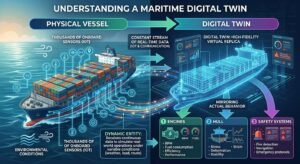
The digital tweens concept
For cruise operators, these twins act as a digital co-pilot. They provide a comprehensive view of the vessel’s health, from the propulsion systems in the engine room to the complex HVAC and hotel systems that keep passengers comfortable. By using maritime simulation software, engineers can test “what-if” scenarios in a risk-free environment, identifying potential vulnerabilities before they manifest in the physical world.
This proactive approach ensures that safety is managed through foresight rather than reaction.
Predictive Maintenance for Ships and Enhanced Monitoring
One of the most transformative benefits of this technology is the transition toward predictive maintenance for ships. Traditionally, maritime maintenance has followed strict maintenance calendars or relied on reactive repairs after a component fails. However, digital twins allow for a condition-based approach. By analysing vibrations, temperatures, and wear patterns, AI-driven platforms can detect anomalies and predict equipment failure with remarkable accuracy.
This shift significantly reduces unplanned downtime and prevents catastrophic failures that could compromise vessel safety. Furthermore, real-time vessel monitoring provides shore-side operations centres with an up-to-the-minute understanding of the fleet’s status. If a sensor detects an unusual spike in engine load or a deviation from standard operating procedures, alerts are generated instantly, allowing for immediate intervention.
The Benefits of Real-Time Data Integration:
– Improved Itinerary Reliability: Early identification of technical issues prevents voyage cancellations and disruptions.
– Enhanced Emergency Response: Real-time data feeds allow for more effective guidance during safety drills or actual incidents.
– Optimised Fuel Efficiency: Monitoring performance metrics helps reduce emissions, aligning with IMO 2030 sustainability goals.
– Reduced Human Error: Automated alerts and decision-support systems provide crews with clear, data-backed guidance. While technology enhances safety, the human element remains vital. Navigating these sophisticated systems is one of the many modern maritime careers or challenges that officers must master to ensure excellence at sea.
The Rise of Digital Classification Societies
The collaboration between ABS and Alfred Maritime also signals a shift in how vessels are certified. We are moving toward an era of digital classification societies, where the survey process is no longer limited to a single calendar date. Instead of a surveyor physically inspecting every inch of a ship during a brief port stay, digital twins provide a continuous record of the health of the hull and machinery.
This enables risk-based surveys, in which inspection efforts are focused on the areas of the ship that require attention. For a cruise vessel—which Eric VanDerHorn of ABS describes as a “floating city”—this level of granularity is essential. By aligning digital insights with classification processes, ABS and Alfred Maritime aim to streamline regulatory activities, reduce operational redundancies, and strengthen the overall safety framework of the cruise industry.
Conclusion
The future of cruise safety is being built on a foundation of data and virtual replication. The partnership between ABS and Alfred Maritime demonstrates that when industry leaders combine classification expertise with advanced fleet performance management, the results are revolutionary.
Through digital twins, predictive maintenance, and real-time monitoring, the cruise sector is becoming more resilient and transparent than ever before. As these technologies continue to mature, they will not only protect the lives of those on board but also ensure that the maritime industry remains a leader in global technological innovation.